Showing posts with label African Art. Show all posts

Saturday, December 18, 2021

Hairstory As History: Nkemdiche: Obiora Nwazota’s Quest To Bring Igbo Culture Into Our Contemporary Lifestyle

BY MICHAEL WORKMAN 


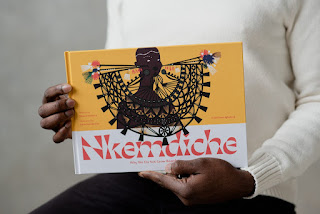
CHICAGO, IL (NEW CITY DESIGN) This sumptuously designed and illustrated volume by Obiora Nwazota and his team is bound like a children’s book, but is also a designed art object in its own right. Presented as a social “hairstory” folktale, it telescopes and uses the value and sacredness of hair in traditional as well as contemporary Black and brown cultures to thread a well-imagined conceit of the bearded women of Igboland. It’s a place also known as modern-day Nigeria where, in this alternative timeline looking back onto a practice that never existed, the women would languish beneath the Udala trees, “grooming their beards” while they “swapped stories and exchanged juicy gossip.”

Made with a clear objective to evoke the ancient dignity and nobility of African cultures that existed before the wretched history of the global slave trade, the book goes beyond the goal of a modern vision of a people and culture that often gets reduced in masscult depictions to that of Black oppression and suffering. “The physical design of the human being doesn’t go out of style,” Nwazota says. “All of a sudden, it opens up when you’re investigating any of these things, if you come at it for the purity of what it is, it’s equally as modern as it is old.”

Nkemdiche” is published by Ọkpara House, whose stated mission is to reclaim and assert the “relevance of Igbo culture on contemporary lifestyles within and beyond the Igbo community,” and the production crew behind the volume has adroitly integrated their efforts to produce a cohesive, moving and visually literate art object. Nwazota, a co-founder of Chicago’s celebrated Orange Skin boutique, and a longtime Igbo culture booster, has conjured this sweeping folktale, in a way that is moving for adults, but likely to spark in a profound way the childhood imagination about people and places otherwise poorly represented in the children’s literature of the States. Told alongside illustrations by Paris-born Chicago artist Lucie Van der Elst, the images are rendered in bold, solid collage-style colors, often integrating traditional Igbo fashions and textural designs, punctuated with bursts of fragmented imagery and rich, deep black skin tones that recall a Kerry James Marshall canvas, while also binding the visual narrative as the story progresses, illuminating it marvelously.

Asked about the idea to make this volume into a design object in and of itself, Nwazota describes his efforts to visualize African culture in an immediate and corrective way. “It was very intentional in the sense that, having explored the things from that era—okay? The normal idea of the imagery, the African imagery, when we see Africa—normally, it’s safari, it’s conflict, all that funniness. But when you think about African culture, you are thinking about masks, you are thinking about people maybe running half-naked with token animals like a giraffe or lion, and I’m like, ‘Wait a minute, that is not how we see ourselves.’ So, if you’re going to also talk about that same period, the way we see ourselves—that is what I wanted to capture in the design, the nobility of the same era. I wanted something as timeless but also filled with curiosity, but a curiosity you could actually identify with. In the same way you can get on a plane and the next day have a baguette in Paris, I wanted to show in this same way this thing where everything is so traditional and different but at the same time you can relate to it somewhat. So I think that is what’s very present in the book.”

It’s also notable how well the body text itself integrates the cultural background of its subject matter, as rendered by Mark Jamra and Neil Patel of Portland Maine’s JamraPatel studio, who set it throughout in Kigelia, “the first system of fonts for the most prominent writing systems in Africa.” Lyon-based Thomas Huot-Marchand’s 205TF studio’s display type flows seamlessly throughout, while Chicago’s Nick Adam and Bud Rodecker’s Chicago-based Span studio have brought it lovingly together in their typesetting and halting cover design.

Nkimdeche” is what is known as an instant classic, the first in a series planned by Nwazota to fill a long-simmering void in children’s literature to portray the life and worlds of Black and brown people. If this slim, important and mighty little design object of a tale doesn’t deserve a Caldecott Medal, none do.

“Nkemdiche: Why We Do Not Grow Beards,” written by Obiora Nwazota with illustrations by Lucie Van der Elst, Ọkpara House ($23), hardcover. For more information and to order, please visit OkparaHouse.com.

Michael Workman

Michael Workman is an artist, writer, dance, performance art and sociocultural critic, theorist, dramaturge, choreographer, reporter, poet, novelist, curator, manager and promoter of numerous art, literary and theatrical productions. In addition to his work at The Guardian and Newcity, Workman has also served as a reporter for WBEZ Chicago Public Radio, and as Chicago correspondent for Italian art magazine Flash Art. He is currently producing exhibitions, films and recordings, dance and performance art events under his curatorial umbrella, Antidote Projects. Michael has lectured widely at universities including Northwestern University, The School of the Art Institute of Chicago and The University of Illinois at Chicago, and served as advisor to curators of the Whitney Biennial. His reporting, criticism and other writing has appeared in New Art Examiner, the Chicago Reader, zingmagazine, and Contemporary magazine, among others, and his projects have been written about in Artforum, The New York Times, Artnet, The Financial Times, The Huffington Post, The Times of London, The Art Newspaper, The Wall Street Journal, New York Magazine, Art In America, Time Out NY, Chicago and London, The Gawker, ARTINFO, Flavorpill, The Chicago Tribune, NYFA Current, The Frankfurter Algemeine, The Chicago Sun-Times, The Village Voice, Monopol, and numerous other news media, art publications and countless blog, podcast and small press publishing outlets throughout the years.

Monday, December 13, 2021

Magic Lines Of Uli Art Style


Uli is an expression of the people’s capacity for creative design, which is firmly rooted in their myths and their experience of life in the past, present and future. At its best, it is an expression of their synthetic present, the epic of their search for a new order in the contemporary world. It is my traditional art style, which I have fallen in love with all over again and it is a privilege to share uli with you in my works. It has been shown that the knowledge of uli motifs and symbols and their application enables one to identify the traditional Igbo artifacts, giving validity to the people’s aesthetic intelligence and judgment. This culture is one of the first known cultures of the world in the recorded archeologically facts to have done bronze casting. (Igboukwu bronze).

Uli symbols may be said to show graphically how the organic forms grow outwards from the core of those elements to point, line, triangle, square and circle that are universal to the concentric circle at the periphery, which contains reflections of everyday world as seen by the artists. Just as the inner circle reflects the uncommon reality or ritual reality of the cultural existence, so the outer circle is in contact with the human and ecological reality, which it expresses.

Artistic activities at Enugu formed part of the early post-1960 independence developments in the country. There was the growing local and international popularity of Nigerian novelists, dramatists, poets, literary critics, architects, artists, and musicians, and scholars. Interesting collaborations took place among those in the literary performing, and visual arts, particularly in southern Nigeria. The efforts and artistic lives of these minds sowed a flourishing seed for an uncommon global harvest. I give thanks to God for these great minds, your outstanding contributions will not be forgotten.

Uli creations relied heavily on drawing skills whose content is based largely on Igbo culture, particularly female body and wall painting called uli and on Igbo tales, ceremonies, and beliefs. The revival of interest in uli through contemporary art had begun with Uche Okeke in the 1960s, when Nigeria’s independence produced a growing sense of freedom from colonial restraints on cultural tradition. It fully developed among teachers and students in the 1970s at the University in Nsukka and was linked to renewed interest in Igbo culture after the destructive Biafran War.

Traditional uli motifs, now rarely painted on human bodies or walls, have a strong linear, often curvilinear, quality. The art makes use of contrasts between positive and negative space, its images at times appearing as sky constellations. Uli’s lyrical qualities express harmony and brevity. It is art style that has often been created in freedom and spontaneity. “Uli is a pride heritage”. Uli motifs generally refer to images of everyday Igbo life, farm and cooking tools, pots, plants, birds, animals, the sun, the moon, and the kola nut, though some are pure design. For ceremonial occasions and important events, skilled Igbo female artists painted uli to add beauty to the human body and the walls of buildings and compounds. Uli has made her way in modern social settings; on sculptural surfaces and on paper, board, and canvas, framed and hung on walls in homes, institutions, and galleries of the world.

Magic of Uli Lines, which is an extended dot or a moving point, has very many possibilities, particularly, the quickly drawn one. My drawing explores the evocative and lyrical possibilities of line and derives from Uli. The Uli artist works spontaneously whether on the human body or the wall. There is no question of erasing or cleaning. There is something about the spontaneously executed work, a breathtaking vitality and freshness that defy description or repetition.

An analysis of Igbo drawing and painting reveals that space, line pattern, brevity and spontaneity seem to be the pillars on which the rich tradition and heritage rests. It is these unique qualities that I strive for, both intuitive and intellectually to assimilate in my work. Intuitively, because during my years of studying and looking at Igbo sculpture, drawing and painting, various aspects of design and recurrent motifs have become internalized in my system and inevitably surface unconsciously in the course of executing my aesthetic challenges. It is perhaps needless to add that the great works of art is a result of the harmonious marriage of intellect and intuition.


--------------------RECENTLY HEARD
(Mbari Image Via The University Of Iowa)

Thursday, February 13, 2020

Njideka Akunyili Crosby Explores Memory...Visits Baylor

Njideka Aknunyili-Crosby in her Los Angeles Studio. Image: John D. and Catherine T. McArthur Foundation


BY CARL HOOVER

Los Angeles artist Njideka Akunyili Crosby explores the cultural collage of memory, particularly for those who straddle two or more cultures, on her canvases for good reason: It’s her story.

Akunyili Crosby, born in Enugu, Nigeria in 1983, came to America to study medicine only to find a different calling in art — a calling that has led to a host of international prizes, a MacArthur Fellowship and pieces that have sold for more than a million dollars.

She visits Baylor University Wednesday night as the subject of this year’s biennial Allbritton Artist Conversation, featuring art critic Jason Kaufman and an accompanying slide show of her work.

The illustrated conversation, sponsored by Baylor’s Allbritton Art Institute, takes place at 5:30 p.m. at McClinton Auditorium in the Paul L. Foster Center for Business and Innovation. Admission is free.

Akunyili Crosby was unavailable for an interview, but Kaufman, who led similar Allbritton discussions with artists Frank Stella and twins Doug and Mike Starn, was more than willing to talk about her and her art. “Her work is stunningly beautiful, made with great clarity and sensibility,” he said from his home in New York. “She has a sophisticated sense of self. She alters our notions on Africanness.” He went on to describe her as radiant, erudite, articulate and “very low key.”

Akunyili Crosby’s best known pieces are large paintings of people in domestic interiors whose walls and surfaces often are overlaid with a collage of images from Nigerian pop culture and history. It’s as if the mental space of her subjects is projected on the physical space where they live. “It’s like mental wallpaper . . . a memory palimpsest,” he said.

It’s not hard to see where that perspective may have come from. One of six siblings, Akunyili Crosby came to the United States from Nigeria as an 18-year-old to study medicine as others in her family had done. Art classes while at Swarthmore College, however, caused her to switch from medicine after graduation. She earned a post-baccalaureate certificate from the Pennsylvania Academy of the Fine Arts in 2006, then a master’s in fine arts from Yale University.

Relocating to Los Angeles, where she lives with her husband Justin Crosby, also an artist, Akunyili Crosby saw the market for her work rise steadily, then soar in value, Kaufman said. Awards have accompanied that rise, including the Smithsonian American Art Museum’s James Dicke Contemporary Artist Prize in 2014, a 2015 Next Generation honor from New Museum, one of Financial Times’ Women of the Year in 2016, and a 2017 MacArthur Fellowship.

Her latest work concerns portals, with spaces punctuated by doors and windows in such a way that invites the viewer in, Kaufman said.

The artist’s Baylor visit brings her back to Texas, where she’s shown her works in shows at Fort Worth’s Modern Art Museum, Austin’s Blanton Museum of Art and Rice University’s Moody Center in Houston.

Kaufman, who writes frequently of art and cultural tourism for Luxury Magazine, said Akunyili Crosby’s treatment of cross-cultural boundaries strikes a chord with many. “There’s a universality of her work in that people are constantly living in places they weren’t born in,” he said. “Americans are all immigrants. Any one of us could take Njideka’s approach and make their own past.”


SOURCE: WACO TRIBUNE

Sunday, October 27, 2019

The Mona Lisa Charm Of Chikadibia Benedict Enwonwu


Every art masterpiece has as allure and charm that revolves around it adding to the value and mystery of the work. When such works are showcased, a cluster of wonder is centred on who the sitter may have been, the relationship between artist and sitter, the working disposition of the artist and more. These and more have guided and led the famous works of Leonardo Da Vinci especially his most prevalent work Mona Lisa. The Mona Lisasmile is a smile that gives credence to the historic renaissance painting of Leonardo Da Vinci believed to have been painted 1503-1519 and probably was not finished due to the death ofthe creator Leonardo Da Vinci. The Mona Lisa painting has lasted a century, as well as it has lasted a lifetime.

The western world has been known to be the hallmark of art, a world exquisitely decorated with beautiful artworks of various artists and let us not exclude that these beauties are laced with what was shipped away from various African countries through the devastating history of Africa, as they add it to their endless collection of art and beautification.

In the African domain of Nigeria, Benedict Chikadibia Enwonwu was a famous Nigerian painter and sculptor, the first professor of arts in Nigeria at the University of Ife (now Obafemi Awolowo University) and fondly called the father of modern art.

His works as it is for unimaginable reasons have recently been making a comeback in the 21century after being lost for over 60 years. His famous work for details of grandeur called the “African Mona Lisa” is the picture of an Ile Ife princess Adeutu warmly called Tutu. Being of noble birth just as Mona Lisa by Da Vinci was and having her as a sitter took tedious patience of 6 months of study and persuasion by her creator Ben Enwonwu, before her family approved. The hesitation leans on the just-ended civil war (Biafra), having an Igbo and Yoruba relationship at such contentious time was like an attempt to commit suicide. The intricacies of Tutu is similar to Mona Lisa with the lost and found curse of great pieces as Tutu was found in a conventional home in London.

Tutu also branded as African Mona Lisa is an embodiment of love, hope and reconciliation at a muddled time of Nigerian history. She may not have suffered series of wars like her counterpart Mona Lisa, but she was affirmatively the beauty born out of war, a symbol that projects the rebirth of a nation. She holds a cultural significance of the Biafra war and the unity sort, in the aftermath of the war therein having an Igbo sculptor and painter work on the Yoruba princess Adetutu.

Mona Lisa definitely does not share this unification trait as Tutu, but she has conquered the hearts of powerful men like Francis 1 of France and the infamous Napoleon Bonaparte hanging on his bedroom wall for years, whilst surviving abduction, war and amputation. Tutu also made a headway for herself as she first conquered her master who could not let her go and therefore drew two more in order to hold on to the first and original which he considered a masterpiece though still missing after a robbery attack in his home.

As fate may have it the second painting emerged as earlier stated in faraway London. She was put up for sale February 28,2018, in London’s Bonhams auction house and was streamed live in Lagos, carting off with the sum of 1.2million pounds. While another of his portrait, Christine Davis recently bagging the second-highest sale of Enwonwu’s works at 1.1million pounds. Both work beating the expected estimation.

Thanks to the recent rising popularity of African contemporary arts, her worth was realized. These sales have made history to probably be the highest selling Nigerian artwork to have sold over a million in dollars and pounds.

In comparing both images of Da Vinci’s Mona Lisa and Ben Enwonwu’s Tutu, one thing is unmistakable, and that is the natural or quirky beauty of both sitters, compared to this time of 3D and HD makeup artistry. While both portraits have a perplexing demeanour, they also exhume an aura of grace with Tutu’s perfect blackness and voluptuous lips and cool look away gaze, as Ben Enwonwus’ works are known to celebrate the African melanin skin being a keen supporter of the negritude movement at the time.

Suffering attacks in 1956,Mona Lisa was therefore replaced with a bulletproof casing; it was further attacked in the years 1974 and 2009. Portraying like Enwonwu’s Tutu, not just of a woman but of history and its times of slavery and war thus revealing the disparity in times and centuries. Tutu so far unlike her western counterpart has had no harm meted out on her as she makes her grand awakening breaking barriers as with other works of Enwonwu.

A year and months after the African Mona Lisa made her debut, so did Christine with an amazing sale. It is believed there is a 50/50 chance of Tutubeing alive or dead coming from a home of over a hundred siblings and relations. She again might have been a sister of Christine in another life because the resemblance is uncanny.Like every great work of art, there is always a history of mystery and fascination befitting it which Tutu and Mona Lisa represent. Like fine wine, the older it gets the better it gets.


SOURCE: THE GUARDIAN

Wednesday, October 16, 2019

"Christine" By Ben Enwonwu

"Christine" the African Mona Lisa painting by Ben Enwonwu sold at London auction for 1.1 million Pounds on Tuesday, October, 15, 2019..

Sunday, September 8, 2019

After 44 Years Of Devoted Service, Ihe-Nsukka Honours El Anatsui

Anatsui dances after his chieftaincy installation. Image: The Guardian


• The Love For Fela’s Music Brought Me Here
• Nigeria Has Not Lost Much Of Its Culture
• Artists Survive In Environment Where There Is Idea Stimulation


BY GREGORY AUSTIN NWAKUNOR


First, the hair. They are silver, without space for any other colour. On a sunny day, the hair glistens like cumulus in the sky. They are not receding yet.

Seventy-five years old El Anatsui, the owner of this hair is one of the most respected artists of the contemporary era.

Born in Anyako, Volta Region of Ghana, and trained at the College of Art, University of Science and Technology, Kumasi, in central Ghana, his work with sculpture and woodcarving started as a hobby to keep alive the traditions he grew up with. He began teaching at the University of Nigeria, Nsukka, in 1975 and has remained in the university town till date.

The critic John McDonald says: “It has taken many years to find artists who can occupy a prominent place on the global circuit while choosing to reside outside the metropolitan centres. William Kentridge has made his reputation from Johannesburg, and El Anatsui has conquered the planet while living and working in the Nigerian university town of Nsukka.”

He did not dare get his hopes up too high when he got to Nsukka. He didn’t want them to be dashed. Many have had that as a welcome gift in new climes.

One year had gone by, and another, and then another, and he was deep into his stay in the university community, worming his way into the heart of Nsukka art School.

He was working day and night, weekends, putting off vacations, losing weight, gaining weight, growing pale and worn out, waking at odd hours.

With a hammer, chisel, rasps — a piece of metal that resembles a file, with small teeth all over the surface — and banker, a very sturdy workbench, used mostly by sculptors, by his side, Anatsui he was always ready.

Forty-four years is no joke staying in a foreign land. When you listen to him, you get a picture of what it was at the beginning: Excitement and hope.

“I was excited coming to Nigeria,” he says.

Pauses.

Anatsui is courteous and measures his words before bringing them out. “I knew something about Nigerians. I was in school with them. I knew something about the country from primary school. There were Nigerians who taught me, and when I finished secondary school, I taught one or two of them in class.”

He says, softly, “when I went to the university, there were so many Nigerians there. I found them very exciting people. In Ghana, at the time, we were on a government scholarship, but these people came and they paid fees. And for that reason, they tended to be more serious than we on a government scholarship. The government was paying us for schooling. So, I knew that when I got the appointment with the University of Nigeria, I was going to be with very serious people like the ones I met in my school days.”

He flashes a grin.

“Also, when I was in school, I was playing in the university band. I was a trumpeter, and occasionally, a drummer. One of our heroes or icons at that time was Fela Anikulapo-Kuti. I think it was in the final year that he visited my school,” he says.

That was when Fela was trying to introduce afrobeat “and we had the opportunity of playing during the halftime of his performance. I thought that if I came to Nsukka, Fela would be within five hours reach and that I would go and listen to his original music anytime I was in Lagos, which I was doing anyway,” Anatsui reveals.

His voice is gentle and cultured.

Now: try to imagine a Bohemian life.

“Each time I was travelling to Lagos, I made sure it was Friday. So, in those early days, I was always going by road for my long vacation,” he says. “I will come to Lagos and do my papers and international driving licence, and in the evening, retire to Fela’s Shrine to listen to good music. At dawn, I will take off to Ghana.”

The artist says, jocularly, “Fela’s music was original to many of us. It was the kind of music you want to hear over and over again. I didn’t want the situation where I would have to wait for him to travel to see his performance. All those things put together, my colleagues, who were hardworking, and then, Fela made it exciting for me to live and work in Nigeria.”

Why Nsukka and not any other place in Nigeria?

He adds, creating a world for the inner eye to inhabit.
“UNN was the place that gave me an appointment. When I came, I found the place welcoming and I didn’t think of going to another university. It was the time that I came that we had the likes of Uche Okeke, Obiora Udechukwu, Chike Aniakor, and so many artists around. Nsukka art school had a very prestigious formation. The staff were very good, and so, initially, I thought I would do a couple of years and then renew at the end. I kept renewing, and the university, on a couple of occasions, renewed without me knowing. So, I needed a place that was very exciting.”

He says, “an artist survives very well in an environment where there is idea stimulation and I have a lot of stimulation in the environment from the things that are cultural and even the language. I’m a very good fan of Pidgin English. It has a lot of art and imagery. Listening to Pidgin English being spoken can be interesting. The radio in my car is permanently on WAZOBIA FM where they speak pidgin. The expressions are revealing and entertaining at the same time. I see that in Nigeria, you haven’t lost much of your culture. The colonialists did not stay long here. In Ghana, they destroyed so many things. When I came, I saw that in this area, especially the Igbo community, a lot of the culture was still intact. In those days, I used to go to events; I even went to a place where a friend took ozo title. The Nsukka environment was exalting, people were experimenting, and sometimes, not experimenting but very active – one that urged you on to do something. It was a synergetic kind of, at that time.”

And he didn’t feel like joining the ‘brain drain’ movement of the 90s?

“I think the people who left mostly were not Nigerians. They were expatriate. Though I’m an expatriate. What I think I was earning did not have anything to do with money. More so, my practise was good enough for me to worry about money the way others would do,” he says.

He admits, “I don’t think I have any regret living here these past 44 years because you cannot imagine another scenario to compare with or maybe with the Ghana that I left.”

According to him, “that’s one thing I don’t know. It could happen, maybe not. The thing is that the kind of artist that I’m, somebody who is constantly working for a new way of doing things, Maybe I would have survived in Ghana, I don’t know. When you leave your domain or country where you are used to things and come to a new place, you tend to probably move faster than when you were in your home where you have all the comforts. You might not be adventurous enough or you might just relax, new things to learn, new challenges to move on.”

Anatsui reveals that his first experience with art was through drawing letters on a chalkboard. “During my pre-school years, I lived in a mission house with an uncle who was a reverend. We used chalk and slate. The letters always baffled me. I thought they were very interesting signs. I thought they were human beings,” the sculptor explains.

The smile on his face is huge. It looms large enough for a close-up shot. “When I went to university, sculpture looked interesting to me. That was an area I had not been introduced to in all the other stages of education. So, I instinctively chose to major in it. Having done that, I discovered that I made a very good choice because sculpture seems to be so wide that within it, you can have so many others,” he confesses.

He adds, “in sculpture, for instance, you handle colour like a painter — They are even restricted kind of to canvas or only papers. In sculpture, you’re handling colours in so many ways. You have all the other areas subsumed in it. As a sculptor, you can use fabrics, paints and just anything to work with. You can even use clay, which is ceramics. All the other areas are easily found in the discipline. As a sculptor, you have the freedom to work in all these areas.”

He expresses a variety of themes and demonstrates how African art can be shown in a multitude of ways that are not seen as ‘typical’ African.

His work utilises conceptual modes that are used by European and American artists but hardly in Africa. He uses his inspiration and materials from Africa to speak about humanity.


In his studio practice, Anatsui creates experiences for his viewers conceptually. He believes that “human life is not something which is cut and dried. It is something that is constantly in a state of change.”

Anatsui’s preferred media are clay, wood and found objects, which he uses to create sculptures based on traditional Ghanaian beliefs and other subjects. He has cut wood with chainsaws and blackened it with acetylene torches.

After he moved from Winneba to Nsukka, wood became less accessible to him. This drove him to pursue clay as a medium.

“I have spent time doing some works. They call it ceramics. That was about three or four years ago. But that’s what I call ceramic sculpture,” the artist retorts.

Anastui’s Broken Pots: Sculpture was a series of vessels formed by shards of existing and created pottery. This series was Anatsui’s first experiment with using many parts to create a whole. Often providing new context or meaning to the pieces he was using.

More recently, he has turned to installation art. Some of his works resemble woven cloths such as kente cloth but were not intended as textiles, but as sculptures.

In his installations, draws connections between consumption, waste and the environment.

For him, art grows out of each particular situation, and artists are better off working with whatever their environment throws up.

He says, “as a sculptor, you’re delving into the meaning of form and the material. Let’s take a look at clay. It is soft and pliable, but when it dries, it is hard. When you fire it, it becomes harder. The main characteristic is that it is fragile. It breaks easily. A sculptor, for instance, might not be thinking of clay when he or she wants to do a work that is not fragile. I’m not restricted to any particular medium and grow into something else.”

According to him, “at this stage, I haven’t closed my eyes or signed off. My mind is constantly in search of any medium that will bring a new message. When I worked with wood, it was to explore certain ideas. It doesn’t mean that I’m finished with wood; I’m still working with wood, but not as much as I’m doing with metals. When I came to metals, it wasn’t as if the wood has been exhausted but because metal comes with a new message and idea. When a new medium shows itself up, then it tends to draw more attention. It doesn’t mean that I have left the other one.”

These works are made from found objects, usually metal bottle caps, which are tied together with wire to create vast sculptures that resemble tapestries. Anatsui incorporates Adinsubli for his works, an acronym made up of uli, nsibidi, and Adinkra symbols, alongside Ghanaian motifs.

With his metal hangings continuing to spread over the world, Western art critics began to connect Anatsui’s work with potential art historical references in order for them, foreigners, to create familiarity. For example, one mentions that his bottle tops could be compared to “Duchamp’s bicycle wheel” and “recall disparate Modernist sweet spots without quite settling into any familiar category.”

On Saturday, August 24, 2019, the traditional ruler of Ihe-Nsukka autonomous community, Igwe George Asadu, honoured the Ghanaian-born Nigerian artist with the chieftaincy title of Ikedire. This is the first traditional title conferred on him since his sojourn here.

On why he chose Anatsui for honour, Igwe Asadu said: “Ihe community searched around Nsukka and all its environs for a distinguished and outstanding personality to be celebrated. Out of the very few names shortlisted, no one qualified for this recognition more than Anatsui.”

He says, “the first time I heard, I thought it was good. It comes with a challenge. You are challenged to see how you can make things better. It’s an official way of having access to members of the community in terms of ideas that can help me and the community to move on. These days, you have artists not looking only in their studios. They are becoming involved in a series of collaborations. Now, if I meet a member of the community and I ask of an idea, they are not going to look at me like, who is this. They will take me seriously and try to collaborate.”

He continues, “when I first arrived in Nsukka almost four decades and a half ago, little did I know that I would be here today as a recipient of this great honour being bestowed on me. Nsukka has been my home for a longer time than even my place of birth and where I grew up in Ghana. I have spent more years living among you all than I have lived anywhere on earth. And, because of this, the town and people of Nsukka shall always remain an indelible part of my being and experience.”

Anatsui adds, “today, I am now being admitted into the honoured sanctum of this town, a few of whose historical antecedents I have tried to encapsulate here, as a reminder of what Nsukka once was and can build upon. I shall continue to do my best to assist in perpetuating some of these legacies.”

Anatsui won an honorable mention at the First Ghana National Art Competition during his time as an undergraduate student in 1968. The following year he was awarded the Best Student of the Year.

In 1990, Anatsui had his first important group show at the Studio Museum In Harlem, New York. He also was one out of three artists singled out in the 1990 exhibition, Contemporary African Artists: Chaning traditions, which was extended for five years.

He has since exhibited his work around the world, including, the Venice Biennale (1990), the 8th Osaka Sculpture Triennale (1995); the Centre de Cultura Contemporània de Barcelona (2001); the National Museum of African Art (2001); Liverpool Biennial (2002); the 5th Gwangju Biennale (2004) and Hayward Gallery (2005).

He also exhibited at the Fowler Museum at UCLA (2007); Venice Biennale (2007); National Museum of African Art, Smithsonian Institution, in Washington, D.C. (2008); Metropolitan Museum of Art, New York (2008–09); Rice University Art Gallery, Houston (2010), A 2010 retrospective of his work, entitled, When I Last Wrote to You About Africa, was organised by the Museum for African Art and opened at the Royal Ontario Museum in Toronto, Ontario, Canada. It subsequently toured venues in the United States for three years, concluding at the University of Michigan Museum of Art.

His works have equally been shown at the Clark Art Institute (2011) and at the Brooklyn Museum (2013).

In a span of two years, he bagged three international Honorary Doctorate degrees from University of Harvard, USA; University of Capetown, South Africa and his own alma mater, Kwame Nkrumah University of Science and Arts, Kumasi.

Again, in 2014, he was made an honorary royal scholar and equally elected into the American Academy of Arts and Sciences. In 2015, Anatsui clinched the prestigious Golden Lion Award for Lifetime Achievement at the 56th international Art Exhibition of the Biennale de Venezia, and just this year, he was decorated with the glamorous Praemium Imperiale Award for Sculpture plus countless other numerous awards, recognitions and honours.


SOURCE: THE GUARDIAN

Sunday, August 11, 2019

Emeka Ogboh Installation Fills CMA Atrium With Sound Of Nigeria And Timely Message Of Diversity

Emeka Ogboh. Image: Cleveland

BY STEVEN LITT
CLEVELAND

The Nigerian artist Emeka Ogboh, based in Lagos and Berlin, wasn’t trying to make an overtly political statement in his large-scale installation, “Ámà: The Gathering Place,” the first work commissioned by the Cleveland Museum of Art for its big central atrium.

But the timing and context of the work surround it with a swirl of political meanings that have local and global implications.

The installation gives pride of place in the heart of the museum for the first time to African art at a moment in which the institution — located in a majority black city — is trying harder to diversify an audience that has skewed largely white for decades.

In that sense, Ogboh’s installation neatly serves the institution’s need to make minorities, particularly blacks, feel more welcome.

Celebrating cultural pluralism

In a larger sense, Ogboh’s work celebrates globalism and cultural pluralism at a time when Western democracies —including the United States — are awash in right-wing nationalism, xenophobia, racial division and hostility to immigration.

Ogboh’s work consists of a 30-foot-tall replica of an African baobab tree, made with giant blocks of Styrofoam wrapped in earth-toned Akwete cloth, that towers over the east end of the atrium.

Arrayed on the granite floor in the center of the atrium is a circle of 14 black, rectangular loudspeakers that stand about 4 feet high. They fill the air intermittently with uplifting choral arrangements of traditional Igbo folk songs from southeastern Nigeria, Ogboh’s home region.

Visitors can sit or lie in the circle on beanbag chairs and cushioned boxes wrapped in Akwete cloth woven in colorful geometric patterns as they let the sound of Nigeria wash over them.

In the bamboo grove toward the west end of the atrium, which borders the museum’s cafe, Ogboh has installed a series of small loudspeakers amid the foliage.

The choral music flips back and forth from the bamboo grove to the center of the atrium and to speakers installed on the baobab tree, creating sonic experiences of intimacy, grandeur and ravishing beauty.

Ogboh, 42, is a rising global star whose work, focusing largely on recorded sound, has been featured in the prestigious Documenta 14 exhibition, held in Kassel, Germany, and Athens, Greece, and in displays at the Menil Collection in Houston and in Philadelphia’s Logan Square.

His show here was organized by Emily Liebert, the museum’s curator of contemporary art, and by Ugochukwu-Smooth C. Nzewi, who joined the museum in June, 2017 as its curator of African art, and its first black curator, and who left earlier this year for a post at the Museum of Modern Art in New York.

Public space at the center

Ogboh’s goal in Cleveland is to draw a comparison between the art museum’s atrium and traditional village squares in southeast Nigeria, which function as places for commerce, people-watching, relaxation and ritual ceremonies.

But Ogboh’s work has other, obvious meanings in a country whose president has described Latin American immigrants and asylum-seekers as part of an “invasion” and an “infestation,” and who described immigrants from Haiti, El Salvador and Africa as coming from “s---hole” countries.

Well, here is an artist from one of those countries, bringing a profound sense of humanity and joy into the light-washed core of the museum, one of Cleveland’s biggest public rooms.

The museum started laying plans for the Ogboh installation in 2017, before Trump’s reported epithet about Haiti, El Salvador and Africa. But the mood of division and fear stoked by the president was certainly apparent as the museum prepared to give an African artist a highly visible exhibit.

Then, as now, the decision to display Ogboh’s work so prominently affirms the role of the museum as a safehouse for cultural expression of all kinds.

Beauty of listening
That doesn’t make the institution a politically motivated island of resistance. But it makes it a place that aims to treat all people and cultures with receptivity and respect. It’s a place where the shouting can stop and, especially in the case of Ogboh’s installation, people can just listen.

In America today, that in itself can be considered a political statement.

Ogboh himself recognizes the inherent tensions in his Cleveland debut at this particular moment.

The gregarious, 6-foot-6 artist firmly declined to say anything about Trump in an interview. But he’s certainly aware of the global climate in which his career is unfolding.

“I mean, right now around the world we have nationalists and right wings rising,” he said. “It’s happening in Germany, but I think it’s not as bad as in America.”

The artist used to describe himself as a migrant or an immigrant, but lately he’s come to use the word “expatriate.”

“They shove ‘migrants’ and ‘immigrants’ down our throats,” he said, speaking of xenophobes everywhere. “So yeah, I want to be an expatriate, living outside my country, working and paying taxes and employing Germans.”

In the current climate, he said he considers his work an invitation to “be more open,” and to realize “there’s nothing wrong with movement of people.”

Ogboh’s act of resistance is to reject the idea of racial or cultural purity. He wants to celebrate exchange, appreciation, understanding.

“There is really no pure form of human culture,” he said. “We’ve been intermixing for thousands of years. So maybe this is the next new wave of the mix.”

udging by the audience reaction to Ogboh’s installation, it’s an instant hit. Visitors have enthusiastically accepted the artist’s invitation to lounge on the Akwete cushions under the big atrium skylight and bathe in 12 compositions performed by 12 Nigerian singers.

Transcending a gap

Ogboh’s recordings are vivid and vital, and they create an aural space that is contained by the museum’s architecture, but also easy to perceive as an embodiment of another place, another society.

The work transcends the gap between here and there, which is what makes it so enthralling, especially now.

It also brings a welcome artistic dimension to the entire atrium, the centerpiece of the museum’s 2013 expansion and renovation designed by architect Rafael Vinoly.

In a more utilitarian way, Ogboh’s work is portable. Its pieces and parts can be moved from time to time during the show’s run between now and Dec. 1, enabling the museum to continue to rent the space for special events.

Until then, music and textiles from Nigeria will serve as a point of entry before visitors explore galleries surrounding the atrium that are devoted to 5,000 years of art from cultures around the world.

Making such a statement at any time would be notable at the museum. But the present political and cultural circumstances in the United States make it especially important now.