Showing posts with label Uzor Maxim Uzoatu. Show all posts

Monday, December 20, 2021

Father Omega: Reverend Father Of Revolutionary Music

BY UZOR MAXIM UZOATU


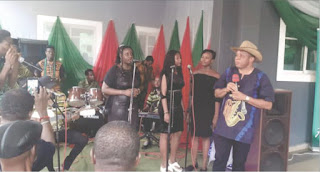
It makes for history when a reverend father appears in bowler hat and offers revolutionary music that rivals Bob Marley’s offerings for class. Reverend Father Emmanuel C. Umezinwa, aka Fada Omega, is indeed a class act. A Professor of Music at Nnamdi Azikiwe University, Awka, Father Umezinwa wowed the audience with his accomplished performance in the forecourt of Testimony Place, near Arroma Junction, Awka, in the evening of Sunday, December 5.

“A Cry for Nigeria” was the first number dished out by Fada Omega. In his brief introduction of the song, Father Omega narrated that he was inspired initially by the riffs of Bruce Springsteen. Even as reggae is the underlying beat of his music, Fada Omega is quite eclectic.

The ace music prelate followed up with “Undertakers”, a no-holds-barred rendition of the state of a nation being buried in installments by the leaders.

Fada Omega upped his ante with the pulsating number “Stop Fooling Yourself” that got the audience singing along with gusto.

His rendering of the fourth number, “Revolution”, laid bare the revolutionary ethos of the priest who would not sit idly by while the underclass suffered.

There was a short interlude of a conversation between Father Umezinwa and the managing director of Anambra Newspapers and Printing Corporation (ANPC), Sir Chuka Nnabuife.

Sir Nnabuife started out wanting to know whether Father Umezinwa preferred Fada Omega or Fada Emma as his stage name. Fada Omega took the prize.

The personable reverend father revealed that he was not restricted to reggae or country music but could put to application a wide range of musical genres.

Fada Omega is not one to fall for easy labels, but insists that music helps to foster change in society, arguing that “Jesus Christ was a revolutionary.”

He informed the audience that, back in 2005, he went for voice training in a studio in the United States only for the studio manager to wonder at the Nigerian being able to sing excellently through all the ranges.

Fada Omega is a natural baritone who does not believe in the existence of falsetto or false voice in the music get-go.

He had been composing and playing music for the past 30 years or so, and in 2003 recorded highlife tunes for his age grade in his native Akpo town in Aguata LGA of Anambra State.

He had over the years been producing classical music on radio. He hardly uses notes when composing the songs. He is quite open to his music being recorded for keeps.

The Fada Omega concert was engineered remarkably by a First Class student of his in the Music Department, Gerald Eze, a winner of the coveted Christopher Kolade Music Award and the singular exponent of the Igbo musical instruments Oja and Ubo-aka. Gerald Eze talked of his intent to immortalize the musical genius of Fada Omega.

The generous hosts, Dr. Patrick and Barrister (Mrs.) Amaka Ezeno, offered to keep to the testimony of hosting the performances as ever. A sage like Fada Omega would always find a home here, Mrs. Amaka Ezeno asserted.

In a lighter mood, Igwe Chidi Onuigbo said he was very afraid that Fada Omega, without the restraining clothing of the soutane, could go on a rampage!

For Hon. Ikem Uzoezie, a former member of the Anambra State House of Assembly, “Fada Omega’s music is timeless and will go a long way in assisting the social revival needed in Nigeria.”

Rev. Father Chika Okpalike of the Ekwulobia Diocese marveled at the abiding relevance of Fada Omega’s songs, having been composed three or two decades earlier.

The evening’s performance was rounded off with the number “We Shall Overcome.” It was music that throbbed with the hope inspirited on mankind by Nelson Mandela.

Fada Omega represents a phenomenon whose time has come. Given the great influence of prelates on the people, Fada Omega carries remarkable charisma into the turf of changing the society for the better. He stands up for his beliefs, daring all dictators and the conservative types. He has built up a good following, and it aids the progress of the society that he is working with the Department of Theatre Arts of Nnamdi Azikiwe University for the release of his musical videos. A professional to the core, Fada Omega is intent on going to the last detail to see that everything is done well.

It was indeed an evening to cherish, complete with a two-man theatrical performance.

Necessary lessons were learnt from all Fada Omega’s songs, notably “A Cry for Nigeria”, “Undertakers”, “Stop Fooling Yourself”, “Revolution” and “We Shall Overcome.”

Fada Omega is a voice destined to rule the waves. Nobody who encounters him in song is ever bound to forget him in a hurry. He makes sound and meaning with an assurance that uplifts the soul. In this day and age of meaningless songs by ill-assorted youths calling themselves musicians, Fada Omega is the way to go.

Tuesday, December 14, 2021

NIGERIA TODAY IS LIKE CYPRIAN EKWENSI’S YARN

Cyprien Ekwensi


BY UZOR MAXIM UZOATU


All the demented facets of Nigerian life today, from brazen kidnappings and robberies to rampant prostitution and political heists, are like the many wonderful tales of Cyprian Odiatu Duaka (COD) Ekwensi, who died on November 4, 2007.

Cyprian Ekwensi lived a charmed life as a pathfinder in the annals of African literature and it is a striking tribute that the current shenanigans of Nigeria read like the yarns of the popular writer.

Ekwensi was arguably the most prolific author in the comity of Nigeria’s first generation of acclaimed writers.

A novelist, short story writer, children’s literature master, journalist, pamphleteer, columnist etc, Ekwensi gave the world a formidable body of work that can never be wished away.

He was a nonpareil craftsman of popular literature who got to the heart of his readers without any unnecessary dabbling into obscurantism and self-serving ambiguities.

Cyprian Ekwensi is Mister Nigeria, born in Minna in the North on September 26, 1921 of Igbo parentage and lived most of his life in the Western part of the country.

Ekwensi was without question the most Nigerian of Nigeria’s tribe of writers.

He was versed in Igbo, Hausa and Yoruba cultures, as much as he equally dwelt on the life and mores of the minorities.

He deservedly earned his celebration across the length and breadth of the country as a pan-Nigerian phenomenon.

His work has been acknowledged all over the world such that while I was in Canada as a Distinguished Visitor, I was told by Professor Peter Desbarats, Dean of the Graduate School of Journalism at the University of Western Ontario, that Ekwensi’s Jagua Nana was the only book from Nigeria he had ever read.

Some critics tagged Ekwensi as Africa’s Daniel Defoe, after the irrepressible author of such classics as Robinson Crusoe and Moll Flanders.

Ekwensi was a progenitor of Onitsha Market Literature when, back in 1947, he published When Love Whispers to spur the market literature that flowered in the Nigerian city of Onitsha after the Second World War.

His novel People of the City became one of the pioneer titles of Heinemann’s African Writers Series, such that alongside Chinua Achebe he gave the world a different view of the canon.

The versatility of Ekwensi can be seen in his novel Burning Grass that helped in no small measure to put the Fulani nomads in the global map of literature.

The disease of wandering known as ‘Sokugo’ was popularised by Ekwensi but let’s not go there because of the wandering president!

It is in the documentation of city life that Ekwensi earned lasting plaudits from the literary critics. One of his novels, Jagua Nana, dwells on the travails of the eponymous ageing prostitute and her tango with the young and dashing Freddie.

The book attracted sustained film interest from overseas and it was debated in the Nigerian Parliament of the First Republic, which stopped its filming by an Italian film company.

Ekwensi eventually wrote a sequel of the novel, Jagua Nana’s Daughter, published by Joop Berkhout’s Spectrum Books, Ibadan.

A yarn-spinner with legendary page-turning intensity, Ekwensi authored The Passport of Mallam Illia, which remains an everlasting adventure story that grips the reader from the first page to the last.

Ekwensi’s titles such as An African Night’s Entertainment and The Drummer Boy are ever-present staples in the junior secondary school curriculum in Nigeria.

An old title of his written early in his career but not published, For a Roll of Parchment, was released by Heinemann, Ibadan, and it bore all the hallmarks of the Ekwensi mystique in Nigeria’s promotion of paper qualification.

For a man who had his training as a pharmacist and worked in forestry, Ekwensi astounded the world with his high literary output.

Some critics like Bernth Lindfors had said harsh things about the quality of Ekwensi’s writings while other equally eminent literary scholars such as Ernest Emenyonu rose up solidly in defence of the man from Nkwelle-Ezunaka in Anambra State.

He maintained a home in the very heart of the city of Lagos, at Ojuelegba Road to the very end. His service in the public sphere had been stellar. From 1957 to 1961, he was the Head of Features at the Nigerian Broadcasting Corporation.

He later earned the distinction as the first Nigerian Director of Information in the Federal Ministry of Information.

Ekwensi was the Director-General of Radio Biafra during the Civil War and became the Chairman of the East Central State Library Board after the war.

He would later become the Managing Director of the Star Printing and Publishing Company, Enugu, publishers of the Star group of newspapers.

He was appointed Information Commissioner, Anambra State, in 1983 and reputedly coined the acronym WAI – War Against Indiscipline – that the military regime of General Muhammadu Buhari put into effect.

All the kidnappers, robbers, debtors, looters, and ill-assorted brigands and prostitutes being paraded all over the nation today are quintessential Ekwensi characters! He created all of them in his many fictions before he died.

This way, Cyprian Ekwensi can never really die!

Friday, February 14, 2020

Umuchu As The Cradle Of Confederation

Uzor Maxim Uzoatu


BY UZOR MAXIM UZOATU

Umuchu, my hometown, offers the world a fundamental legacy of unity in confederation. A large and populous town of about 50 square kilometres and 300,000 people, Umuchu in Aguata Local Government Area of Anambra State thrives on the business done in the famed Nkwo Uchu market patronized by all the neighbouring communities such as the border towns of Achina and Enugwu-Umuoyia to the north, Akokwa and Arondizuogu in Imo State to the south, Umunze and Umualaoma to the east, and Amesi and Uga to the west. History makes Umuchu tick.

There was no aboriginal Umuchu town. The legendary progenitor of the land, Ezedike, was blessed with six male children. There used to be three sovereign communities known as Ihite, Amanasaa and Okpu-na-Achalla. Each of the three independent units suffered from sporadic violent attacks from oppressive brigands such as the slave-catchers from Arochukwu. Knowing that a single broomstick could easily be broken, the leaders of the three communities decided that there was the need for all of them to be bound together like an unbreakable broom bundle.

The amalgamation was forged by the assembling of crack indigenous doctors to prepare a charm as an antidote to the invading army of their enemies. It was thus binding on the three consenting units to always act as one. The charm made to ward off the attacking marauders was known as Ichu and it was buried both at the Uchu lake-cum-stream and at the place known as Nkwo Uchu today which was the meeting point of the three communities.

After the enactment of the Ichu (warding off) antidote the sons and daughters of the commonwealth became known as Umu-Ichu, that is, the children of Ichu. In the course of time the name turned to Umuchu, thus yielding the ichu antidote to uchu because the people were a hardworking breed, and uchu meant endeavour.

The goddess of the town guarded the union from her Uchu grove in Nkwo Uchu. The mystical Uchu lake-cum-stream with its source at Nne-Nkwo nourished the town from the upland of Ihite and Amanasaa to the lowlands of Okpu-na-Achalla – not unlike the gift of the River Nile to Egypt.

The confederating bond of Umuchu into a lasting political union is an object lesson to countries in Africa, especially Nigeria. Unity can be forged once the political will is there. The example of Umuchu is that the federating units can retain their pristine qualities while gaining strength from the larger union.

In the order of Umuchu affairs, Ihite, comprising of three villages – Ugwuakwu, Umugama and Akukwa – is at the head of the stream, with Ugwuakwu village at the apex. The Amanasaa section is made up of seven villages, namely Ogu, Osete, Umumilo, Umubogu, Umuojogwo, Umuojum and Amihie. The two villages that make up Okpu-na-Achalla are Ibughubu and Achalla.

The advent of the six sons of the ancestor, Ezedike, alongside the coming together of the three confederating units serve as the fulcrum of The History of Umuchu written by Simon Alagbogu Nnolim. The booklet got into controversial limelight when Professor Charles Ekwusiaga Nnolim in a 1977 26-page essay entitled A Source for Arrow of God, published in the journal Research in African Literatures (RAL), charged that Chinua Achebe lifted everything in The History of Umuchu and simply transferred it to Arrow of God without embellishment.

Professor C.L. Inness published A Response to Prof Nnolims article in another edition of Research in African Literatures in 1978 where she defended Achebe by stating that The History of Umuchu and Achebes Arrow of God varied significantly in detail, structure, length, and phraseology.

Its not my meat here to dwell on the controversy. It just suffices to stress that Umuchu has a rich history and story worthy of abundant retelling in aid of Nigeria and the wider world.

Remarkably Umuchu was never overrun by the federal troops during the Nigeria-Biafra war, and the sacredness of the land made the then Archbishop of Onitsha, Dr. Francis Arinze (now Cardinal) to christen Umuchu as Alanso. Unity and camaraderie permeate the age grade groupings and the masquerade fests such as Uku in Amanasaa and Ogwugwueke in Umugama. People are at liberty to eat and drink in all the open places without any fear of being poisoned.

The practice in Umuchu is democracy of the mouth with a healthy dose of taunting known as “Njakiri”. The fear of “Umuchu Press” is the beginning of wisdom. Anybody who misbehaves is quickly reminded that Ndi Press had made broadcast his offences. Nobody knows the editor or the reporters of “Umuchu Press.”

The coming together of Umuchu in unity is exemplified by the communal doings in the capacious Uzoatu family compound where everybody eats out of the same pot in the village of Umugama village that shares a boundary with Akokwa town in Imo State.

In the lore of the land of Umuchu, the people of Umugama are the descendants of Ugama, one of the six sons of Ezedike. Warlike Umugama warriors of yore were reputed as the arch defenders of the Umuchu confederation, and the story has lasted from age to age of how the village defeated the evil spirits and poltergeists that attacked the town!

Being away from Umuchu can be suicidal for me and many. I once made the mistake of spending my Christmas in the United States. I nearly ran mad in New Jersey, USA. It was cold. I had no companions to play with. I went to the library to read on Christmas day, and I had to run out because I found no meaning.

In my anguish I had to perforce appreciate Christmas in our Umugama home in Umuchu back in Nigeria where I would have been at absolute liberty to eat and drink all I wanted and more in the Uzoatu compound without contributing a kobo from my pocket! Among Uzoatu sons and daughters, it is a classic case of the Marxian term from each according to his ability, to each according to his needs.

To end, Nigeria needs to learn from Umuchu. Confederation does not kill; it unites. The world cannot but rise up to the example of Umuchu in bonding. I have written this piece as homage to the rootedness of the teenage years in Umuchu when my father handed me over to the dreaded masked ancestral spirit, Nwogbaka, who said to me, gutturally: You are the child to tell our story.


Uzoatu writes from Lagos.

Wednesday, February 5, 2020

How I Oppressed Chukwuma Charles Soludo!

Charles Chukwuma Soludo


BY UZOR MAXIM UZOATU


Now that the erudite former Central Bank Governor, Professor Chukwuma Charles Soludo, is the odds-on favourite to become the next governor of Anambra State, I am in deep fear over a sin I committed against him in the past.

I oppressed him when he was still in secondary school and I was what was then called an auxiliary teacher. Back in my secondary school days, I was seen as something of a rebel, earning bad nicknames such as “Anarchy”, or “Young Dimka” – after that drunken “dawn-to-dusk” coup-plotter named Buka Musa Suka Dimka.

While other students were excited about getting into the university, I was more interested in starting my revolutionary activities in the manner of Che Guevera.

God sort of answered my prayers when the school certificate results for the year, 1977, otherwise known as “Expo 77”, were delayed for a long time such that entering the university became impossible because I could not have gone to Nsukka, where I had won an admission, without a school certificate to show.

Of course I had no occult powers to foresee that one can even become a president without any certificate. There was talk by my parents for me to do higher school studies at Christ the King College (CKC), Onitsha where I had lived in the staff quarters all through my primary school years with my uncle, Job Okwuoma Aginam, who was a teacher in the elite school.

I had other ideas. I felt I could actualize my revolutionary drive by taking up a post as an auxiliary teacher on N96-per-month salary.

Incidentally the education ministry in the state then was under the charge of my future father-in-law, Chief Innocent E. Ofor, whose daughter I would marry many years later. I camped in his Savage Crescent, GRA Enugu home to get the auxiliary teacher job and was posted to the newly-minted school in my hometown, Umuchu High School, just a stone’s throw from the Uzoatu family compound.

The school was actually established that year and had only Class One students.
I had my mother’s mobylette to cruise around town with, and I caused such a stir that after a paltry six months the school principal threatened to revoke my appointment if I did not carry my antics to the university.


All the students instantly took to the new Che Guevera in town. Even as the brand new school could only boast of its pioneer class it competed in every sphere with all the major schools in the state that had the full complement of classes and teachers.

In football matches, you may see the teacher playing as a student. Soccer mercenaries were hired from far-flung places such as Enugu and Aba; this way, soccer stars like Ndubuisi Ajomiwe and the late Benjy Okorogu played for the school when they were not registered students!

Don’t ask me about the morality of this enterprise! As Bertolt Brecht, the great German playwright and socialist would say, don’t speak to me of morality but of its victims.

I served as a self-appointed games-master, as opposed to the actual games-master Jide Ezeani who earned the monetary allowances. I took the school’s champion table tennis player, Victor Ibe, alias “Action”, to the Aguata divisional championships.

His opponent happened to be a certain Charles Soludo from Uga Boys High School. There was something familiar in the lad because he was a native of Isuofia, my mother’s hometown, and my maternal cousins, Dr Arthur-Martins and Dr Obijiofor Aginam, had told me of his brilliant activities in the town’s student union.

Even as I had some sympathy for Soludo in the tennis contest, I had the extra motivation to make my student win because I was the last person to hold the title as the table tennis champion of the selfsame zone!

But for the fact that I had left school, I was the defending champion, and all the top divisional sports officials knew and hailed me. I desperately wanted my boy to win the title back for me.
I
t was decided that the table tennis match-up will be decided over the best of five sets. My boy easily won the first set. He equally took the second set, but I could use my trained eyes to see that Soludo was coming on strongly.

I decided to act fast. I said that the game was over since Soludo had nothing more to offer.

It was quite remarkable that Soludo protested, insisting that the next game must be won by my boy before the contest could be over.

There was a kind of stalemate, and the officials who of course bonded with me as the former champion had to appeal to me in the end.

That was how I decided to end my oppression as a teacher over the protesting student Soludo!

As fate would have it, Soludo won the next three games on the trot to take the match and the title!

Having experienced this come-from-behind victory of Soludo, I am keenly waiting with bated breath to see him win the Anambra State governorship polls, especially now that the Supreme Court can appoint a governor with the finality of bad arithmetic!

Now if Soludo wants to oppress me back in retaliation on winning the Anambra governorship, I will as a “Nwadiani” report him to the Isuofia Town Union!

-Uzor Maxim Uzoatu, poet, writer, journalist, writes from Lagos

Thursday, January 16, 2020

BOOK REVIEW Apotheosis Of Ironsi

BY UZOR MAXIM UZOATU

Ironsi: The Army, Power And Politics
By Chuks Iloegbunam
Eminent Biographies,
Awka, Nigeria, 2019; 298pp


There is an almost general acknowledgment that “The Class of 1966”, that is, the northern revenge coup plotters that killed General JTU Aguiyi-Ironsi and ousted his regime, has somewhat superintended over the affairs of the country ever since. The vengeful class has its finger on the pulse of the country and only puts its minions in charge of affairs at the commanding heights. It is against this background that the story of Ironsi is hardly ever given a mention in the Nigerian scheme.

Chuks Iloegbunam is one courageous writer who has dared to right and write the forgotten history of Ironsi, in a sense ensuring that the first should not be put aside as the last. In 1999, Iloegbunam published Ironside – The Biography of General Aguiyi-Ironsi, Nigeria’s First Military Head of State. The irrepressible Iloegbunam has followed up with this new volume that expands the earlier version to include intervolving issues on Nigerian nationhood, the army, power and politics. The preface to the 1999 Ironside is included in the new book before a well-annotated “Preface To This Edition” that starts out with quotes from President Alvaro Uribe who ruled Colombia from 2002 to 2010, and General Ibrahim Badamasi Babangida who served as the Military President of Nigeria from 1985 to 1993.

Babangida’s words deserve attention because he was among the Northern Nigerian soldiers who toppled the Ironsi regime. According to Babangida, “He (Ironsi) was killed for advocating for a unitary system of government in Decree No 34, ‘the unification Decree’. He meant well. In fact, the decree was promulgated for the preservation of Nigeria as an entity. Unfortunately, some Northerners interpreted it to be a means for Ndigbo, after the January 15, 1966 revolution, to further take over the entire affairs of the nation. General Aguiyi-Ironsi was a man who saw tomorrow; he wanted Nigeria united in accordance with the military command tradition and it was probably never intended to facilitate any form of domination. Interestingly, even today, we are still struggling to remain united as one.”

Ironsi rose at a time Nigeria was embroiled in eventful contradictions. He was a remarkable hero and leader in the Nigerian Army’s peace mission to the Congo. The divisions in the Nigerian military were such that Northern Nigerian soldiers had planned to stage a bloody coup tagged “Operation No Mercy” on January 17, 1966 only to be upstaged by the January 15, 1966 revolution of Majors Emmanuel Ifeajuna, Chukwuma Nzeogwu and others. Ironsi led the charge of quelling the January 15 coup though some Northern officers assert that he was somewhat part of the plot.

When the rump of the civilian regime as represented by the then President of the Senate and Acting President, Dr Abyssinia Akweke Nwafor-Orizu, ceded power to the soldiers led by Ironsi, there were frayed nerves all over the country. Ironsi’s response, following the advice of top civil servants like Chief Simeon Adebo, was the enactment of the Unification Decree, and the touring of the four regions of the country to preach peace.

It was at the Western Region wing of the tour that Ironsi was arrested in the company of his host, Col. Adekunle Fajuyi, by a junior officer who had accompanied Ironsi on the tour, to wit, Theophilus Yakubu Danjuma. It was akin to a “maiguard” undercutting his master! The horrendous torture and killing of Ironsi and Fajuyi make for heart-rending reading, but Danjuma claims he lost command only for the irate soldiers to lynch Ironsi and his host Fajuyi. Remarkably, Danjuma dismisses Ironsi as “absolutely useless desk-clerk Head of State.”

Against Danjuma’s dismissal of the slain Supreme Commander, here are Chukwuemeka Odumegwu-Ojukwu’s words on Ironsi: “In a military career studded with firsts – first Captain, first Major, first ADC to the Governor-General of Nigeria, first Equerry to the Queen, first Lieutenant Colonel, first Battalion Commander, first Brigadier, first psc, first IDC, first Military Attache to a Nigeria Diplomatic Mission, first Nigerian Commander to a UN Battalion, first Major-General – General Ironsi commanded the United Nations Force in the Congo with such distinction that he was awarded international honours by countries grateful for his superb command of their troops during the emergency.”

Like all heroes denied honour in the homeland, Ironsi represents the Nigerian tragedy writ large. Iloegunam does not buy the holier-than-thou role of General Yakubu Gowon as per the demise of Ironsi and cites current Nigeria reality as giving the lie to Gowon’s triumphalism that “The rising sun of Biafra has set forever.”

In dealing with the pogrom against the Igbo, Iloegbunam had to include excerpts of the 279-page, 14-chapter “Report of the Justice G.C.M Onyiuke Tribunal: Massacre of Ndigbo in 1966.” It’s as gory as they come!

Iloegbunam fittingly depicts Ironsi as “The Last Nigerian”. Given the nepotism and prebendalism that is the rule rather than the exception in the exercise of power in Nigeria of the here and now Ironsi indeed belonged to a different planet!

Ironsi – The Army, Power And Politics by Chuks Iloegbunam is without question a rare gem of a book. It teems with quotes from Christopher Okigbo’s poetry, requisite appendixes, references to cognate books and apt notes. The editing errors of mixing up the country Colombia as Columbia and putting the Babangida years as 2003-2011 can easily be fixed in future editions.

Iloegbunam has done great justice to Ironsi by addressing the multiform issues attending to the brutal mauling of an original Nigerian hero. Iloegbunam goes further afield by broadening the book Ironsi beyond the protagonist to address Nigeria’s anarchic democracy and its greedy gatekeepers and stakeholders. Iloegbunam does not end up just condemning but critically proffers germane solutions on how the country can conquer her woes through wide-ranging restructuring and authoring a fresh autochthonous constitution. Iloegbunam has earned lasting stripes as a leading thinker in Nigeria, and it is hoped that through his innovative publishing enterprise, Eminent Biographies, he would in due course put more distinguished lives up for deserving attention and recognition.

Wednesday, November 20, 2019

Achebe: The Doyen Of The African Idiom

 
Chinua Achebe


T is well-nigh impossible for November 16 to go by without much of the world remembering that the date is the birthday of Chinua Achebe. It needs stressing that Achebe is arguably the most influential novelist who ever drew breath all over the world. The argument pitches him in the ranks of Cervantes, author of Don Quixote, James Joyce who wrote Ulysses, Franz Kafka who penned The Trial, Gabriel Garcia Marquez of One Hundred Years of Solitude fame etc.

Things Fall Apart by Chinua Achebe is a supreme classic. Achebe’s oeuvre is indeed intimidating starting from the legendary Things Fall Apart in 1958 and grandly lapping all the way through No Longer at Ease, Arrow of God, A Man of the People, Anthills of the Savannah, Girls at War and Other Stories, Beware Soul Brother, Morning Yet on Creation Day, The Trouble with Nigeria, Chike and the River, Home and Exile, Hopes and Impediments, The Education of a British-Protected Child, There Was A Country etc.

Born in Ogidi in present-day Anambra State on November 16, 1930, Chinua Achebe who was baptized as Albert was indeed a child prodigy from the very beginning such that his academic feats was known far and wide culminating to his lifelong buddy Christian Chike Momah, alias Papa Ada, confessing that he and his mates were warned early in life that one Albert Achebe from Ogidi would send them to the cleaners in the regional school exams!

It was therefore no wonder that Achebe was early in life given this nickname: Dictionary. He passed his school certificate exams at the top of the class with five distinctions and one credit, and the one credit was paradoxically in literature that would eventually earn him worldwide fame. In the nationwide examination for entry into the University College, Ibadan which had just been established Achebe came first or second in the entire country and thus won a major scholarship. His alma mater Government College, Umuahia was so proud of his achievement that they put up a big sign that stayed on the wall for many years.

At barely 28 years of age Chinua Achebe published the novel Things Fall Apart in 1958, and it has in its 55 or so years of existence proven to be the single most important piece of literature out of Africa. The 50th anniversary of the 200-odd page novel was celebrated all over the world with festivals, readings, symposia, concerts etc.

The novel which has been likened to epic Greek tragedies has been translated to 50 languages and has sold over ten million copies. It is taught not just in literature classes but in history and anthropology departments in colleges and universities across the globe. The archetypal theme of the meeting of the white world and the black race makes Things Fall Apart an epochal event in the annals of world literature.

The book works at several levels, and can be read at any age from 10 to 100. As a child one can enjoy the incidents such as the match with Amalinze the Cat, Unoka’s dismissal of his creditor, Okonkwo’s attempted shooting of one of his wives, the visitation of the masked spirits etc.

Later in life the many ironies in the book come into play such as the joke on the District Commissioner thinking that Okonkwo’s story can only end up as a paragraph in his planned book, The Pacification of the Primitive Tribes of the Lower Niger, without knowing that one Chinua Achebe had taken the thunder from him by giving Okonkwo an entire book in which the story is narrated from inside!

It is not for nothing that Achebe is celebrated as the father of African literature. He has changed the perspective of world literature from the gaudy picture of Africa as painted by Europeans such as Joseph Conrad, Joyce Cary and Sir Rider Haggard to the authentic telling of the tale by the Africans. Unlike earlier African writers like Guinea’s Camara Laye, author of The African Child, who painted a romantic picture of the continent, Achebe is relentlessly objective in his narration, telling it as it is, warts and all.

It is because of the remarkable success of Things Fall Apart that the publishers Heinemann UK launched the African Writers Series (AWS) in 1962 with Achebe’s first novel as the first title. For many years Achebe served as a non-remunerated Editorial Adviser of the series in which the majority of African writers got their breakthrough in publishing. Things Fall Apart reputedly accounted for 80 percent of the entire revenue of the AWS.

Former American President Jimmy Carter numbers Achebe as one of his favourite writers. The rave reviews for Achebe’s most famous novel have somewhat dwarfed his other novels such as No Longer at Ease (1960), Arrow of God (1964), A Man of the People (1966) and Anthills of the Savannah (1987). Achebe won the Man Booker Prize for his lifetime achievement in fiction writing, beating a formidable shortlist that included Philip Roth, Salman Rushdie, V.S. Naipaul, Ian McEwan etc. He equally won, as the first African, the American National Arts Club Medal of Honour for Literature in November 2007. Things Fall Apart has earned its uncommon distinction as a modern classic and was in 1992 adopted into the esteemed Everyman’s Library of world classics. The Igbo world of the late 19th and early 20th centuries which Achebe limned in Things Fall Apart has become the global picture of Africa writ large. At the turn of the 20th century the book was voted as Africa’s “novel of the century”.

Achebe has in the book given the world a new English language which paradoxically portrays African life without facetiousness or affectation. He lays bare the brute masculinity of the age without bending the knee to latter-day political correctness or gender balance. The truth happens to be Achebe’s sublime weapon in telling the immortal African story.


SOURCE: DAILY SUN

Tagbo: Legendary Father Of A Thousand And One Sons

Rev. Fr. Nicholas Chukwuemeka Tagbo. Image via PM News


The rule is that a Catholic Reverend Father must not father children. Another rule says that if you don’t break the rules you cannot change the world and attain the height of legends. Very Reverend Father Nicholas Chukwuemeka Tagbo has an uncountable number of very eminent sons. I count him as my father too.

He was the longest-serving Principal of the famous Christ the King College (CKC) Onitsha, and all his former students adore him as their father.

I did not attend CKC but I knew Father Tagbo more than the students because I lived all my early years in the staff quarters of the renowned secondary school with my linguist uncle, Job Okwuoma Aginam, who taught Bible Knowledge and French in the school.

After my primary school education at Sacred Heart School, Odoakpu, Onitsha, which shared the same compound with CKC, I passed the Common Entrance Examination and was given admission without my choice in St Peter’s Secondary School, Achina.

It would have been easy meat to change from SPSS Achina to CKC but Father Tagbo and my uncle decided that I could excel anywhere!

Incidentally, most of my mates who got admitted to CKC and finished up in 1977 as me could not get results due to the widespread WAEC leakages of that year known as EXPO 77.

As you can see, Father Tagbo and my uncle could see the future! The only subject I took in WASC that was not released was History, but I was home and dry in fine fettle.

Father Tagbo had such a towering impressive height to behold in his white soutane. I remember after the Biafra War that I was carrying my little sister, Chinwe, of about three years while Father Tagbo was talking in front of the CKC staff quarters and the little tot kept stretching her hand to touch the priest while I kept drawing her hand back.
Then the little baby raised her voice in protest in Igbo thusly: “Kam metunu m ya aka”, that is, “Let me touch him with my hand!”

Then, Father Tagbo took notice and admonished me to let my sister touch him before he then lifted her into his arms!

We used to be altar boys at Christ the King Parish within the CKC compound, a church that was dedicated by the then Archbishop of Onitsha (now Cardinal) Francis Arinze, with me winning a gold medal as a torch-bearer. Father Tagbo never used to say the masses, but one certain morning the regular priests – Father (later Bishop) Simon Okafor and Father (later quit the priesthood) Emeka Okide – were not around.

Father Tagbo had to step in to do the morning mass. Some altar boys had dressed up, but Father Tagbo looked at them and then turned to me and said: “Nwa Aginam (that’s what he calls me, after my maternal uncle’s surname) dress up and follow me! I don’t want anybody to delay me on the altar!”
Before I could get into gear, he was already at the altar. The mass that used to last about an hour-and-half took only 30 fast minutes! Father Tagbo was that sharp!

My attachment with Father Tagbo continued even after I had gained admission into the university. A dear friend of mine, Aloy Umeodinka, who had taken his WASC at CKC had to seek me out while I was holidaying at the CKC staff quarters to get his results and testimonial from the priest.

A book on the life and times of Father Tagbo entitled ‘Sons of a Priest’ has just been edited and published by a distinguished alumnus of CKC, the prize-winning novelist Odili Tony Ujubuonu.

A peep into the book reveals the testimony of Father Tagbo’s classmate and football playing partner, the former CEO of Ajaokuta Steel, Dr Fidelis Ezemenari who among other things disclosed that as a youth Tagbo reproached their goalkeeper – now an acclaimed Igwe of a big town – who conceded a goal and claimed he had seen six different balls at the same time, that he ought to have caught one of the balls instead of taking time to count them!

To conclude, here is an excerpt from the coffee table book:

“He gave up his life ambitions to make us rule our worlds. Tagbo was satisfied to be just a principal and a priest while some of his classmates in Christ the King College became bishops and one would later become a cardinal. He gave Nigeria over twenty Senior Advocates of Nigeria and remained an obedient citizen. He raised men who became GCON, CON, CFR, MFR etc. but was content and very proud to be honoured with just an OON. He produced three state governors while he remained a simple priest in a local parish. He had over a hundred billionaire businessmen as his sons yet he remained faithful to his vow of poverty as a priest. He trained boys that became Chief Judges of about four states and senior judges in courts across Nigeria, yet he ended as Citizen Nicholas. His bell of humility tolled twelve when he happily lived as a poor old priest under the current Archbishop of Onitsha Diocese, who was once his obedient student in Christ the King College.”

Monday, November 18, 2019

The Imperative Of A National Holiday For Zik

Nnamdi Azikiwe


Today (November 18) is a public holiday in Anambra State in honour of Nigeria’s first President, Dr Nnamdi Azikiwe, who was born on November 16, 1904. The holiday was shifted by two days because his (post humous) birthday this year was last Saturday, a work-free day. There ought to have been a holiday throughout the country today because Zik was not just Nigeria’s finest national leader but also a pan Africanist of the finest hue.

It is a deserving honour for the pivotal leader who led the charge for Nigeria’s independence on October 1, 1960. As a result of his unparalleled efforts Dr. Nnamdi Azikiwe would in the course of time become the only black Governor-General of Nigeria, the first President and Commander-in-Chief of the Armed Forces, the only Nigerian whose name appeared in a Constitution of Nigeria, the first Senate President, among many other sterling firsts.

The great one fondly called Zik of Africa remains a binding force of togetherness in Nigeria even in death. He deserves a national holiday on his birthday, November 16, as eminently highlighted by Chief Willie Obiano, the Governor of Anambra State, by urging President Muhammadu Buhari to declare the birthday of Nigeria’s first president as a public holiday.

Governor Obiano who made the call at Alex Ekwueme Square, Awka, while marking Nigeria’s 59th Independence celebration stressed that some African nations like Ghana and Tanzania had honoured their pan-African leaders such as Kwame Nkrumah and Julius Nyerere. He described Dr. Azikiwe as the greatest Nigerian who lived in the last century and argued that with the requisite honour being given to Zik it would enable the people to have a better understanding of Africa and the black race that Azikiwe inspired.

The governor revealed that Zik inspired notable citizens and nationalists, including Chief Obafemi Awolowo and Bashorun MKO Abiola, with his intelligence, eloquence and public oratorical skills.

Leading from the front, Governor Obiano stated that Anambra State will start to observe November 16 annually as a Work-Free Day in commemoration of the birthday of Dr. Nnamdi Azikiwe. He pointed out that the day would be set aside to reflect on the contributions of Dr. Azikiwe to the growth of the country at large.

There is no gainsaying that Zik remains Nigeria’s foremost nationalist and therefore deserves a national holiday. This comes from the background of President Buhari having set the precedent of honoring the presumed winner of the June 12, 1993, presidential vote, Chief Moshood Abiola, with the renaming of the National Stadium in Abuja after him, bestowing on him the Grand Commander of the Federal Republic, Nigeria’s highest national honour given to only heads of state, and making June 12 a national holiday.

As the erudite Anambra State Commissioner for Information and Public Enlightenment, C. Don Adinuba, said, “Abiola never left anyone in doubt that he was greatly inspired by the nationalism, patriotism and sportsmanlike spirit of Nigeria’s first president, Dr Nnamdi Azikiwe, GCFR, PC. Abiola remained an avowed Zikist up to his death.”

On his part, Governor Obiano reiterated: “It has become imperative to remind President Buhari of the request I made to him on behalf of the government and people of Anambra State when he visited Onitsha to commission the newly completed Zik Mausoleum last January 24 that he declare Zik’s birthday a national holiday. Ghanaians observe the birthday of their first president, Dr Kwame Nkrumah, himself a Zik protégé. Tanzanians observe a national holiday in memory of their first president, Mwalimu Julius Nyerere, as Angolans do in memory of Dr Agustiono Neto, their first president.

“The Great Zik of Africa was not just Nigeria’s first president or the man who led Nigeria to independence in 1960. He was Nigeria’s first indigenous Governor General and the first Senate President. He was the first Nigerian to build a bank, thus inspiring his colleagues as regional premiers in the 1950s to establish their own banks. He was also the first Nigerian to set up a university, and consequently challenged his peers to follow in his footsteps. A Nigerian nationalist of incomparable status and a man of letters through and through, the Great Zik of Africa had established as early as the 1950s newspapers in Ibadan, Zaria, Kano, Onitsha, Port Harcourt and, of course, Lagos to fight for Nigeria’s liberation from oppressive colonial rule.

“Zik inspired a generation of Africans, including the late President Nkrumah of Ghana, Chief Obafemi Awolowo and Dr Nwafor Orizu, who became Nigeria’s second Senate President. It has, therefore, become a national scandal that a national holiday has yet to be declared in honour of this great African son. The people and government of Anambra State once again call upon President Buhari to end this national blight by declaring November 16 of every year a national holiday in commemoration of Dr Azikiwe’s birthday.”

A quintessential Renaissance man, Zik was a politician, poet, author, orator, sportsman, visionary, nationalist, but above all else, a remarkable human being.

Zik lived and died as the acclaimed Father of Modern Nigeria. Zik was the complete Nigerian. Born in the Hausa-Fulani North of Eastern Igbo parentage, Zik spent his most productive years in the Yoruba West. He spoke Hausa, Yoruba and Igbo fluently, as well as other Nigerian languages. He was a welcome presence everywhere n the country.

A native of Onitsha in Anambra State, Zik was born on November 16, 1904 in Zungeru and died on May 11, 1996.

Zik who wore the traditional title of Owelle of Onitsha with uncommon aplomb was the lionized author of books such as Renascent Africa, Liberia in World Politics, My Odyssey etc.

A national holiday for the leader who made Nigeria’s independence possible is very imperative. The Nnamdi Azikiwe national holiday, or Zik’s Day, is an idea whose time has come in celebration of the father of modern Nigeria. It is incumbent on President Buhari to make it happen.


SOURCE: SUN NEWS