Showing posts with label Biafra. Show all posts

Wednesday, June 8, 2022

Farewell, Alexander Madiebo

Biafran War General Alexander Madiebo (1932-2022) 

BY AHAMEFULA NJOKU

Shortly after the book, ”The Nigerian Revolution and the Biafran War,’ written by Alexander Madiebo, who was a Lt Colonel in the Nigerian Army and later promoted to a Major General was published by Fourth Dimension Publishers, Enugu in 1980, l saw my father reading the book on a daily basis. At that time, l did not realise my full connection to the events and some personalities in that book or indeed that of the entire Igbo race for that matter. l later realised why he was reading the book with great interest. My father, an entrepreneur at the young age of 34 years in 1967, was one of the richest men in Port Harcourt with ownership of four houses there, a lot of landed properties, two brand new cars, the best photo studio, Sams Photos, with 13 members of staff and a manager, often frequented by Nigerian President Nnamdi Azikiwe, opposition leader Obafemi Awolowo and even Europeans, including those working in the crude oil industry. All these were lost, including three of my siblings to the Biafran war.


Many years later when l read the book from cover to cover, it dawned on me that Madiebo who hails from Awka in Anambra State and recently died at the age of 90 years was not just a master story teller but a world class military strategist.

When you read his book, you learn many invaluable lessons of life. The most important lesson you would learn is that every action a human being takes carries consequences.

For example, it was Madiebo and one or two other persons who convinced Chukwuma Nzeogwu after the January 1966 coup failed in the South of Nigeria and General Aguiyi-Ironsi had become the Head of state of Nigeria to surrender himself to the authority of the new leader. Had Nzeogwu done otherwise and proceeded to ”complete” the coup in Lagos and southern Nigeria, the history of Nigeria could have been different today and maybe the 1967 to 1970 civil war may have been averted.

In my work with some Nigerian politicians, businessmen and indeed many human beings, l have observed that many of them pay scant attention to strategy or often ignore good advice based on research, experience, feedback. A few of them who are patient and wise enough to adopt a strategy for what they want to achieve often do better than others who do not. The reason is obvious. To formulate a good strategy for whatever you want to do and execute same is very tasking. Many human beings do not have the patience, wisdom or resilience to execute same.

Madiebo in that classic book also told the story about how his course mate at the United Kingdom elite military academy, Sandhurst, General Yakubu Gowon had tried to get him out of harm’s way by penciling down his name for a course abroad at the height of the 1966 crisis. But Madiebo, a very wise man, turned down the offer because he felt he needed to be around to protect his wife and children as the uncertain events of 1966 unfolded. Had he accepted the offer, he would have been outside the country when the epochal events of 1966 to 1967 unfolded and perhaps he would not have played the central role of the General Officer Commanding of the Biafran Army and a war tactician of the highest order.

Madiebo also told a story of how he advised an Igbo officer to leave the Kaduna Army Officers Mess at the army barracks in 1966 after the counter-coup because of the mutiny by ‘northern’ soldiers against their southern colleagues. Madiebo left, but the Igbo officer who refused to heed his advice was later that night arrested at the same officers’ mess and was killed. This story often reminds me of the famous statement by one philosopher that, ”He who cannot be advised cannot be helped.” In life taking a good advice from someone who is more experienced and more knowledgeable than you can make a big difference in your life. If you take the advice, you move to success, if you do not, sooner than later you would come face to face with failure to your utmost regret.

Another lesson one can learn from Madiebo’s book is the importance of planning and organisation in whatever anybody who wants to be successful in life does. In all the battles he plotted in Biafra, he did a lot of planning and succeeded in defeating the enemy with minimal resources. His story of how he escaped from Kaduna to the Eastern part of Nigeria in the water tank of a train after hiding in the bush is another interesting narrative full of wisdom and strategy.

Madiebo also has a great sense of humour. Although the events he narrated were very serious and grim, underneath them was a mischievous sense of humour. He told a story about a telephone conversation with Lt Colonel Emeka Ojukwu who was in charge in the army formation in Kano. When Ojukwu was being told of the events of the January 1966 coup, he kept saying, ”good, good, good” to every statement made to him. One could not then decipher whether he was in support of the issues being discussed with him or against.

Ojukwu, the Oxford trained historian in one of his displays of a sound knowledge of the English language, once sent a signal to Madiebo. Ojukwu in a very short message was trying to give a background to a situation that required that Madiebo take over a particular war assignment from two officers who ought to have carried out the assignment. To paraphrase him, he told Madiebo that a certain Biafran officer ”hopes” while another officer is ”hopeless.” This was Ojukwu’s way of telling him that the two officers cannot be in charge of the impending battle.

He also narrated an encounter with Frederick Forsyth, the celebrated British Broadcasting Corporation Correspondent and famous author who he frightened off from his area of operation because he didn’t know whether Forsyth was a spy for someone or a genuine sympathiser. Another funny narrative of his was how Achuzia, a civilian was given the title of a Lt Colonel by Ojukwu for his bravery during the war. But Achuzia was posturing as a full Colonel. According to Madiebo, in the military tradition, a Lt Colonel could be addressed as a Colonel although he was not a full Colonel. Achuzia was protesting that Madiebo was ”demoting” him from the rank the Head of State had bestowed on him by designating him as a Lt Colonel. Still on Achuzia, Madiebo told another story of how Achuzia, a fearless soldier went into another battle without adequate planning and lost. While trying to evolve a battle strategy, Achuzia who had grown impatient told Madiebo to stop all these ”Sandhurst” planning and allow the boys (soldiers) to fight. After the battle was lost, Ojukwu now directed Madiebo to take ”personal” charge to recover the place. And Madiebo did. I later met Ojukwu, himself, in 1994 and had a good relationship with him.

Madiebo is a foremost military tactician and strategist. He narrated how he was on a routine visit of the front lines of the Biafran war fronts before the first shot was fired and saw some young Biafran soldiers with their rifles engaged in idle chats. He reprimanded them and told them to start digging trenches to keep them busy and create a defensive strategy. When the war started shortly, it was those trenches that saved the soldiers from artillery bombardments and death.

One of Madiebo’s fascinating narratives was the ‘Abagana Ambush’ where the dreaded Nigerian commanders, Colonel Murtala Muhammed set up a convoy of ferrets, armoured vehicles, transport vehicles and hundreds of Nigerian soldiers and military stores to ”link up” Onitsha. However, the convoy was destroyed by a Biafran ambush party. Some of the arms and ammunition recovered were used by the Biafran Army that was suffering from scarcity of these military wares.

I later realised my further connection to Madiebo when l found out that he attended my school, Government College Umuahia. In his own book, ”The Last Flight: A Pilot Remembers The Airforce And The Biafran Air Attacks,” another Old Boy of my college, Capt August Okpe observed that Government College Umuahia produced 13 senior and mid-level officers in the Nigerian armed forces who later transfered their services to Biafran Armed forces at the onset of the civil war hostilities.

As the Chairman of the 2007 Dinner Committee of the Lagos Branch of the Government College Umuahia Old Boys Association Awards And Dinner night l interacted with some of these gentlemen including Lt Colonel Anthony Eze who also played a prominent role in the war. It was Eze that told me that if a complete account of the Biafran war was to be written, Ojukwu, Madiebo and himself would have to sit down together and write it. They never did.

However, anybody who wants to know why Biafra failed should read Madiebo’s book. And l think Ojukwu in many of his interviews after the ill-fated war, agrees largely with Madiebo that Igbos should not fight another war.

Madiebo also made me to develop interest in military books for which l can modestly say that l am a connoisseur. It has influenced me to the extent that l do not do anything serious without evaluating it and painting possible scenarios around it, including its outcome and potential consequences.

In conclusion, l wish to send my condolences to Madiebo’s wife, children and family. As one great philosopher said, ”If we are related, we shall meet.” I met Madiebo in several ways after l first met him in that book which my father was reading in 1980.

Njoku, a lawyer, author and political strategist, writes from Abuja.

------------------THIS DAY

Friday, February 11, 2022

THE HISTORY WE DIDN’T LEARN THE LESSONS WE DIDN’T TAKE

BY OKEY ANUEYIAGU

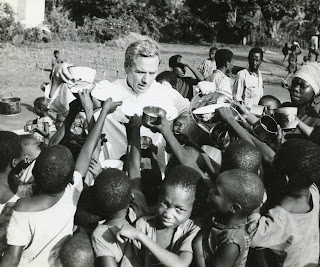
The Biafra War: Distribution of food and wood for cooking at the nurtrition centre in Umuoso, 1968. CC BY-NC-ND / ICRC / H.D Finck


By the turn of the years 1966-1970, it was incontrovertibly evident that Nigeria had committed massive crime against humanity, and had gone through a vicious journey through atrocities against its citizens, particularly the Igbo and other ethnic minorities of the then part of the country known as Eastern Nigeria. Today, it is becoming evident that nothing much has changed; and that this glaring passivity discounts in a rather frightening manner, the horror of this genocide and the ultimate impetuosity of this crime. It appears that as the world turned a blind eye in the past to this crime, it has, once again, anfractuously grown numb to these atrocities.

The shameful, but ignored history of these atrocities have never been taught in our schools for over five decades. The massacre and other related vicious episodes of Nigerian violence carried out against its citizens, and the Easterners, especially the Igbo, have become part of the history we did not learn, and the lessons we have not taken.

We have spent a considerable amount of time and wasteful energy trying to outrun the ghost of all those whose lives were wickedly taken, but the weight of the past and the haunting spirits of our sins are lurking night and day, behind us. I have, on my own, spent a lifetime trying to understand and comprehend the savagery in our past, wishing that I could turn back the hand of time and unsee the scenes that I witnessed as a child growing up; of children, men and women savagely terrorized and slaughtered simply because of their tribe, tongue or creed.

How our past informs the present in beautiful and tragic ways must be our primary concern as we constantly seek ways to correct the ills of our past and of a bewildering and checkered Nigerian history. Only when this is done and implemented to the fullest, can we build a virile and strong country.

The Inclination and the effort to learn and teach the history of the Biafra war and the horrors of it, must include the ghastly results of the ethnic cleansing, the tribal annihilation and the general hostility of the horrible era. This history when told, must also share the resilience, fortitude and perseverance of the Igbo people that survived that war. I believe that it is only in acknowledging our faults and admitting that these crimes were committed, that we can hope to grow and survive as a country. Otherwise, the omission of these events in the history of our nation must be considered as the perpetration and manifestation of a continuing oppression of the Igbo and other Easterners.

Why is it imperative that our sepulchral history must be told? Not as a politicized or polarized recounting of our past, but as pedagogical moments and as tools to help us understand our historical sordid past with an optimistic lesson that knowledge brings insights that help people change and heal.

It is claimed in several quarters that the most heinous crime against our society, apart from the physical atrocities from the pogrom in the North and some parts of the South West, and the genocide that followed in the East, is the deliberate exclusion of the teaching of the history of these events in our schools and our cultural institutions. It is rather shameful that our leaders considered and decided that the critical tribal theory of our disgraceful past have no place in the curriculums of our students. The question of why our leaders took these terrible actions remain painfully valid today. Some consider these actions to be because people may be made uncomfortable upon learning about the mistreatment of the Igbo, or may expose the attempts made by the active participants in these actions to surpress their wicked deeds and cover their perfidious pasts. Let us allow history, the clear metaphors of our lives, to be the judge.
The history of Nigeria’s sordid pasts and the senseless spilling of innocent blood preceded the January 15, 1966 military coup in which prominent politicians were murdered in cold blood. But this coup, the first military coup in the history of the country, signalled a new dimension to killings with some tribal undertones. This coup, tagged an Igbo coup because a radical and idealistic young Igbo officer led it, took the lives of many politicians of other ethnic groups, except that of the Igbo stock. Although it has long been proven by many authoritative sources that it was not a tribal (Igbo) coup, as many of the participants were from many other ethnic groups, the promoters and proponents of tribal dichotomy, have conveniently used this excuse to exact some form of comminatory actions and vengeance against the Igbo without any commiserate measures or limits.

As I grew up in the North, I witnessed and became an integral part of the history of these atrocities. In my book; Biafra, The Horrors of War, The Story of A Child Soldier, I chronicled a clear and vivid personal recollection of the crisis in the North, and all the way to the war in the East. It was a historical journey for me, and of an about to be forgotten dramatic but painful and perilous mental and physical struggle of a people. In my grappling with the horrors of the very long crisis and the almost forgotten war, with the devastating sordid and haunting imagery, I worry that our history has failed to recall and record the bitter and wicked account of our people’s journey through darkness and of a country that has gone berserk.

Today, it seems that the lessons of that war have been consigned in the dustbin of our scanty memories, and that the fissiparous forces have once again appeared, dripping with blood, in Nigeria.

Nigeria, a country with the greatest potentials for prosperity, not necessarily from its huge oil and hydrocarbon reserves, but from its vast and veritable human resources in a world ruled today by technology and digital economy, has fallen way back in meeting the threshold of global development. By general consensus, the problem of Nigeria is largely in part due to the country’s inability to learn from the history of its past, and by its refusal to utilize the opportunities of exploiting the events of the past, to reconcile with the present.

The gripping and memorable history of Nigeria’s vitriolic past that have been denied its people, is principally responsible for its failures. I believe very strongly that until we know our history, we will never have a future. To move forward, we must look back in order to solve a lot of our problems.

The crisis that led to the war in which 3 million Igbo and other Easterners died, led to the deep feeling of accumulated grieviances and general bitterness. People began to feel a lot of prejudices and repression toward each other. The prevalence of unjust and authoritarian rule emerged and began to truncate democracy and ravaging national unity which got displaced by tribalism, nepotism with primodial tendencies.

It appeared then, and even more prominently now, that we did not learn from the history of our past, and that we have deliberately not addressed several issues from our history that provided no books in our libraries, or our archives, but only those that are left in our blury and bloodied memories. The well-planned avoidance of a systematic recording and accounting of the crisis and the war, as we have no official history of these events, and as it has not been part of the teachings in our schools, is a major issue and a hindrance to the path to peace and prosperity. For these and many other reasons, the hypothesis of Nigeria as a Nation-State has been very contentious and hanging on a thin tread for decades.

Many believe, and I agree, that if we were allowed the ever so compelling privileges of studying the history of our past, especially that of the sordid history of the killings of over 3 million helpless people, our country would have hearkened to the admonitions and brutal lessons that those disturbing periods afforded us.,

What lessons do we as responsible Nigerians expect to learn from our past horrible history? There are many. This history, once it is properly told, will reveal The Truth. It will also acknowledge the harm committed by, and done to certain people, and will hold the perpetrators accountable. The lessons will point to Truth and Justice as the anchor and pillar for a strong country desiring unity and national harmony.

To know, acknowledge and to recognize the history of the crisis and of the war, is to prevent future occurrences. We all have a legitimate right to know the history of the war, and to deny us this inalienable right, is to destroy the future of the country. History may compel us to show remorse, and may also ensure forgiveness and healing from pains and horrors of our past, leading to institutional reforms and closure.

In my aforementioned book, I wrote extensively about the period in the history of our country between January 15, 1966 and January 12, 1970, as a period when darkness befell the nation. This period was marked by murder, killings, pillage and indescribable destruction. My personal experience of this parlous period, was to say the least, devastating. It is difficult to describe the effect that this war had on so many people, especially on the Igbo who were at the receiving end of the bitter and horrible experiences. Fifty years after the end of this debacle, all my thoughts – while inexplicably escaping from the hold of words and emotions – are always wandering and drifting over dark images and shadows in my attempts to meander into indescribable nightmares from the events of the pogrom, the genocide and the continuing neglect of the people who suffered through this period.

Today as many of us who witnessed this carnage ponder the devastation, all we have left are memories of horror and questions about how it was possible for people to inflict such pain and sorrow on their fellow citizens and phlegmatically go about as if nothing happened. One must also wonder why and how the history of this war was not told, preserved and conserved. The suppression of this story is responsible for the disunity in the land.
I believe that because we did not learn any lessons from this war, our country from the day that that war ended, until today, has become a wasted opportunity without any bright future. It has become a kleptocratic and an autocratic state that is very divisively dysfunctional, with political and economic structures that are not inclusive and devoid of equality. Contextualizing this country Nigeria ─– within the axiom of the crisis and the Civil War; its causes, results and outcome, ─¬─ exposes breathlessly, the level of evil, incompetent and tyrannical leadership, monstrous corruption, religious and tribal bigotry, violence and all manners of destabilizing vices.

There are so many unanswered questions about the crisis and the civil war that constantly beg for a clear resolution that many believe would enhance the protracted healing and some form of restoration and reforms.

Why have there been no answers and truthful explanation for the killings of politicians and other leaders in 1966? Who planned and executed these coups? For what purposes were these coups and counter-coups carried out? Were they military, tribal, ideological coups? The answers, and the correct answers are known by true patriots. No matter how mischief-makers may try to distort our national history, the truth can never be hidden, and it is only when it is told, and told with the boldest and truest inspiration and intention, that our country will be set free from the bondage of lies, deceit and bloodletting.

Why have there been no answers for the crimes against humanity committed against the Igbo in all parts of Northern Nigerian and in some parts of the West known as the pogrom? What about the brutal and senseless massacre of innocent Igbo citizens in Asaba; the deliberate Nigerian Government policy to blockade all routes into Biafra causing deadly starvation that took the lives of millions of children; and the other genocidal war crimes committed by Nigerian troops against innocents civilians, mostly women and the elderly during the war? These high crimes were not investigated, the perpetrators were not tried and brought to justice. The history of these ugly incidences have been deliberately discarded and buried for the sole purpose of preventing our people from knowing our evil past. How can we heal if we do not know what and why those things happened? How can we learn from our mistakes and make amends?

How can we begin to forgive if we do not learn of what happened? Remarkably, it appears that the Igbo, while not forgetting what they have experienced in the hands of their fellow citizens, may have learned the lessons of forgiveness. They may have forgiven the pains they suffered, and are continuing to suffer as members of a country they have invested heavily in founding and building. Otherwise, how do you explain the fact that the Igbo right after the war, embraced the concept of one Nigeria and began to rapidly reintegrate with the rest of the country, moving to live in faraway places like Sokoto and Maiduguri; places that witnessed their near annihilation.

Though the brutal war was fought and lost, the majority of the Igbo were ready to forgive their transgressors and those that mercilessly took the lives of 3 million of their own. This was one of the many paradoxes about that dreadful war. The ability of the Igbo to forgive the torments of that war, and their facility to regain equanimity in the wake of the unspeakable atrocities and the dehumanizing scars inflicted on them is a remarkable feat that is unparalled in the history of genocide, repression and persecution in the world. Many have posed the question of whether there is a special attribute in the Igbo DNA that activates a forgiving nature or spirit, and if there is a cultural disposition in them that prevents them from harboring any form of hate for their tormentors? Others think that they possess a God-given ability to endure agregious cruel acts and aggravated malice perpetrated against them without reciprocating in kind. But for how long will they continue to uphold this heteronymous disposition of willingness to forgive?

My punctilious and scrupulous dissection of this Igbo forgiving spirit, serves as a worthy exercise for the rest of Nigeria. It is a virtue worthy of emulation, because I believe that forgiveness serve as an instrument for stopping wars and promoting lasting peace and prosperity; that forgiveness entails a divine reciprocity, for when we forgive others, God forgives us. The lesson learned from the Igbo spirit of forgiveness, is an amazing lesson of how to create spiritual, physical and fiscal growth for our country.

But how do we forgive when we have been denied the history and knowledge of what transpired? How do we stop these atrocities when we do not even recognize that we have made surreptitious mistakes? How do we grow if we do not learn from our history and take lessons from our fugacious and perfidious past?

I will dare, with some measure of trepidation, to say that the calamitous and lugubrious condition that our country finds itself today is spiritual and karmatic. That the failure to admit and atone for our sins may be responsible for the many killings going on in virtually all parts of Nigeria. As trivial as this postulation may sound, I drew some of my conviction after I spoke to my father just before he passed at the age of 100 years a few years ago. I asked him why our country was falling apart so rapidly. With tears in his eyes, the old man began to explain that the country missed a great opportunity when after the war it failed to reconcile the waring factions, and truly rehabilitate the East. He regretted that a country he fought so hard with others to gain independence for, turned against him and his people.

When I noticed that my father was reluctant to discuss this issue further, I prodded and pressed him, realizing that his vast experience as one of the founding fathers of our country will be valuable in solving some portions of our dilemma. I asked him what he did after the war to influence the leaders then. He told me how he had met three of his closest friends and allies from the North; Malam Aminu Kano (who was the Federal Commissioner For Communication), Alhaji Ado Bayero (Emir of Kano) and Alhaji Maitama Sule. They all agreed that the war was unnecessary and that the outcome was disastrous for the Easterners. They agreed with my father, that there was a dire need to rehabilitate and reconstruct the East and its people. My father regretted that despite the good intentions of these men, the rest of the country was content on carrying out further spurious and punitive actions against the Igbo and other Easterners. The profundity and import of this brief interjection here, cannot be lost to our present day predicaments, as we ponder the wise words of a man who was knocking on the gates of heaven on his way to meet his ancestors.

I am optimistically hopeful that this write-up will not be negatively provocative and will not be viewed as an apologia for any tribe, religion or region, but as a chary and sorrowful cry of a human being who was entangled in the bilious and sickening incidences of our past. For those who are insouciant and unworried about these issues, may they never feel the pains and agonies of those that perished in the hands of their fellow human beings. May they never father children who were made orphans and left in desolation. May the dead bodies of their relatives never be dumped and abandoned in the forest of despair and on lonely roadsides, left to rot and to be eaten and devoured by vultures and wild animals. May they never suffer the fate of the Igbo and other Easterners whose mothers were made widows, and who could not provide breast milk for their young babies simply because they were themselves famished, malnourished and dying from starvation, torture, bullets and bombs, for sins they knew nothing about, or of.

May all mankind and people of good conscience; all people of our Creator, pause for a second and share the enormous burden of our past in recognizing and cherishing the contents of this story and the agonies suffered by many in our land. May we all be spared this experience and make ourselves tools and instruments for the repair of our past ugliness and our impending doom as our nation is engulfed and encircled in cataclysmic plundering, wanton rapings and kidnappings, killings and other traumatic decimations of no mean proportion.

These days, it is tough to get a supermajority of Nigerians to agree on the color of the sky, much less on the politically and ethnically delicate and sensitive topics of the ignominious pogrom and the civil war. Will the vestiges of these issues pollute our already convoluted political atmosphere? My clear wager is NO. And it is a pertinent and perspicuous NO. What bothers me, and should bother many other well-meaning Nigerians, is how we have incinerated our history to the point of overhandedness that cynically and with such agony, created silly, but painful diversions from the grave injustice that has been visited on a vast number of our fellow citizens.

I think that denying us the history of our past is in all circumstances, so injurious and cruel, and a shameful defeat of our constitutional and moral principles and the ultimate defeat of the triumph of equity, fairness, empathy and justice.

I am not a Historian. I am, but a conscious citizen who realizes that the only way we can all live a peaceful life is by us all recognizing our past mistakes. We must write and talk about them, relive and savour them, and use them positively to direct our present and future actions. For those who think that revisiting and studying this history is so complicated and dangerous, I invite them to consider that the price of freedom and emancipation, is embedded in the knowledge of truth, and by a reminder that freedom in this Country has never meant and felt the same for everyone and has more often than not, been conditional.

The intentional rush to obliterate the history of our past by our leaders who laboriously paint the mythical picture of a “one-Nigeria”, “a city upon a hill” or a site of moral justice, is hopeless and lacking in clarity and authenticity. In our collectivity, I reckon that we have mostly lost sight of the possibility that exist in the hidden and marginalized histories of Nigeria.

We MUST tell the stories of our past. This story will set us FREE.

The history we didn’t learn, and the lessons we didn’t take are responsible for the anachronism that our country has become today.

-----------------THIS DAY

Saturday, January 8, 2022

A Reckless Israeli Film Crew In Nigeria And The Igbo Jews Who Paid The Price

Irish missionaries distribute foods to malnourished Biafran children. Image via IMDB/Biafra-Forgotten Mission


BY IMAN SULTANA

In southeastern Nigeria, many Igbo, members of Nigeria’s third-largest tribe, believe they are of Jewish ancestry. Some of their traditions, such as circumcision and menstrual rituals, resemble those of Talmudic Judaism. The Igbo population is estimated at 30 to 35 million. Dozens of communities have become fully practicing Jews, and countless more incorporate elements of Judaism into a syncretic belief system. While the tribe’s origins remain unconfirmed, Igbo Jewish oral tradition traces the Igbo back to an African Hebrew diaspora that resided near the Niger River after the 722 BCE expulsion of the Israelites from the northern kingdom. This predates even the Babylonian exile of 586 BCE.

The Igbo are not accepted as Jews by the Israeli government. Consequently, they remain subject to ongoing threats, including severe persecution in the wake of Nigeria’s liberation from British colonialism. For example, between 1 million and 3 million Igbo were slaughtered en masse during the Nigeria-Biafra war that lasted from 1967 to 1970.

Early last summer, an Israeli filmmaker went to West Africa with a film crew to document Igbos’ stories. While there, the crew was arrested in Ogidi by the Department of State Services (DSS) on July 9 and imprisoned for approximately 20 days without trial. An elderly Igbo woman, who had welcomed them, was also arrested by the DSS and imprisoned alongside the team. After the international community got involved, the filmmakers were released and subsequently returned to Israel. A Nigerian film director and cinematographer was then arrested at the end of July for associating with the filmmakers.

Ambitious filmmaking projects that feature marginalized communities are admirable. However, outsiders must fully understand the specific risks to these communities. They must recognize when their efforts do more harm than good to the locals, lest they endanger them.

This time, heavy press scrutiny and extensive international support mitigated the worst. The filmmakers, who got the lion’s share of attention, were released within three weeks. The locals received far less media coverage, despite being the subjects of the film, and lacked the support of international embassies. Although elderly, the Igbo Jewish woman was detained for a longer period of time. Unlike the Israelis, she was not given hospital visits or Chabad kosher meals.

While the Nigerian government clearly violated basic human rights, the filmmakers also contributed to the fallout. They traveled to Nigeria claiming to aid the locals and while there, frequently posted about their experiences on social media. Some of their posts contained overtly political undertones and disclosed identities of specific Igbo Jews. One Instagram photo showed the filmmaker with Igbo King Eze Chukwuemeka Eri and the following description: “Israel X Igbo are locking arms.”

Irrespective of intent, this and other posts could easily be interpreted as promoting a political alliance between Israel and the Indigenous People of Biafra (IPOB) or other groups which are viewed as separatist by the Nigerian government. On paper, freedom of speech is protected under Nigeria’s constitution. In practice, Nigeria typically censors certain types of ideas, including discussions about ethnicity, political diversity, and differing views of morality. In other words, Nigeria is not Israel, the United States, Canada, or Australia; protections surrounding freedom of speech, legal representation, and other rights expected in the developed world are not widely available.

Whether or not this is moral or ideal in our eyes, it is a reality that must be recognized. The Igbo Jews have already suffered immense harm from their own government, as well as from neighboring ethnic groups. The film crew’s reckless actions further risk an already isolated and vulnerable population. Thus, the filming was in direct contradiction of the Talmudic value of communal responsibility toward the well-being of one’s fellow Jew. This is core to the Jews as a nation and a people.

The filmmakers have repeatedly condemned the Nigerian government for the arrests, without taking time to reflect on the ways in which they themselves may have brought harm upon the very community they claim to support. Two local Nigerians are known to have suffered as a result of the film crew’s lack of cultural awareness and sensitivity. The fallout of this incident could cause harm to many more.

Although it may not be possible to reverse this particular situation, it is possible to prevent similar incidents from occurring in the future. First, this film crew can reflect on the ways in which they acted irresponsibly, as opposed to milking the story on YouTube and painting the Nigerian government as the villain in an attempt to absolve themselves. Second, they can make a public statement acknowledging the specific ways in which they contributed to the situation. Third, they can do their due diligence in educating themselves about their countries of interest to ensure that this kind of voluntourism mentality does not persist, should they continue their work. Far be it for one Jew to add to the suffering of another.

This post was co-authored by Rebecca Sealfon who is a Reconstructionist Jewish writer and social media consultant who lives in New York City. She started and maintains a popular Israel-Palestine peace forum called Unity is Strength, which receives more than 1,000,000 views per year and attracts writers from Israel, Palestine, and all over the world. Rebecca has published in the New York Daily News, Smithsonian magazine, and the Daily Beast, as well as appeared numerous times on national television,


ABOUT THE AUTHOR

Iman J. Sultana is completing a Peace and Conflict Studies graduate degree at the University of Waterloo. Her specialty is conflict zones in MENA, including Israel-Palestine, Kurdistan, and Yemen. She is also interested in environmental-based peacebuilding and social entrepreneurship. In her free time, Iman administers online peacebuilding communities.

Tuesday, December 14, 2021

FASHION: Spring-Summer 2022: Emmy Kasbit


Fashion designer Emmanuel Okoro's "Emmy Kasbit" men's wear new collection for Spring/Summer 2022 collection shot at the National War Museum in Umuahia, Abia State, a heritage site and memorial of The pogrom and Biafran War. 

Nigeria’s Second Civil War

BY SOLA EBISENI
VANGUARD

Boko Haram Islamist Group


I have always wondered at the often-quoted statement that no country survives two civil wars. I do not know the origin of that theory but simply assume that it was based on some empirical evidence by people to whom any form of security or military expertise may not necessarily be ascribed. After all, one would justifiably say there have been two World Wars, yet the world is probably stronger for it.

Now I know better, that the ongoing civil war, which daily gains traction in space and velocity, is very much unlike the earlier one over Biafra which in itself is still ever-present. The raging civil war is also unlike the 16 years (1877-1893) Yoruba Kiriji War, reputed to be the longest civil war in history.

Kiriji, though an internecine war among various tribal states of the Yoruba ethnic nationality, the contending powers knew one another and the causes of the conflict. The coastal Yoruba states of Ilaje and through Ikale and Ondo territories provided the alternative and circumventing routes for the supply of arms to the eastern Yoruba states outside the Egba-Ijebu which the Ibadan was used to. Only the intervention of the British, an armistice entered at ImesiIle in 1886 by the warlords, finally brought peace.

The civil war of 1966-1970 was the first official war since the different constituent ethnic nationalities were grouped together into the modern sovereign state of Nigeria. The war was very clear in its cause and main theatres. The rest of Nigerians were recruited into a Nigerian army fighting their compatriots mainly in the South East and parts of South-South some of whom were actually moles on the Biafran side.

That they were able to hold out for 30 months with the relatively humongous arsenal of the rest of Nigeria speaks volumes of the Ndigbo, not necessarily of its much-vaunted Ogbunigwe military hardware but the pride of the most republican African race. If Nigeria ever thought Biafra was dead with the surrender on January 15, 1970, of Philip Effiong, Ojukwu’s then second in command, events since then are only suggestive of a nation sitting on several kegs of gun powder.

When Muhammadu Buhari took over the Presidency in 2015, not a few people forgot his previous actions and mindset which were absolutely indicative of his incapacity to perform the task of keeping Nigeria one. The Yoruba, especially, would not easily forget the unjustifiable invasion of Awolowo’s house and seizure of his passport to prevent him from leaving Nigeria even when he was then not in any public office.

His lieutenants, as governors, who were absolved by a military tribunal, were never released from detention but re-arraigned by the Buhari junta, two of whom, Professor Ambrose Alli of the old Bendel State and Chief Bisi Onabanjo invariably paid with their lives. But all the above paled into insignificance as the nation was most expectant of a saviour to deal with insecurity which was then essentially confined to the North East territorially.

Contrary to the noise being made by some government spokesmen, including some of the cabinet members who still manage to risk their integrity speaking publicly for this administration, the attitudes of Nigerians today is simply that they want to live. Whatever impact the dollar has on the economy, the people no longer care; they just want to access their farms, if only for subsistence operations until the current hell comes to an end.

Rotimi Amaechi may decide to extend his rail tracks beyond Maradi even to Niamey, even where there is no longer passage from Sokoto Zamfara; the Chief of Naval Staff may choose to avoid the deep sea at the coast of Ilaje in Araromi or Erunna and site his naval base in Kano; Nigerians scrutinizing the nepotistic list of Buhari’s security chiefs currently on tour of the tip of the North West of Sokoto and Zamfara no longer bother if they are all from Daura; they just want to sleep, even if it is with one eye closed for now.

This current civil war has no precedent in history. It has shattered all the myths we used to hold dear. It has thrown up the Middle Belt tribes most vociferously craving its strict identity tucked within states deliberately created to sandwich them within states they could never aspire to govern.

As at the time of writing this on Monday afternoon, the press is agog with never-heard-of Hausa ethnic nationalism. The press reported the emergence of “Hausa Association of Nigeria, also known as Kungiyar Hausawan Nijeriya or KUNHAN, which in an open letter called on President Muhammadu Buhari to resign from office because of the obvious failures of his administration”, adding that “the Buhari regime spared Fulani terrorists and bandits, but went after agitators such as Nnamdi Kanu, the detained leader of the Indigenous People of Biafra and Sunday Adeyemo, aka Sunday Igboho, Yoruba Nation agitator”.

The Association specifically identified “Turji and Co as a high profile deadly Fulani terrorists but still nowhere to be found because they are just a threat to Hausas rather than your sovereignty while Nnamdi Kanu and Sunday Igboho could be found even beyond our territory.”

They listed all the vices of destruction of their means of livelihoods, including the violation of their sisters, wives and mothers which they unpretentiously put at the door steps of some members of the same ethnic nationality the rest of the country has been complaining of since the advent of the Buhari administration to no avail. For those experts, who reasoned that no nation ever survived two civil wars, this intractable and undefined war if allowed to blossom may sing Nigeria’s nunc dimitis.

On APC manifesto and restructuring: It is not part of our culture in Yorubaland for little boys to interfere in the dialogue of elders. So no temptation will make me dwell on some of the issues raised in Chief Bisi Akande’s just released autobiography, My Participations. I was only curious on some of the issues that concern the whole nation which might expose the Yoruba to ridicule on important national affairs. I was dumbfounded to imagine Pa Akande claiming APC never promised Nigerians restructuring and querying the definition of the concept.

I took a look at the manifesto of the party online and the first item therein is that the party shall “initiate action to amend our Constitution with a view to devolving powers, duties and responsibilities to states and local governments in order to entrench true Federalism and the Federal spirit”.

I doubt if the APC would embark on matters which it found impossible to define, even at the time Baba Omokekeke was the national chairman. If restructuring is not about reinventing true Federalism, what really is it?

As a reminder to the former Governor, it was the insistence on the fulfilment of this promise of ensuring the restructuring of Nigeria on the path of true federalism by the citizens, that forced the party to set up the El-Rufai Committee on True Federalism in 2017.

We do not insist on Chief Akande’s understanding of restructuring; we do not even bother if he still recollects that the agitations of NADECO, led by the Afenifere, and its insistence on restructuring through the instrumentality of a Sovereign National Conference, that ultimately provided the platform that made him Governor of Osun State in 1999. All we ask of Chief Akande and the APC lords is to take steps to implement the El-Rufai Report before the 2023 elections.

The PDP members in the National Assembly who have been canvassing for the implementation of the Jonathan 2014 National Conference will readily support the majority APC on its own report. They are both of a kind with the Rufai Committee drawing absolute inspiration from the 2014 edition.

Lest I forget. I was a delegate to the 2014 National Conference, then in my early fifties. Overwhelming majority of the about 84 South West delegates were below 60. While we have less than 20 percent in their 70 and above, we have far older compatriots from other climes.

Pa Edwin Clark, perhaps older than any of the Yoruba elders at the Conference, was the leader of the Southern Nigeria caucus. Alhaji Tanko Yakassai fall into that category, older than Ayo Adebanjo and a convenient uncle to Chief Olu Falae. There was also the Chairman of the Conference, Justice Legbo Kutigi, a former Chief Justice of Nigeria of blessed memory.

Time and space are not on my side, but it is important to inform that the APC, particularly in the South West, deliberately shunned the Conference, except for their Governors who sent three delegates each

In spite of their braggadocio, the Committee set up by the APC, led by El-Rufaicould not go outside the unassailable 2014 CONFAB report

Itsekiri Yoruba origin echoed at Pa Pessu’s 10th birthday in Warri: Over the weekend, our Leader, Chief Ayo Adebanjo, commandeered Abagun Kole Omololu, the National Organising Secretary and I to represent the Afenifere in Warri at the centenary birthday of Pa Daniel Solomon Tuedonjeye Odeworitse Pessu, a former Chief Magistrate, parliamentarian and political juggernaut of the Awolowo school of politics.

It was a celebration that involved noble men and women from all walks of life trooping in and out of the centenarian’s modest residence at Pessu town. Political bigwigs, particularly from Delta State and the celebrated Itsekiri nation, graced the occasion.

As soon as my presence was announced as representing the Afenifere, as Abagun could not make it for flight difficulties, Papa got excited and asked that I sat on the side of his chair. He baffled me with the remembrance of the veterans of the Awolowo political family and the exploits of yesteryears.

Papa DSTO, as he was warmly called, insisted I addressed the gathering before the end of the event. I was quite at home because the Itsekiri tongue and my Ilaje’s shared mutual intelligibility. As I addressed the crowd and reminded them of the Yoruba origin of the Itsekiri, the Iwere children were ecstatic, so confirming their origin. And when I made them understand my own Ilaje background, I heard the shout of “omere”, attesting to the fact that we are siblings.

I left Pessu in high spirits. Papa son, Olu, who himself is a member of the Afenifere was a fantastic company.

Monday, December 13, 2021

Nd'Igbo: 10 Years Without Ojukwu


BY MAGNUS EZE AND GEORGE ONYEJIUWA


Igbo hero, Dim Chukwuemeka Odumegwu Ojukwu, who led the people of defunct Eastern Region to a 30-month war between Biafra and Nigeria, died on November 26, 2011. In commemoration of his death, founder of the Movement for Actualization of the Sovereign State Biafra (MASSOB) and the Biafra Independent Movement (BIM), Chief Ralph Uwazuruike, has consistently hosted the Ojukwu Day on November 26 at the Ojukwu Memorial Library built in honour of the Ezeigbo Gburugburu, in Owerri, Imo State capital.

The celebrations were usually marked with fanfare and have attracted the Igbo and other Nigerians from far and near. In the last decade since the Ojukwu Day began, several important personalities from across Nigeria had graced the event including the late founder of Odua People’s Congress (OPC), Dr Fredrick Fasheun; Major Al Mustapha, Chief Security Officer to the late Military Head of State General Sani Abacha and the 1996 Long Jump Olympic Gold medalist, Assistant Commissioner of Police, Chioma Ajunwa.
Breaking News, Nigerians can now work in Nigeria and get paid in US Dollars Click here to apply today .

The late Nri monarch, Onyesor Obidigwu; former Secretary General of Ohanaeze Ndigbo Worldwide; Uche Okukwu; Niger Delta activist, Asari Dokubo; former Ohanaeze Ndigbo President General and Secretary General, Dr Dozie Ikedife and Col. Joe Achuzie (Rtd) respectively as well as politicians had also graced the memorial.

Ojukwu Day has become a veritable platform where issues militating against Ndigbo are discussed and solutions proffered. Chairman of this year’s event was no less a person than Afamefuna Ojukwu, son of Bianca, widow of the late Biafra leader. The younger Ojukwu who has become the youngest chairman of the event was fittingly ushered into the arena by the Ijele masquerade, the biggest masquerade in Igbo land.

Painfully, no South East state government has in the past 10 years identified with the Ojukwu Day, this was condemned by Afamefuna. He accused governors of the five South East states of abandoning his father in death. His mother, Bianca, had raised similar issue in the past. She alleged that Governor Chief Willie Obiano of Anmabra State has not given her husband the due recognition, but using his name during elections.

Afamefuna lamented governments of states, which his father fought to defend their people turned their backs on him after his burial. He praised Uwazuruike for keeping Ojukwu’s name alive at all cost and urged the Igbo to use the 10th anniversary of his exit to look back and look deep, while not forgetting the vision planted so long ago:

“Ten years ago, when my father, Ikemba, Eze Igbo Gburugburu left us, I was a child. Yet, I can never forget the outpouring of love that you, ummu nne m, showed him. In life and in death, you stood with him.

“Since that fateful day 10 years ago, Okenwa, Chief Ralph Uwazuruike, who in his lifetime took the baton of fighting for our people, has also taken it upon himself to celebrate my father year after year. As he honoured the Ikemba in life, he has continued to honour him in death.

“In these almost 10 years, no state governor in the South East has done this incredible and noble task, despite the fact that Eze Igbo Gburugburu was our leader through a war to save us from the genocide that faced our people.

“Today, we live in a world where many prefer to forget the battles waged to bring us this far, the sacrifices of so many in this unrelenting quest to end our marginalisation and the continued fight for a just and equitable state that we can live in without oppression. Nobody without passion for his people and a spirit of sacrifice can lead us to the Promised Land, no matter how genuine their intentions may be.”

Deputy Governor of Anambra State, Dr Nkem Okeke, who was the special guest of honour, also commended Uwazuruike: “We are here today to honour the memory of a great man, a true son of Ndigbo. He was a brave man with integrity who loved his people and stood for truth all his life. I am here to show solidarity to his family and I will continue to stand by them.

“Ndigbo are great people and all we need is unity of purpose and with that we can achieve whatever we want. We must stand together and if we don’t do that, we will never achieve our desired position in Nigeria.”

The guest speaker, Prof Proteus Uzoma, presented a paper titled; “The Marginalization of Igbo Nation and the Call for Nigerian unity –The Way Forward.” He noted that the Igbo nation has continued to face enormous political and economic challenges since the instigated and imposed civil war by the General Yakubu Gowon-led Federal Military Government.

He asserted that Nigeria would only be considered normal in terms of where Ndigbo stood vis-a-vis the other ethnic nationalities politically and economically. The Professor of Philosophy noted: “The Igbo people in reality experienced an overwhelming level of disadvantages based on public policies that seemed crafted to undermine their ability to maximize political and economic potentials.

“The restructuring of Nigeria to create more states for the northern states to the detriment of the Southern Nigeria, especially, the South ast was not only an impediment politically; it impacts the economic potentials of the Igbo people negatively.

“Such policies as the failure to rehabilitate the Biafra land after the war, the 20 Pound flat refund to any Biafran who wished to convert the old currency, or deposits with bank prior to the war; the Nigerian Enterprises Promotion Decree of 1972, also known as Indigenization Decree, federal character principle, manipulated population census, creation of states and local government areas in favour of the Northern Nigeria, deliberate underuse of seaports within the Igbo axis, lack of standard international airport and other exploitative actions speak volume.

“These formed many overt and indirect actions to diminish the ability of the Igbo people to compete on a level-playing ground with other major ethnic groups. This has given rise to the current agitation in the South East for equity, justice and fairness.”

He posited that the only remedy to the current agitation both in the South East/South West is restructuring of Nigeria into a true and real federal polity as well as conceding the presidential slot to the Igbo in 2023 for equity and justice:

“The crux of the matter lies in fact that the Nigerian Federal Government has too much powers, plays dominant roles and overbearing influences that have been grossly abused, thus leading to intensified calls for restructuring, coupled with suppressed frustrations and resentment during the military interregnum; resulting in inter-communal violence now threatening the peace and unity of Nigeria.

“Come 2023 and in accordance with the gentleman’s agreement among the Southern and Northern Nigeria in 1998, power must rotate to the Southern Nigeria, and since the South West and South-South have taken their own shots to the Presidency since 1999, ‘to-be-and-not-to-be’ is the question. Will a South-Easterner be the next President of Nigeria or not?”

Bianca in a vote of thanks lauded Uwazuruike for ensuring that the memory of her late husband was kept alive: “Some other person may have given up after two years. But this is the tenth year and I am grateful for what he has been doing including the Ikemba Ojukwu Library he built.”

She called on President Muhammadu Buhari to heed the appeal of eminent Igbo elders led by First Republic aviation minister, Chief Mbazuluike Amaechi, who recently paid him a visit to ask for the release of detained leader of the Indigenous People of Biafra (IPOB), Nnamdi Kanu.


Saturday, November 13, 2021

NNAMDI AZIKIWE'S OPINION OF OJUKWU AND BIAFRA

Benjamin Nnamdi Azikiwe, governor-general of Nigeria and member of the Queen's Privy Council, on the day of his appointments, November 16, 1960. Image: Popperfoto via Getty

AZIKIWE'S OPINION OF OJUKWU/BIAFRA


"Yes. I played a prominent role in Biafra for the unity of the country in order to restore peace and bring about unity of the country. That’s the role I played. I advised Ojukwu. I said well look, you have declared secession.

What we should do is to get the elder statesmen and women of the nation to reconcile you and Gowon. I said by declaring secession, you get so many people who do not believe you to remain there.

You see all of us were interned. As we were interned then, we couldn’t express our own views as we see it because, he made Decree Number 5 which vested absolute powers in himself and if you were against his views, it then constituted an act of subversion and the penalty was death by shooting.

Well, it was a war-time measure and that is understandable. So, I advised him. I said go to the conference table and iron out your differences. Allow elder statesmen and elder stateswomen to bring the two of you to the conference table and settle this matter so that there will no more be civil war and the country may be united. He agreed. But Gowon was advised by the Ministry of External Affairs to insist on pre-conditions .

That is that before he could negotiate with the secessionists, that they must accept certain terms; accept the 12-state structure and all. So, it was quite obvious that the Federal Government wanted Biafra to come to the conference table with their hands tied and their feet tied. But they won’t be free agents.

That was the diplomatic mistake on the part of the Federal Government. So, when they did that, then Lt- Col. Ojukwu told me, “How can I go to the conference table based on these ultimatums?”

Still I advised Ojukwu to go to the OAU and ask them to use their good offices to settle the dispute and that we should avoid loss of lives. He accepted my advice in good faith.

Then he said, ‘Now, you have some heads of state in Africa who are your friends, would you mind going to appeal to them to use their good offices so that the Nigerian civil war could be an item on the agenda for OAU summit in Kinshasa?’ I said I would gladly go. So he sent me to Monrovia as a peace envoy.

I went there and met my friend, President Tubman. Tubman expressed his willingness to use his good offices. He told me he would see another mutual friend, the late Haile Sellassie, Emperor of Ethiopia, and both of them would see that the civil war was placed as first item on the agenda of the OAU Summit in Kinshasa.

I returned and broke the news to Ojukwu. He was very pleased.

Then, when the OAU summit opened, Chief Awolowo, as Vice-Chairman of the Federal Executive Council and Commissioner for Finance, led a strong Nigerian delegation to Kinshasa and raised a very strong objective on the Nigerian civil war being placed as an item on the agenda on the grounds that according to the OAU Charter, this was a domestic affairs and member states were precluded from interfering in the domestic affairs of each other, which was really sound according to international law.

But we wanted to solve it in the African way, to use mediation and conciliation to bring two warring brothers together.

The OAU accepted the submission of Chief Awolowo and so it was not put into the agenda. Well, history will show now between Chief Awolowo and myself, who actually accentuated the war. I was trying to get the OAU to settle the dispute so they could go to the conference table and he was thinking of legalism, that it would amount to interference in the domestic affairs of a member-state.

But meanwhile here you have two brothers killing each other.Well, Ojukwu told me, I have done my best. You see, Nigeria was relying on law and we are relying on humanity.

What’s next? I said why not try other heads of states and see what could be done to bring about peace? He then said he left the initiative with me. I suggested going to some heads of state and see what can be done. But his advisers led by Dr. Nwakama Okoro suggested recognition.

That if we can get other states to recognize Biafra, maybe the hands of Nigeria may be forced to go to the conference table.

Well, I thought that was a sound idea and I placed my services at their disposal so as to meet my friends.

We had in mind President Senghor of Senegal, President Houphouet Boigny of Ivory Coast, President Julius Nyerere of Tanzania, President Milton Obote of Uganda, President Kenneth Kaunda of Zambia and of course Francois Bongo, he is now Omar. He now has become a Muslim. He was then a Christian.

The long and short of it all was that I and these great African statesmen agreed that if Gowon persisted with pre-conditions, then they would accord recognition to force the hands of Gowon to go to the conference table and bring about peace.

That was one.

Two, Gowon had already predicted that the war would end on March 31 and as far as these African statesmen were concerned, these killings and atrocities did not do any credit to the image of Africa and as such what should be done was to stop it as soon as possible.

Therefore if the war didn’t end by March 31, then the propaganda of ‘Biafra’ that it was an act of genocide would be justified. And they didn’t want to accept that.

I went on this mission and succeeded in persuading these heads of state to agree to give recognition just to force the hands of Nigeria, diplomatically speaking, to the conference table.

President Senghor said he couldn’t because the majority of his supporters were Muslims and rightly or wrongly they felt it was a religious war. And he said well, if he granted recognition, then his government would fall.

But he supported the idea of forcing the hands of Nigeria to the conference table. Houphouet Boigny was prepared, provided his people backed him. Ditto for the others except Milton Obote who told us that Prince Mutesa and the Bagandans wanted to secede and he couldn’t support secession when his own state was confronted with similar problems. It left four of them.

That is, President Nyerere, Houphouet Boigny, Kaunda and Bongo. They agreed on the understanding that the war did not end by March 31, 1968 and pre-conditions would be removed to make it easy for both Ojukwu and Gowon to go to conference table.

So they granted recognition and it worked like magic because immediately after this, Dr. Okoi Arikpo, who must be presumed to be responsible for this diplomatic blunder (he was the Commissioner for External Affairs]---a good man no doubt, but he is a very poor diplomat in my own humble opinion - announced to the outside world that Nigeria would no longer insist on pre-conditions and that he was prepared for conference table but the war did not end on March 31 and so, they left the impression, you see, that Nigeria wanted to annihilate the Ibos.

You noticed the Soviets gave Nigeria more arms and Nigeria used those arms to destroy the secessionists. Here, I came in again and I advised Ojukwu. I said look since Gowon has withdrawn the pre-conditions, go to the conference table and argue the points so as to pave way for a peace conference.

It was agreed that they should meet in Niamey. I advised Ojukwu to go. Again Gowon was ill-advised so he couldn’t come.

At Niamey here was Ojukwu. I was on his side. Gowon wasn’t there but Haile Sellassie, Hamani Diori, Tubman and General Akran were there representing OAU. So, I told Ojukwu, I said now you have an upper hand.

These respected leaders of the OAU were there. I had briefed Ojukwu. I said ‘look your line of approach is to express appreciation for what the OAU was doing in order to maintain peace in Africa but you were prepared to co-operate and you are leaving the whole matter in the hands of the OAU to see what could be done to bring an earlier cessation of hostilities.

I said just say that and thank them and sit down.Now Gowon didn’t attend. He sent a junior man, I think Alhaji Femi Okunnu or so, to represent him. And they didn’t even attend this conference at which the four heads of state presided. It was only the Biafran side.

So Ojukwu won a diplomatic victory and you know Ojukwu is a very good speaker if you give him all the facts. He was a good public relations expert and he won. He said, ‘well if Gowon was sincere why did he spite such great men and didn’t attend?’ That worked.

They agreed that Nigeria could be contacted so that we have a peace conference in Addis Ababa. It was a diplomatic victory for Biafra and so we returned to Biafra highly elated. And Ojukwu insisted that I should accompany him to Addis Ababa.

Then something happened. Some of his advisers felt that I was becoming a victim of compromise and that I was a bad influence. That all I was trying to do was to make Biafra impotent. They told Ojukwu that Biafra was holding its own militarily. And why should we want a peace conference?

That he should be very, very careful with me, especially as an Onitsha man because they thought that I was using him as a means to give publicity for myself internationally and that time will come when people will look more to me than to himself.

Well, as a young man, human, he fell for such flattery. I don’t want to mention all the names, but particularly influential in swinging his opinion at that material time was Mr. C. C. Mojekwu, who was based in Lisbon. Then Mr. Matthew Mbu was our Commissioner for External Affairs and he himself did as much as possible, but then he realized that he was having someone who has power of life and death over everybody.

So, we went to Addis Ababa and on the night before the conference, Matthew came to my bedroom at about 10 in the night. He said, “Do you know that all we have done, this man is going to undo them tomorrow?’ I said ‘No’. Then he brought out a printed version of a long speech.

The world press said it lasted for 90 minutes.

He [Ojukwu] went back on everything we discussed. He attacked the United Kingdom, the United States, the Soviet Union - all the nations of the world and the OAU, and said that they were misleading us and that the sovereignty of ‘Biafra’ was not negotiable.

We went to the conference. I sat next to him. I thought that he was going to speak in accordance with the spirit of Niamey. But he spoke for 90 minutes and he just got the whole place upside down.

Naturally, Tony Enahoro - he led the Nigerian delegation - replied in kind and so we were back to square one. So, when we returned, I advised him. I told him that I was surprised at what he did but it was not late. He said, ‘The sovereignty of Biafra is not negotiable and if anybody should try to compromise that sovereignty, then it will be an act of subversion.’

Well, that was quite clear to me so I said, ‘Your Excellency, you still have Port Harcourt and you can still bargain from position of strength - after all, the main issue in the civil war is oil and they say that in international politics, oil is combustible and as you have a combustible situation you can begin from the position of strength’. He said, ‘No, Port Harcourt is impregnable.’ ‘Very well, Your Excellency,’ I said. I went back to Nekede where I had been in protective custody since February, 1968. Two weeks later, Port Harcourt fell.

He sent for me. I said, ‘Well, Your Excellency, I did warn you. You cannot now negotiate from a position of strength but having received recognition from four states, we can still use them to see what we can do to appeal to the outside world.’ He said, ‘Very well, I think you should go to the United Nations to seek for recognition.’ I said, ‘Your Excellency, let us wait until after OAU summit in Algiers and find out what Africa thinks.’ In the meantime, I went to Tunisia to see my friend Habeeb Bourguiba of Tunisia. He wasn’t quite well, so we moved from Carthage to Hermit where he stayed. Ojukwu had always said the civil war would be won on the battlefield and not on the conference table, and Bourguiba didn’t take kindly to that. He said don’t you people advise this young man? I explained to him that I have done everything I could to advise him, but he insists on going to the battle field.

So we crossed our fingers awaiting the verdict of Algiers. You know it was decided by 33 to 4 in favour of Nigeria. I advised Ojukwu that to go to the United Nations to seek recognition would be unrealistic since Africa had decided by 33 to 4 in favour of Nigeria. I said Nigerian envoys, the Nigerian delegations, would just percolate the membership of the United Nations and they would frown at the whole thing. He insisted. I was then in Paris. I wrote him a letter. I said:

‘Since you refuse to go to the conference table to negotiate for peace, since you prefer that the civil war should end on the battle field and not on the conference table; since you said that the sovereignty of Biafra is not negotiable, I am afraid I cannot continue as a peace envoy because you have destroyed all the vestiges of any optimism for peace.

Therefore I am relieving myself of my services as a peace envoy. I cannot continue as a peace envoy. I cannot continue as a peace envoy because you have let me down. You left me under the impression that if I succeeded in getting recognition you will go to the conference table. You got four recognitions; you did not go to the conference table. I am therefore going to London on exile.’

I went to London in voluntary exile and the British government granted me asylum. I do not see how anybody could say that I ran away from my country.

I crossed the Atlantic 46 times, trying to negotiate with various heads of state so that they could grant recognition or make OAU to settle the dispute. How could the head of state turn round now and accuse all those who were politicians in pre-1966 and post-1966 as being responsible for the downfall of the republic?

I did my best to preserve the unity of Nigeria and also to preserve the lives of old men, able-bodied men and women and children but I failed. What could I do? I went on free exile and they keep saying that I was among those responsible for the downfall of the republic. I plead not guilty".

Excerpts from the interview he granted to New Nigerian Newspapers, 1979, as Presidential aspirant under the platform of Nigerian People's Party.


Friday, July 2, 2021

Nigeria’s Northern Elders Forum: Keeping The Igbo Is Not Worth A Civil War


BY JOHN CAMPBELL

On June 9, following a closed-door meeting, the Northern Elders Forum (NEF) issued a public statement that the Igbo-dominated southeast should be allowed to secede from the Federal Republic of Nigeria if it was necessary to avoid a civil war. NEF spokesman Hakeem Baba-Ahmed said “the Forum has arrived at the difficult conclusion that if support for secession among the Igbo is as widespread as it is being made to look, and Igbo leadership appears to be in support of it, then the country should be advised not to stand in the way.” His statement continued that secession was not in the best interest of the Igbos or of Nigerians. Rather, all should work to rebuild Nigeria. But, blocking secession “will not help a country already burdened with failures on its knees to fight another war to keep the Igbo in Nigeria.” The statement also suggested that northerners subject to harassment in the southeast should return to the north. There was no reference to secessionist sentiment in Yorubaland, in southwest Nigeria, to which former President Olusegun Obasanjo has referred. The former president said that Yoruba secession, too, would be unwise, but that maintaining unity should not come “at any cost.”

Though there is no specific reference to it, clearly animating the NEF statement is the memory of Nigeria’s 1967-70 civil war, successfully fought by Nigerian nationalists to keep Igbo-dominated Biafra in the federation; it left up to two million dead. It, too, involved massive population movements, with Igbos fleeing to the south a northern pogrom and fewer northerners leaving the southeast. In the civil war, northern elites strongly supported the nationalists. Current Igbo disgruntlement has its roots in defeat in the civil war and the belief that they are marginalized from the upper reaches of the Nigerian state. (There has never been an Igbo president of Nigeria.) Such feelings of marginalization are exacerbated by Nigeria’s nationwide epidemic of violence and economic malaise. The NEF, for its part, has responded to rising insecurity in Nigeria by calling for President Buhari to resign or to be impeached. Resignation or impeachment is a reversal of the NEF’s support of Muhammadu Buhari’s presidential candidacy in 2015.

It should be noted that the NEF statement in support of allowing secession had two caveats: that there be widespread support for it among the Igbo but also among their “leadership” (not further defined). While secessionist advocates will argue to the contrary, prima facie evidence for both either way is thin.

Do the views of the NEF matter? How representative is it of northern elite opinion? Buhari’s Special Adviser on Media Femi Adesina responded to its June 9 statement by dismissing the NEF as “a mere irritant” that hardly exists beyond its convener, Ango Abdullahi—a distinguished, former vice chancellor (president) of Ahmadu Bello University, Zaria. According to Adesina, the former vice chancellor is a general with no troops. Indeed, the influence of the NEF is hard to judge. But, its public statements attract widespread media attention. As with former President Obasanjo’s comments on Yoruba separatism, at the very least the NEF statements is an indication that rising insecurity is leading at least some of Nigeria’s elites to rethink the basis of the Nigerian state—and of the consequences of its civil war.

Tuesday, January 28, 2020

Obiano Floats Free Medical Scheme For Ex-Biafran Soldiers

Anambra State Governor Willie Obiana. Image: Facebook


BY TONY OKAFOR

AWKA (PUNCH)
--Governor Willie Obiano of Anambra State has announced a free medical scheme for ex-Biafran soldiers in the state.

He said the gesture was part of the activities marking the 50th anniversary of the Nigerian Civil War.

The war, which lasted from 1967 to 1970, was between pro-secessionists of the defunct Eastern Region led by the late Chukwuemeka Ojukwu and the Federal Government.

The state Commissioner for Information and Public Enlightenment, Mr Don Adinuba, said the veterans would receive medical treatment through the Anambra State Health Insurance Scheme.

He said also included in the free health scheme were former players of the Rangers International Football Club of Enugu who played for the team between 1970 and early 1980s.

He said, “This is in recognition of their pre-eminent role in lifting up the spirit of Igbo people at the end of the civil war.

“The veterans are, therefore, required to register with the state health insurance scheme. A committee to conduct a census of the veterans is to be set up shortly under the leadership of Air Vice Marshall Ben Chiobi (retd.).

“The committee has one month to submit a list of all the veterans in the state regardless of whether they are indigenes of Anambra State or not.”

Adinuba added that since Obiano assumed office in March 2014, a large number of people had approached the governor for financial assistance for the veterans, just as many of them had been soliciting help directly.

“Most of the veterans are now old and frail and a good number of them suffer from various disabilities as a result of gunshots and other war-related experiences. In other words, they cannot fend for themselves and many of them do not have relatives rich enough to take care of them.”

Copyright PUNCH.

Contact: theeditor@punchng.com

Wednesday, January 22, 2020

Nigeria And Ndi-Igbo Fifty Years After The Civil War

Chukwuemeka Odumegwu Ojukwu and Yakubu Gowon meet in Aburi, Ghana for a peace conference on the Pogrom and Biafran War presided by Joseph Ankrah.


It is difficult to believe that it is over fifty years since the end of Nigeria Civil War, what with the scars and the wounds that seem to fester and become more malignant and the ensuing cold war that has refused to abate. This is because at the end of the war in 1970, the Nigerian government rather than follow the part of genuine reconciliation had adopted crude punitive retribution and recrimination measures against the war-weary Ndi-Igbo thereby weakening the unity of the country in the process. In a very subtle and cruel manner the Igbo man has been attacked, ridiculed and demonized so much so that it is stigmatizing and burdensome to be called an Igbo man in Nigeria.

Although the war ended on a no-victor-no-vanquished note and a promise of reconstruction, rehabilitation and reconciliation as pronounced by the Gowon-led Federal Government, yet the real war continued in a more insidious and sinister manner. Apart from the initial punitive measures immediately after the war there has been series of obnoxious measures to stymie development in the South East inhabited by mostly ndi-Igbo. There is no visible Federal Government presence in Igbo heartland. Every successive government follows the same repressive pattern except for the brief periods when IBB and GEJ were in power. That is the main reason why the two pan-Nigerian leaders are hated by those who feel Nigeria belongs to them and that Igbo deserve no fair deal in the Nigeria project. A good government is the one that is revanchist and swingeing in its policies against ndi-Igbo. Those who persecute ndi-Igbo are profiled as heroes and achievers.

Thus, ndi-Igbo have continued to experience insufferable marginalization. Every geopolitical zone in the country has at least six states, only South East, the Igbo strong hold has five. The South East has the fewest number of local government areas and is least represented in the National Assembly and in the government. Over 70% of travelers and over 70% of importers in the country are Igbo yet the seaports in the East and the geographically contiguous South-South region are made not to function. There is no international airport in the East. The only one built by GEJ has been tactically closed down for almost one year now. They are made very vulnerable by their ubiquity in every city and every nook and cranny of the country; a clandestine design by those in power since the end of the war.

Apart from the government sphere, the war also continued in the most unusual place—in the press—that is supposed to be the bastion of truth. The Nigerian Press in particular has been most unfair to ndi-Igbo in its reportage, analysis and interpretation of events and in gate-keeping functions. Igbo are not in power yet they are blamed for all the woes of the nation. Hard work is mischievously misinterpreted to mean love for money. It is fashionable to attack the Igbo man and many revel in doing it. When you attack an Igbo man, it is normal, a fact, and the bitter truth but when he makes a riposte, it becomes hate speech. Some think Igbo has no right to complain about their pitiable situation and that they should be grateful to Nigerians. The press war is meant to brutalise the Igbo psyche; a little wonder some renegade Igbo men think that denigrating ndi-Igbo is a sure way to become relevant and be seen as a nationalist or a detribalized person and even the Igbo elite and the intelligentsia has been brow beaten into submission. They live like dependant characters out to mollify the feelings of others.

Ndi-Igbo have continued to live like endangered species in Nigeria. They bear the brunt of every religious and politically instigated disturbance in the country. It is disheartening that in the post civil war Nigeria ndi-Igbo have continued to lose thousands of its own through organized and systemic riots, sometimes for inane reasons like the February, 2006 attack over a cartoon about Mohammed in a Danish newspaper and the November, 2002 Kaduna riot over Miss World Beauty pageant in Abuja. And yet no one is arrested or tried for any of these.

At the risk of being termed an alarmist, I must state that the hatred for the Igbo man is ineffably worrisome, ingrained, baseless and asphyxiating. Some even among the Igbo believe it does not exist but it is a palpable reality. Nigerians are united in their hatred for the Igbo man as the vintage Achebe piquantly puts it in his book: There was a country. The hatred for the Igbo man is sustained by the press war and ignorant public that believe in stereotypes. The attack on ndi-Igbo is fueled by those who live in perpetual fear of the Igbo nation, the supplanters who feel the only way they can dominate and continue to parasite on the others is when the Igbo nation is subjugated or out of the way. Thus, fifty years after the end of the fratricidal war there is no respite for the Igbo man as he is oppressed and harangued from all fronts—the government, the press, the alimajiri, and the area boys among others.
The exact cause of the war has been misinterpreted and manipulated by the obscurantist and suppressionists to justify the pogrom, genocide and crime against humanity committed and to justify the continued obnoxious policies against ndi-Igbo in Nigeria. The popular opinion is that ndi-Igbo planned coup against Nigeria and took up arms against Nigeria. But the truth suppressed is that Ndi-Igbo did not fight Nigeria. They acted in self defence.

The coup of January 1966 was the misdemeanor of a few ideologically misguided young military officers who were goaded by false notion of patriotism. They were influenced by the ideology of the Eastern Bloc that was the rave of the 60s and incited by the Nigerian Press that were in sympathy with the Action Group (AG) and its leaders jailed for plotting to violently overthrow Tafawa Belewa government. They putschists confessed that their intention was to release Awolowo the leader of AG, whom they felt was wrongfully accused and jailed for treasonable felony in 1963 and whom they believed had ideological inclination towards the left, from prison and install him as head of state. It was a sympathy coup. This is the part of the coup narrative that has been willfully suppressed.

Although the bulk of the officers that planned the coup were of Igbo extraction, yet officers from other ethnic groups were also involved. The leader of the coup was Major Chukwuma Nzeogwu. He was born and bred in Kaduna. His middle name was Kaduna. He was more Hausa than Igbo. He came from Okpanam, a place he rarely visited when he was alive, in present day Delta State. How could it have been Igbo coup when the planners did not have the approval of ndi-Igbo and did not have Igbo agenda before embarking on their felo-de-se mission?

The obscurantist would not tell us that those who frustrated the-said Igbo coup were Igbo officers. General Ironsi quelled the mutiny in Lagos while Lt. Col. Ojukwu who was the garrison commander in Kano stopped the revolt in the North. Lt. Col. Arthur Unegbe an Igbo officer who was the Quartermaster-General of the Army then was killed by the mutineers for refusing to hand in the key to the armoury. Zik of Africa was out of the country on medical treatment as at the time of the coup and could not have been killed in absentia. The mutineers did not operate in Enugu because apparently they did not want create diplomatic row as Okpara was hosting the Prime Minister of Seychelles Island in Enugu. Akintola was killed because he resisted the coup plotters when they came for him. The same people that killed Akintola spared Remi Fani-Kayode, drove him to Lagos and released him.

The misinterpretation of the January 1966 Coup was what led to the counter coup of July, 1966 and the consequent pogrom and genocide in the North. As I have noted in another piece, the genocide of 1966 was organized with the insidious collaboration of the state; the army and the police, not just spontaneous street riot. The promises of protection from the government did not stop the pogrom. At four different occasions: in May 29th, July 29th, September 29th and October 29th, 1966, over fifty thousand Igbo were butchered and hundreds of thousands of others raped, maimed, robbed, displaced and dehumanized in the most horrendous circumstances and till date no person or group has been queried for that. It is also worthy to note that the organized attack on Igbo predates the January, 1966 coup. In 1945, there was attack on Ndi-Igbo in Jos and in May, 1953 there was attack on Igbo in Kano over a harmless motion for self rule moved by Enahoro on the floor of the Federal House.

Thus, the federal government refusal to protect ndi-Igbo during the genocide of 1966 and 1967 and the flagrant refusal to implement the Aburi Accord was what led the civil war.

Clearly, the effects of trying to marginalize the South East the abode of Ndigbo in Nigeria is unimaginable. The potentials of the Igbo nation known for their industry and hard work have not been properly harnessed due to the adverse socio-political climate in Nigeria. Nigeria has a lot to gain from the Igbo nation. The Igbo man believes that: ebe onye bi ka o na wachi: meaning that one should identify with one’s place of abode. The reason he feels at home any where he finds himself. He contributes actively to the development of any environment he finds himself. He is intelligent, creative, innovative, hardworking and liberal in his views. He is patriotic not clannish; he does not show senseless solidarity. He believes in equity, justice, fairness and meritocracy.

The problem of Nigeria today is poverty, corruption and bad leadership and none of these is the making of the Igbo man. Igbo man has not been at helm of affairs since 1966 to date and yet when their traducers want to pass blame they call the Igbo man. Why would Nigerians spare the buttocks that fart and give knock to the head that has done nothing wrong? Why are Nigerians venting their frustration on the hapless Igbo man when those who brought us to this sorry state of affairs are prancing around? Since the end of the war, they have not been in government meaning they are not the cause of the problem ravaging the land. In fact, among the few people that have acquitted themselves creditably in public office since the current democratic dispensation are people of Igbo extraction: Akunyili, Ezekwesili, Okonjo-Iweala, Soludo, Peter Obi…

Nigerians should know that the injustice that led to the civil war is still staring us menacingly in the face today, indicating that that those who claim to be leaders in this beleaguered nation are suffering from acute learning disorder. Fifty years after the Nigeria fratricidal war, there is no glimmer of hope of unity and national cohesion. There is no sense of nationhood.

When Martin Luther King (Jr.) said in his famous speech that he had a dream, there were discrimination, racism and white supremacists in America but he was optimistic because those who rule America were intelligent statesmen, nationalists and patriots. Nobody can say that in the present day Nigeria except hypocrites and those suffering from self-delusion. Those who rule Nigeria are kakistocrats and anarchists, people with unbridled bulimic tendencies. I am not a pessimist, in fact those who know me from close quarters know that I am an incurable optimist and a realist, but in Nigeria case it will take more than a millennium to attain nationhood except there is an upheaval. The leaders in Nigeria are people that would instead of empowering their people prefer to leave them perpetually blind as alimajiri and area boys so that they could continue to use and exploit them for their selfish political gains. Nigeria system is wicked, oppressive and superannuated and it is sustained by the violence and barbarism from a section, hypocrisy and arrogance from another, foolishness and ignorance of others and apathy of the greater majority. Nigeria will benefit more from integration yet the drones that control the state affairs want the status quo sustained for parochial reasons. Nigeria should restructure along the recommendations of the Aburi Accord or split peacefully. Other nations have done so in the past. Our so-called unity is not cast on stone. It is indeed negotiable!


SOURCE: OPINION NIGERIA