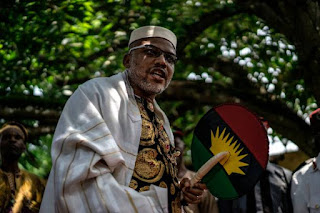
Biafran separatist leader Nnamdi Kanu has infused his movement with a Jewish sectarian identity in a country riven by tensions between Christians and Muslims. Is he putting Nigeria’s Igbo Jewish community at risk?
TABLET MAGAZINE
In early July, three young Israeli filmmakers—Rudy Rochman, Andrew Noam Leibman, and Edouard David Benaym—traveled to Nigeria to film a documentary on Africa’s lesser known Jewish communities. They were arrested by the Department of State Services (DSS), Nigeria’s internal security organization, on informal charges of supporting Biafran independence, and were held in custody under reportedly terrible conditions for 20 days, along with an Igbo Jewish woman. For the duration of their arrest, the Israeli filmmakers were not informed about the charge or the expected length of their detention. Their capture seems to have been prompted by photos showing them presenting a Sefer Torah to a local shul, and a shiviti to a local Igbo royal, that were shared on Facebook by political supporters of Biafran independence.
Thus did the filmmakers learn about Nigeria’s Igbo problématique in the hardest possible way: Biafra, a southeastern territory that seceded from Nigeria between 1967 and 1970, is predominantly populated by the Igbos, 2 million of whom died of starvation during the Nigerian Civil War. Jeff L. Lieberman’s 2012 documentary, Re-Emerging: The Jews of Nigeria, had drawn attention to the fledgling community of Torah observant converts among the Igbo, who consider themselves “biological” Jews, but didn’t so much as mention the issue of Biafra secessionism or Igbo nationalism.
But when the face of the secessionist movement, Indigenous People of Biafra (IPOB) founder Nnamdi Kanu, was arrested on June 27, 2021, his supporters abroad protested for his release by waving Israeli flags. In 2017, after a similar arrest and 19 months in custody, Kanu had declared himself a Jew and a “believer in Judaism” in front of the judge. In 2018, while on Israeli television, Kanu called on Israel to “come and defend Judaism all over the world.” In March of this year, his opponents within Nigeria’s Jewish community (including Chief Arthur-Regis Odidika, president of the Nigeria Jewish Community) publicly claimed that Kanu’s ethnic Igbo secessionist supporters are trying to take over the otherwise apolitical and peaceful Jewish communities in southeastern Nigeria, and accused him of un-Jewish “proselytizing” on Radio Biafra. As of this writing, Kanu remains in the custody of Nigeria’s DSS, and his trial, adjourned for the first time in late summer, was adjourned again after Oct. 21, when he pleaded not guilty to charges of “terrorism, treason, involvement with a banned separatist movement, inciting public violence through radio broadcasts, and defamation of Nigerian authorities through broadcasts.”
Kanu’s mix of Jewish identity, rock star political status, and advocacy for ethnic separatism is an unusual one. It is difficult to deny that he is advocating for an armed insurgency among Igbos, a “tribe” that numbers upward of 50 million people in a country with a total population of 206 million. Igbos have historically constituted a majority in southeastern Nigeria, have traditionally maintained “acephalous” political systems (i.e., lacking in leaders or hierarchies, instead depending on consensus among different age groups and secret societies), and have also upheld cultural traditions of matriarchy, as well as shared political power among both women and men. Today the Igbos are famous for their entrepreneurial spirit.
Beyond the well-known case of Ethiopia’s Jews, sizable Jewish communities have existed all over Africa. In Uganda, South Africa, and Zimbabwe, genetic traces of Cohenic ancestry were recently discovered, and in the Sahel, the Jewish presence goes back millennia. But no DNA evidence has yet substantiated Igbo claims to Jewish ancestry, although the claim is at least as old as the late 18th century, when it was made by the Black British intellectual and abolitionist Olaudah Equiano. In Kanu’s idiosyncratic version of history, 50 million Igbos are in fact 50 million Jews, the vast majority of whom are Christian merely because they were misled by colonialist missionaries. Estimates put the mainstream Igbo Jewish population in Nigeria at only 12,000-15,000. But in Kanu’s telling, the Igbo Jews have no intention of remaining part of Nigeria or settling in Israel, but only of bringing about the independent State of Biafra.
Behind Kanu’s grand claim is, in fact, a core group of diehards. Kanu may be an eccentric who has himself photographed in tallit and a Fendi tracksuit at the Kotel or in the custody of security agents at undisclosed airports. But Nigeria’s very serious Igbo Jewish community is earnest in its beliefs. William F.S. Miles’ 2012 book, Jews of Nigeria: An Afro-Judaic Odyssey, provides a vivid account of the fervor with which mitzvot are performed by the Igbos, from bar mitzvah celebrations and davening, to concern for the timing of lighting Shabbos candles, mikvah rituals, putting on tefillin, and even women donning wigs. Some synagogues in Nigeria are eager for a more Orthodox relationship with Torah that reminds one of some Breslov communities, in which balei teshuvah (the newly religious) make up the majority. It is no coincidence, perhaps, that the Breslov Rabbi in Jerusalem Dror Moshe Cassouto considers the Igbo a lost tribe of Israel and shares sympathetic accounts of their plight on his Facebook page.
Others in Israel have shown less enthusiasm: In 1993, the Israeli Supreme Court declared that Igbos were not Jews, and David Sperling, professor emeritus of Bible at Hebrew Union College, has said that the notion of Igbos as a lost tribe is “mythical.” Miles, who does not deny that genetic claims are unsubstantiated, argues nevertheless that in the case of the Igbos, theology should trump DNA, given the seriousness of their practical commitments and observance.
According to Igbo lore, their common ancestor is Eri, the fifth son of Gad. Igbo customs that point to a possible Judaic connection have historically included circumcision on the eighth day of life (universal for Igbo males), niddah (physical separation of married women during menstrual cycles), ritual slaughter of animals, and new moon celebrations, to name a few. For practical purposes, however, any verifiable connection to modern Judaism is a contemporary phenomenon, stretching back no further than the late 1960s. The largest denominations of Igbos today are Roman Catholic, Anglican, and Protestant (including Pentecostal and born-again) Christian. One of the more interesting questions is how a modern Jewish community of any size managed to emerge in a hotbed of fervent Christianity. Here it helps to employ a North American parallel.
Messianic Judaism, Jews for Jesus, and similar groups were originally founded with the aim of converting Jews to Christianity. Rabbis like Michael Skobac in Canada and Tovia Singer in Israel spent years trying to keep vulnerable Jews from falling prey to the theology and practices of Messianic Jewish groups, which they saw as engaged in clear subterfuge. But as they did so, they noticed a surprising phenomenon: The messianic groups were actually attracting small groups of Protestants (and other Christians), who then began to move closer to normative Judaism. Today, there is a small Noahide movement in the United States; Orthodox Judaism is the professed ideal of the community, in which most members are former Protestants.
In terms of the number of adherents, messianic groups in Nigeria far outweigh normative Jewish ones. But there has been an observable movement recently by some of the former in the direction of the latter. As a member of a Yahweh Yahshua Synagogue in the city of Umuahia and the scion of the local royal family, Nnamdi Kanu is as much a particularist religious preacher as a separatist political leader. His speeches are peppered with Hebrew names for God (his preference is "Elohim,” perhaps to signify the judgments his enemies should expect from the Heavenly Court), Shabbat, and Israel. He often talks of “this gospel of redemption,” by which he means Biafran armed struggle for independence. But he is often at pains to distance himself from the born-again movements prevalent in Nigeria. He warns against praying to Jesus, presenting him as merely a teacher, the way Unitarian Christians would. Adding to the complexity, he does not discuss the return of the Messiah, but does say things like, “In the year of the Most High Elohim, 2021.”
As an orator, Kanu rages angrily and emotionally as he attacks what he perceives as Fulani (Muslim) domination of Nigeria. He often conflates former generals, oil rig owners, political bosses, and nomadic herders all as the same Fulani. And he takes radical and progressive stances on sociopolitical issues like industrial policy and unemployment. All this appears to be at odds with the constituency of mostly peaceful and earnest Igbo Jews, who do not in any way seem to represent an ethnic secessionist vanguard, let alone a mass movement of 50 million people. According to Odidika, president of the Nigeria Jewish Community and Kanu’s opponent, what we are witnessing instead is an ethnic secessionist movement that is adopting a Jewish religious identity as a way of defining itself against the Messianic, Christian, and Muslim groups from which it seeks to declare independence.
This is, potentially, no small matter. In Nigeria, home to Boko Haram, religion is often a question of life and death, and many of the country’s political problems can take on a religious form. Kanu himself has made his Judaism an ideological weapon with which to fight Muslims (his preferred terminology for the Fulani is Janjaweed, the pro-government militant group of Darfur renown). He calls Nigeria “the zoo,” and his opponents “animals” and “midgets.” In contrast, according to the Igbo Jewish historian Remy Ilona, normative Igbo Jews do not by and large share Kanu’s hatred of Islam or Muslims.
That Kanu’s political program does have an audience likely has more to do with Nigeria’s problems writ large. Nigeria is a major oil producer, and after 2018 it became Africa’s largest economy. It is also a cultural powerhouse, whose high literature is celebrated abroad, whose music and Nollywood films have a global following, and whose vibrant press, civil society, and trade unions are the envy of West Africa. At the same time, a numerical majority of Nigerians live in absolute poverty, and enjoy only a few hours of “town electricity” on most days. Boko Haram and other extremist jihadi groups run rampant across the country, and the Nigerian Army is currently deployed (as opposed to being stationed) in 22 of the federation’s 36 states. Kidnapping, armed robbery, and government dysfunction and predation are features of everyday life. There is a lively scholarly debate about whether the country is currently a failed state, a failing state, or a “successful failed state.”
Kanu’s push for Biafran independence from the federal government thus strikes some people in southeastern Nigeria as far from insane, if not necessarily the best option. But if the Nigerian government commits the mistake of making the imprisoned Kanu into a martyr for the Igbo separatist cause, it may boost Igbo “political Judaism” in the process, perhaps similar to the way the dreaded Boko Haram rose to prominence after its founder allegedly met his death under opaque circumstances at the hands of the Nigerian police. The longer the federal government goes without addressing structural problems like endemic injustice and corruption, the exploitation of religious and ethnic differences by political opportunists will only proliferate. The majority of Igbo Jews may want to simply be left alone and out of this mess, but like other diaspora communities throughout history, they may find themselves instead at the center of a storm.
In early July, three young Israeli filmmakers—Rudy Rochman, Andrew Noam Leibman, and Edouard David Benaym—traveled to Nigeria to film a documentary on Africa’s lesser known Jewish communities. They were arrested by the Department of State Services (DSS), Nigeria’s internal security organization, on informal charges of supporting Biafran independence, and were held in custody under reportedly terrible conditions for 20 days, along with an Igbo Jewish woman. For the duration of their arrest, the Israeli filmmakers were not informed about the charge or the expected length of their detention. Their capture seems to have been prompted by photos showing them presenting a Sefer Torah to a local shul, and a shiviti to a local Igbo royal, that were shared on Facebook by political supporters of Biafran independence.
Thus did the filmmakers learn about Nigeria’s Igbo problématique in the hardest possible way: Biafra, a southeastern territory that seceded from Nigeria between 1967 and 1970, is predominantly populated by the Igbos, 2 million of whom died of starvation during the Nigerian Civil War. Jeff L. Lieberman’s 2012 documentary, Re-Emerging: The Jews of Nigeria, had drawn attention to the fledgling community of Torah observant converts among the Igbo, who consider themselves “biological” Jews, but didn’t so much as mention the issue of Biafra secessionism or Igbo nationalism.
But when the face of the secessionist movement, Indigenous People of Biafra (IPOB) founder Nnamdi Kanu, was arrested on June 27, 2021, his supporters abroad protested for his release by waving Israeli flags. In 2017, after a similar arrest and 19 months in custody, Kanu had declared himself a Jew and a “believer in Judaism” in front of the judge. In 2018, while on Israeli television, Kanu called on Israel to “come and defend Judaism all over the world.” In March of this year, his opponents within Nigeria’s Jewish community (including Chief Arthur-Regis Odidika, president of the Nigeria Jewish Community) publicly claimed that Kanu’s ethnic Igbo secessionist supporters are trying to take over the otherwise apolitical and peaceful Jewish communities in southeastern Nigeria, and accused him of un-Jewish “proselytizing” on Radio Biafra. As of this writing, Kanu remains in the custody of Nigeria’s DSS, and his trial, adjourned for the first time in late summer, was adjourned again after Oct. 21, when he pleaded not guilty to charges of “terrorism, treason, involvement with a banned separatist movement, inciting public violence through radio broadcasts, and defamation of Nigerian authorities through broadcasts.”
Kanu’s mix of Jewish identity, rock star political status, and advocacy for ethnic separatism is an unusual one. It is difficult to deny that he is advocating for an armed insurgency among Igbos, a “tribe” that numbers upward of 50 million people in a country with a total population of 206 million. Igbos have historically constituted a majority in southeastern Nigeria, have traditionally maintained “acephalous” political systems (i.e., lacking in leaders or hierarchies, instead depending on consensus among different age groups and secret societies), and have also upheld cultural traditions of matriarchy, as well as shared political power among both women and men. Today the Igbos are famous for their entrepreneurial spirit.
Beyond the well-known case of Ethiopia’s Jews, sizable Jewish communities have existed all over Africa. In Uganda, South Africa, and Zimbabwe, genetic traces of Cohenic ancestry were recently discovered, and in the Sahel, the Jewish presence goes back millennia. But no DNA evidence has yet substantiated Igbo claims to Jewish ancestry, although the claim is at least as old as the late 18th century, when it was made by the Black British intellectual and abolitionist Olaudah Equiano. In Kanu’s idiosyncratic version of history, 50 million Igbos are in fact 50 million Jews, the vast majority of whom are Christian merely because they were misled by colonialist missionaries. Estimates put the mainstream Igbo Jewish population in Nigeria at only 12,000-15,000. But in Kanu’s telling, the Igbo Jews have no intention of remaining part of Nigeria or settling in Israel, but only of bringing about the independent State of Biafra.
Behind Kanu’s grand claim is, in fact, a core group of diehards. Kanu may be an eccentric who has himself photographed in tallit and a Fendi tracksuit at the Kotel or in the custody of security agents at undisclosed airports. But Nigeria’s very serious Igbo Jewish community is earnest in its beliefs. William F.S. Miles’ 2012 book, Jews of Nigeria: An Afro-Judaic Odyssey, provides a vivid account of the fervor with which mitzvot are performed by the Igbos, from bar mitzvah celebrations and davening, to concern for the timing of lighting Shabbos candles, mikvah rituals, putting on tefillin, and even women donning wigs. Some synagogues in Nigeria are eager for a more Orthodox relationship with Torah that reminds one of some Breslov communities, in which balei teshuvah (the newly religious) make up the majority. It is no coincidence, perhaps, that the Breslov Rabbi in Jerusalem Dror Moshe Cassouto considers the Igbo a lost tribe of Israel and shares sympathetic accounts of their plight on his Facebook page.
Others in Israel have shown less enthusiasm: In 1993, the Israeli Supreme Court declared that Igbos were not Jews, and David Sperling, professor emeritus of Bible at Hebrew Union College, has said that the notion of Igbos as a lost tribe is “mythical.” Miles, who does not deny that genetic claims are unsubstantiated, argues nevertheless that in the case of the Igbos, theology should trump DNA, given the seriousness of their practical commitments and observance.
According to Igbo lore, their common ancestor is Eri, the fifth son of Gad. Igbo customs that point to a possible Judaic connection have historically included circumcision on the eighth day of life (universal for Igbo males), niddah (physical separation of married women during menstrual cycles), ritual slaughter of animals, and new moon celebrations, to name a few. For practical purposes, however, any verifiable connection to modern Judaism is a contemporary phenomenon, stretching back no further than the late 1960s. The largest denominations of Igbos today are Roman Catholic, Anglican, and Protestant (including Pentecostal and born-again) Christian. One of the more interesting questions is how a modern Jewish community of any size managed to emerge in a hotbed of fervent Christianity. Here it helps to employ a North American parallel.
Messianic Judaism, Jews for Jesus, and similar groups were originally founded with the aim of converting Jews to Christianity. Rabbis like Michael Skobac in Canada and Tovia Singer in Israel spent years trying to keep vulnerable Jews from falling prey to the theology and practices of Messianic Jewish groups, which they saw as engaged in clear subterfuge. But as they did so, they noticed a surprising phenomenon: The messianic groups were actually attracting small groups of Protestants (and other Christians), who then began to move closer to normative Judaism. Today, there is a small Noahide movement in the United States; Orthodox Judaism is the professed ideal of the community, in which most members are former Protestants.
In terms of the number of adherents, messianic groups in Nigeria far outweigh normative Jewish ones. But there has been an observable movement recently by some of the former in the direction of the latter. As a member of a Yahweh Yahshua Synagogue in the city of Umuahia and the scion of the local royal family, Nnamdi Kanu is as much a particularist religious preacher as a separatist political leader. His speeches are peppered with Hebrew names for God (his preference is "Elohim,” perhaps to signify the judgments his enemies should expect from the Heavenly Court), Shabbat, and Israel. He often talks of “this gospel of redemption,” by which he means Biafran armed struggle for independence. But he is often at pains to distance himself from the born-again movements prevalent in Nigeria. He warns against praying to Jesus, presenting him as merely a teacher, the way Unitarian Christians would. Adding to the complexity, he does not discuss the return of the Messiah, but does say things like, “In the year of the Most High Elohim, 2021.”
As an orator, Kanu rages angrily and emotionally as he attacks what he perceives as Fulani (Muslim) domination of Nigeria. He often conflates former generals, oil rig owners, political bosses, and nomadic herders all as the same Fulani. And he takes radical and progressive stances on sociopolitical issues like industrial policy and unemployment. All this appears to be at odds with the constituency of mostly peaceful and earnest Igbo Jews, who do not in any way seem to represent an ethnic secessionist vanguard, let alone a mass movement of 50 million people. According to Odidika, president of the Nigeria Jewish Community and Kanu’s opponent, what we are witnessing instead is an ethnic secessionist movement that is adopting a Jewish religious identity as a way of defining itself against the Messianic, Christian, and Muslim groups from which it seeks to declare independence.
This is, potentially, no small matter. In Nigeria, home to Boko Haram, religion is often a question of life and death, and many of the country’s political problems can take on a religious form. Kanu himself has made his Judaism an ideological weapon with which to fight Muslims (his preferred terminology for the Fulani is Janjaweed, the pro-government militant group of Darfur renown). He calls Nigeria “the zoo,” and his opponents “animals” and “midgets.” In contrast, according to the Igbo Jewish historian Remy Ilona, normative Igbo Jews do not by and large share Kanu’s hatred of Islam or Muslims.
That Kanu’s political program does have an audience likely has more to do with Nigeria’s problems writ large. Nigeria is a major oil producer, and after 2018 it became Africa’s largest economy. It is also a cultural powerhouse, whose high literature is celebrated abroad, whose music and Nollywood films have a global following, and whose vibrant press, civil society, and trade unions are the envy of West Africa. At the same time, a numerical majority of Nigerians live in absolute poverty, and enjoy only a few hours of “town electricity” on most days. Boko Haram and other extremist jihadi groups run rampant across the country, and the Nigerian Army is currently deployed (as opposed to being stationed) in 22 of the federation’s 36 states. Kidnapping, armed robbery, and government dysfunction and predation are features of everyday life. There is a lively scholarly debate about whether the country is currently a failed state, a failing state, or a “successful failed state.”
Kanu’s push for Biafran independence from the federal government thus strikes some people in southeastern Nigeria as far from insane, if not necessarily the best option. But if the Nigerian government commits the mistake of making the imprisoned Kanu into a martyr for the Igbo separatist cause, it may boost Igbo “political Judaism” in the process, perhaps similar to the way the dreaded Boko Haram rose to prominence after its founder allegedly met his death under opaque circumstances at the hands of the Nigerian police. The longer the federal government goes without addressing structural problems like endemic injustice and corruption, the exploitation of religious and ethnic differences by political opportunists will only proliferate. The majority of Igbo Jews may want to simply be left alone and out of this mess, but like other diaspora communities throughout history, they may find themselves instead at the center of a storm.


