Showing posts with label Olaudah Equiano. Show all posts

Saturday, April 2, 2022

Israeli Event At United Nations Commemorates Victims Of Slavery

An enslaved man who bought his freedom and wrote compellingly about his experiences, Olaudah Equiano (c. 1745–1797) was an extraordinary man who became a prominent figure associated with the campaign to abolish the slave trade.

Equiano was born in what is now Nigeria and sold into slavery aged 11. After spells in Barbados and Virginia he spent eight years travelling the world as slave to a British Royal Navy officer, who renamed him Gustavus Vassa. His final master, an English merchant in Montserrat, let him buy his freedom for £40 – almost a year’s salary for a teacher, but Equiano made it in three years of trading on the side.

Equiano worked as an explorer and merchant for 20 years, and eventually settled in England, the country where he had converted to Christianity in 1759. With the encouragement of the Abolitionists, who campaigned against the slave trade, he published these memoirs in 1789.

This book – one of the first in Europe by a Black African writer – was an enormous success, selling out immediately. This, the second edition, was published the same year. Equiano travelled widely to promote the book, and became wealthy from its royalties.

The ability of this cultured and intelligent man to relate first-hand the horrors of slavery helped sway public opinion, and by 1807 Britain had formally abolished the trade. Equiano did not live to see it; he died in 1797, leaving his English wife and two daughters.

In 2007, the first edition of Equiano's book was carried in procession at a special service in Westminster Abbey, London, to commemorate the bicentenary of Britain’s Abolition of the Slave Trade Act.

BY MIKE WAGENHEIM

A film recounting a tale of African bondage and freedom, told through modern-day social media, becomes the focal point for a U.N.-sponsored event to mark the International Day of Remembrance of the Victims of Slavery and the Transatlantic Slave Trade.

Jews will celebrate and commemorate their exodus from slavery during the upcoming Passover holiday, utilizing the Haggadah to retell to their children the biblical story.

Would the Israelites have been granted their freedom earlier had social media existed them to capture the injustice? Would it have changed things for an African child in the 1700s who was sold into slavery?

To mark the International Day of Remembrance of the Victims of Slavery and the Transatlantic Slave Trade on March 25, the Permanent Mission of Israel to the United Nations initiated a special event on Tuesday that featured excerpts from the Israeli film “Equiano.Stories.” It presents the story of Olaudah Equiano through Instagram stories. Equiano was abducted and sold into slavery as a child in 1756 before securing his freedom and working to end the slave trade in Great Britain.

“We, the Jewish people and the State of Israel feel sympathy towards victims of racism and slavery because our people endured the same kind of suffering as we’re going to commemorate two weeks from now during Passover,” Gilad Erdan, Israeli Ambassador to the United Nations, told JNS. “I think it had an extremely important effect that the formal event to commemorate the victims of slavery was focused on an Israeli production and it was based on the initiative of the Israeli mission to the U.N., and it exposes the truth about all of our enemies and political rivals who are trying to brand Israel as an apartheid state and the truth is stronger than anything else.”

Erdan has prioritized strengthening ties between Israel and African countries in the United Nations while emphasizing common values in the fight against racism. This event is designed to continue emphasizing these common values.

Showing the importance of the Israeli initiative, the president of the U.N. General Assembly, Abdulla Shahid, decided to hold the event as an official one for all U.N. members.

“Equiano.Stories connects us to the past in a way that is often hard to achieve, particularly as we are prone to see the past as something long ago, distant and unrecognizable,” said Shahid.

The event featured the first visit to the United Nations by New York City Mayor Eric Adams.

Addressing participants, Adams drew parallels between the evils shows in the film and global ills today, such as accelerating climate change, hunger and conflict.

Urging multilateral action, he said that the world body “must be more than a symbolic building; it must be a rallying cry.”

United States Ambassador to the United Nations Linda Thomas-Greenfield spoke remotely, and technology and media entrepreneur Mati Kochavi, who produced “Equiano.Stories,” addressed the gathering, which included former NBA All-Star Amar’e Stoudemire, a convert to Judaism. The permanent representatives of Jamaica and Senegal, along with the permanent observer of the African Union, also spoke, as did the chair of the Task Force on Addressing Racism and Promoting Dignity for All in the United Nations Secretariat, U.N. Under-Secretary-General Catherine Pollard.

‘His words were his power’

“Equiano.Stories,” an excerpt of which was featured during Tuesday’s event, reimagines the childhood saga of Olaudah Equiano, an 11-year-old boy living in a vibrant Igbo village in West Africa in 1756. Deeply connected to his family and community, he happily documents his life in the village through stories shared with his followers. But one day, Equiano and his sister are kidnapped from their home. They are separated, and Equiano is transported alone, by foot, to Africa’s Western shore. There, he is made to board a slave ship.

Equiano would go on to buy his freedom and wrote compellingly about his experiences in the book, The Interesting Narrative of the Life of Olaudah Equiano, Or Gustavus Vassa, The African. The film tells his tale as a modern-day self-recorded, first-person account, within the format of Instagram stories, using video, still images and text, highlighting the struggle and strength of African people during the Middle Passage—the stage of the Atlantic slave trade in which millions of enslaved Africans were forcibly transported to the Americas.

“When George Floyd was murdered, the horrific video, captured on a cellphone, shocked the world into action. And as [Russian] President [Vladimir] Putin’s forces unleash senseless violence on Ukraine, the images we’re seeing and the stories we’re reading in real time have rallied the global community to stand united with the people of Ukraine,” said Thomas-Greenfield. “We see these same dynamics play out in brutal conflicts and under repressive regimes around the world. Activists and everyday civilians who are able to share their stories and call on others to help, and it really can make a difference.”

“In Olaudah Equiano’s time, they didn’t have smartphones or social media. But he used the tool he had at his disposal to share his story with the world: his words. His words were his power,” she emphasized.

‘The commonality is our past’

One of the writers and directors said she saw her own Israeli identity in Equiano’s story, which is one of the aspects of the saga that drew her to the film project.

“As an Israeli, the values of family and the values of humanity are incredibly important and something that mean a lot to us, and we saw that very clearly in Equiano’s story in the way that he describes his family, in the way that he fights for humanity and fight for his freedom. And not only in the way that he bought his own freedom, but then went on to fight for the freedom of his people and spent his whole life fighting for the freedom of his people, and that’s just something that really resonated with us,” Adi Kochavi told JNS.

Erdan, who has placed a priority on strengthening ties between Israel and African countries in the United Nations, said that Tuesday’s event was designed to emphasize common values in the fight against racism and anti-Semitism.

“Both of our fights emanate from a history of enslavement. …The commonality is our past, and this is what makes Israelis so empathetic to Africans, whose equality, dignity and self-determination was stolen in the slave trade,” said Erdan. “This commonality is why it is so important for Israel’s Mission to the United Nations, and for me as its ambassador, to have initiated today’s presentation.”

SOURCE: JEWISH NEWS SYNDICATE

Wednesday, February 16, 2022

After The Holocaust, Now African Slavery Also Hits Instagram

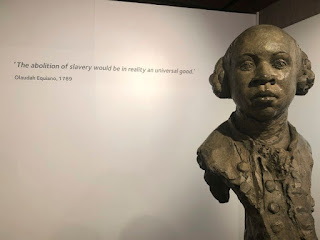
A sculpture of former slave and later abolitionist writer Olaudah Equiano, on display at the International Slavery Museum in Liverpool, England. Now his story is also being told on Instagram. Credit: AP Photo/Russell Contreras

Three years after generating hundreds of millions of views by recounting the tragic story of a teenage girl during the Holocaust, Equiano.Stories hopes to do the same for another traumatic historical event

On the eve of Holocaust Remembrance Day in 2019, billboards suddenly appeared along Tel Aviv’s highways featuring a hand holding a cellphone behind barbed wire and the question “What if a girl in the Holocaust had Instagram?”

Nearly three years on, very different-looking billboards but with a similar message have started appearing in the city. This time, a young African boy holds up a smartphone with a text reading: “1756. I’ve been kidnapped into slavery. And I’m recording it all,” inviting viewers to follow @equiano.stories on Instagram.

Signs have also gone up across Chicago Transit Authority train stations, in the midst of Black History Month in the United States, advertising Equiano.Stories as a new “feature film exclusively on Instagram.”

Those 2019 billboards kicked off the campaign known as Eva.Stories, a fictional Instagram account for a real girl: a 13-year-old Hungarian Jew called Eva Heyman. Based on the diary of the real Eva, the Eva.Stories account took followers on a journey through posts on the popular platform Instagram Stories. They experienced her life until the Nazis invaded, her forced move to a Jewish ghetto and, ultimately, her deportation to Auschwitz in 1944.

The high-budget effort was a viral success, with hundreds of millions of views globally, translation into various languages and an additional account on Snapchat. It also sparked a fierce debate over whether bringing the Holocaust to Instagram was an innovative way of bringing history to a new generation in their online comfort zone, or represented a cheapening and dumbing-down of Holocaust education.

Now the creators of Eva.Stories are bringing an equally sensitive historical trauma, African slavery, to the social media platform as well.

Yvonne Mbanefo, a British-Nigerian historian and cultural consultant for entertainment and media projects, recounts that when the team behind Eva.Stories – led by Israeli-American billionaire entrepreneur Mati Kochavi, and his daughters Maya and Adi – asked her to help helm the Equiano project, the controversy surrounding the original gave her little hesitation.

“It actually turned out that my daughter had seen Eva.Stories. When I told her about this company that approached me and that they have a novel concept of telling stories to young people on Instagram, she said, ‘Oh, I’ve watched it!’ So it really intrigued me that a Black teenager in London would watch a film about Holocaust and love it so much. I knew it would be a winner if we could do the same for slavery.”

What really sold her on the idea, Mbanefo says, was the fact that the project the Kochavis conceived would establish the character of Equiano as a happy child in his Igbo village – the pre-colonial Nigerian culture Mbanefo specializes in – and feature the details of his culture and life, before his horrific journey into slavery begins.

“Stories like this usually begin in enslavement. This one was starting from freedom. That was what really intrigued me,” she says.

‘Very natural progression’

Like Eva.Stories, the Equiano narrative is built around a real-life experience. Olaudah Equiano was kidnapped as a young boy from an Igbo village in West Africa, in 1756, enslaved and brought to the Caribbean.

The real Equiano bought his freedom when he was about 20 years old, moved to London and published a bestselling and influential memoir in 1789. His book, “The Interesting Narrative of the Life of Olaudah Equiano,” is credited with helping to end the practice of slavery in Britain.

In the Instagram videos, photos and posts, Equiano shares details about a joyful village life in Africa with his followers. They will accompany him as he is kidnapped from his home and witness the brutal existence on a slave ship bound for the Caribbean.

Equiano.Stories went live on Instagram on Wednesday, with more than 500 short videos, stills and posts to be uploaded on an hourly basis as the main character speaks directly to followers. According to its creators, Eva.Stories garnered some 300 million views within the first 48 hours of its release, a figure they hope to match or exceed.

Following their Holocaust narrative with a story about slavery felt like a “very natural progression,” says Maya Kochavi, the 30-year-old co-founder of Stelo Stories, the Kochavi family’s company that is based in New York and Tel Aviv.

“We began with something that was our story – our holocaust, the Jewish Holocaust. And we moved to the African holocaust: it felt like the right next step. We knew going into ‘Eva’ that so many kids don’t know enough about the Holocaust and that it was not being taught enough in schools … and [there’s] a lack of interest because it feels like something that happened so long ago. And we were very passionate about changing this. And we know the same is true for slavery: that it’s not taught enough and kids don’t know enough about it,” Kochavi explains.

The Equiano.Stories film was shot on a Hollywood-level movie set in South Africa, where the village and slave ship were recreated in detail. Before filming began, Mbanefo first traveled to Nigeria, to a village as close to Equiano’s as possible to prepare herself mentally and to conduct research. Heading down to South Africa and entering the slave ship set for the first time, she says she “put on the chains that the slaves wore” to gain a deeper understanding of the suffering her character endured.

The experience of filming was not only emotional for her. “During the filming of the slave ship scenes, every single person on the film set cried at one point – from the actors to the security people to the snake catchers we needed to keep snakes off the set,” she recalls. “It was an amazing environment where color didn’t matter. Everyone just wanted this thing to work.”

Like Eva.Stories, the Equiano project is certain to spark debate. Does the use of a social media platform to relate the painful and tragic history of slavery degrade the dignity of those who suffered? Or is it an invaluable tool that will help a new generation process history more effectively than merely reading about it in books or hearing a narrative intoned to them in a traditional documentary format?

Maya Kochavi says that, for her, that debate is obsolete, conducted by those who haven’t watched the “Eva” project, which in her eyes proved the effectiveness of what she sees as a new “genre” of storytelling.

“One of the reasons we think that people today can really connect with Equiano, regardless of the fact that he lived 300 years ago, regardless of their culture and where they come from, regardless of how much they know about this story, is because the genre essentially creates a kind of universal language,” she says, holding up her smartphone for emphasis.

“Kids will say, ‘Equiano may look different from me, but he films his life the way that I film my life.’ I believe that creates a connection between us across time and space and culture. It creates a universal language, and the really powerful way that kids today … will relate to this boy.”

‘Community of creators’

Any potential criticism of white Israelis initiating such a project has been anticipated and blunted not only by Mbanefo’s central role in the collaborative endeavor, but the fact that Stelo Stories developed the project in close cooperation with Chicago’s DuSable Museum of African American History – the nation’s oldest independent museum of Black history and a Smithsonian affiliate.

“We don’t believe in having one voice tell a story,” says Adi Kochavi, 33. “Each one of our stories has a community of creators. We have partners in Yvonne and the museum, and we’ve been working with them for the past two years on every aspect of this film.”

On the same day Equiano.Stories dropped, the Chicago museum planned to unveil an exhibition featuring a handcrafted replica of the thatched-roof huts seen in the film, surrounded by African art and interwoven with interactive digital experiences and screens showing scenes from the Instagram experience.

Another educational dimension of the project are short lessons embedded in the Instagram posts, explaining what viewers see in the film, both historically and culturally, which followers can access by clicking mid-clip for more information – an interactive element that did not exist in the “Eva” project. Another interactive addition is an accompanying app where Equiano fans can use a “mixed reality AI-dance tutorial” that will teach them the steps of the Nigerian dances seen in the film.

Both Eva.Stories and Equiano.Stories were funded through the deep pockets of the sisters’ billionaire father Mati Kochavi, whose mega-deals in security and infrastructure have underwritten a series of media endeavors. Most prominent among these is the media and technology company Vocativ, run by Adi.

According to the sisters, “Eva” and “Equiano” are the first two installments in a planned series of 10 interactive stories of young people from history. The third installment, featuring a 14th-century Italian musician, has already been filmed and will be released this summer.

Once the Stelo Stories brand is established, the sisters say, they will transition to a more traditional business model. The first two projects involved “topics that are so incredibly sensitive, we didn’t want to make money from either one,” they say.

For the team that worked on the project for more than two years – and saw its release delayed for over a year due to the COVID-19 pandemic – its release felt like anticipating the birth of a baby, Mbanefo says.

“I can’t wait for this to come out – not just for white and other non-Black people to watch and learn from, but also for Black people,” she says. “Even in Nigeria, not many people who are from the Igbo community know about the story of Olaudah Equiano. We live in a world where everything changes so quickly. Young people need role models, and there are very few Black role models. So I believe this project will help young people reconnect to a new role model they can learn from.”

When Eva.Stories was released in 2019, Maya Kochavi recalls, “We could see through the reactions that people just cared about Eva so much. … We’re hoping that people will love and care that deeply about Equiano, and through that care about the story of what happened to him.”