Showing posts with label Christopher Okigbo. Show all posts

Monday, June 27, 2022

Okigbo And The Makerere Conference

Christopher Okigbo

BY JAMES GIBBS

What happened at and after the Makerere Writers Conference held in June 1962? The significance of the Conference of Writers of English Expression held in Makerere College, Kampala, during June 1962, continues to be pondered, and rightly so. As I write, a conference to mark the sixtieth anniversary of that gathering is being organised by the Pan-African Writers Association (PAWA), Nigerian Academy of Letters (NAL) and Association of Nigerian Authors (ANA), and is scheduled for June 23-26. It is to be hoped that questions raised by the original meeting will continue to be considered. There is certainly much about what happened 60 years ago that should be examined closely and, indeed, I note that, myth-making is still in progress. This was illustrated by the use of a photo-shopped picture to illustrate the article about the PAWA Conference by Akintayo Abodunrin carried in the Nigerian Tribune of June 19, 2022.(See ‘Ibadan hosts Pan-African Writers conference, 60 Years After Kampala’.) This is not the first time that this particular photograph has featured in relation to an event marking an anniversary of the 1962 Conference.

In London, during 2017, the same picture was used by the organisers of a London conference marking the 55th anniversary of the Makerere Conference. It is reproduced below, along with a ‘key’, and the full title that includes the words ‘artist impression.’ At the 2017 anniversary meeting, the picture filled the cyclorama behind the speakers who included Wole Soyinka. During an early session, I raised the question of the origin of the photograph, and went on to point out that whatever it showed it did not reveal the organisation that had funded the event. That is to say, it did not hint at the presence ‘behind the scenes’ at Makerere of the Central Intelligence Agency. As has since become common knowledge, the 1962 Makerere conference was financed by the CIA, then operating clandestinely through the Farfield Foundation and the Paris-based Congress for Cultural Freedom. The betrayal of trust involved in this deception has been chronicled in detail by Frances Stoner Saunders in her exposé of ‘The CIA and the Cultural Cold War’ entitled Who Paid the Piper? (1999).

The ‘photo-shopped’ photograph used in London in 2017 that has now resurfaced was a shoddy piece of work on several levels. To ‘pick apart’ the photograph, we must start by saying that it shows the heads of some of the writers present at the conference ‘grafted’ onto to bodies in a fairly formal picture of a group that may be of members of a Makerere College Society. This is monstrous enough and to imagine all is explained or excused by the description ‘Artist impression’ is preposterous. The deception is compounded by the fact that the picture does not show all who were present. A full ‘gallery’ would include, for example, critics, publishers, and editors, at least one of whom was a long-serving agent of the CIA.

The objectionable photograph is, I understand, the work of Dada Khanyisa for a website called ‘Chimurenga Chronic’. It was irresponsible of the London 2017 conference organisers to have used it in 2017 without a clear ‘Warning’, and it is sad to see it being used again, once more, without warning. Incidentally, it may be of interest that when Soyinka was button-holed after the first session of the London conference, and asked what he made of the picture, it was apparent that he had not ‘recognised himself’ in the podgy, suited figure on the extreme left. In part explanation,he pointed out that he had stopped wearing ties and suits long before June 1962!…It is to be hoped that the 60th Anniversary gathering will get off to a better start than the 2017 event, and that there will be a determination to get to the bottom of what really happened at Makerere in 1962. Despite the presence of Soyinka – and it should be said of Cameron Duodu -at the 55th anniversary in London, the gathering did not by any means sort out all the issues raised by the 1962 conference. Many loose ends remain. Serious research into archives are among the steps required to discover who expected what from the gathering.

Over the years, details about individual experiences at Makerere 1962 have emerged but the conference is still surrounded by uncertainty. Perhaps fifty-five years was too strange an anniversary to celebrate. It smacked of organisers who had failed to mark the fiftieth anniversary sufficiently and feared that none of the original participants would be alive at the time the sixtieth celebration – that has now ‘come along’.Perhaps the 60th Anniversary Conference will fare better?

Christopher Okigbo and Makerere 1962

To shed light on the 1962 Conference and to gesture towards areas where work is still required, I am going to bring together some reports and thoughts about the experience of the poet Christopher Okigibo at Kampala. I am doing so in the hope that it will provide an insight into what was going on below the surface and behind the scenes. Okigbo presents himself as a suitable subject for this exercise because he has been the subject of a scrupulous biography, Thirsting for Sunlight by Obi Nwakanma (2010), and because a significant ‘industry’ has gown up around him his life and works. For example, during 2007, he and his works were considered at a four-day conference held in Boston. Okigbo was easy to find at the Makerere Conference: he put himself forward, contributed to discussions, delighted in shocking the more staid of his fellow delegates, and generally ‘made his mark’. He did this by, for example, declaring that he did ‘not read his poetry to non-poets’ and he also took a leading role in ensuring that the social side of the conference was ‘memorable’. First some background to his presence at the Conference:

Okigbo graduated in Classics from University College, Ibadan, and embarked on a career in the Civil Service. However, that did ‘not work out’ and he moved into teaching. In the meantime, he had begun to write poetry and had had some success, notably with verses published in the Ibadan-based Black Orpheus. That publication had been founded by Ulli Beier, and had been put on a fairly solid financial basis thanks to grants from the ‘Farfield Foundation’ – that Saunders and others have exposed as a CIA front. Okigbo’s writing has long intrigued and pleased. By 1962, he had already attracted the interest of Donatus Nwoga, who was a member of the Nigerian delegation at Makerere and who must be briefly introduced here. By the time he set off for Makerere, Nwoga had completed a Dublin PhD and secured a lectureship at the University of Nigeria. He was, in fact, one of the first Nigerian literary critics to establish a reputation and it was inevitable that he would engage with Okigbo’s work. The two men had much in common: they were near contemporaries, and both had been brought up in Igbo families that had been exposed to Catholic missionary influences.

The Makerere Conference has become known as a ‘Writers Conference’, but this has tended to obscure the presence of critics, such as Nwoga. The same, misleading ‘short-hand’ has tended to obscure the presence at the Conference of others who were not writers. The ‘delegates’ included, for example, broadcasters, editors, and publishers, and people who were ‘more than publishers’ – see below. Okigbo clearly made an impact on the deliberations of the Conference. He did this, first of all, by his contribution to a discussion at the heart of the conference: the answer to the question: What is African writing? To this Okigbo responded abruptly, ‘finally’, and, as many must have felt, frivolously, by saying: ‘There is no such thing as African writing. There is only good or bad writing.’ (Nwakanma: 182.) Of Okigbo’s other contributions, Nwakanma records that in the session on Language and African Literature the poet threw ‘many of the writers into guffaws when he wondered aloud about the kind of Pidgin English Nigerian prostitutes spoke in Lagos.’ This topic – The Language Issue – has, of course, been of consuming interest to many, including one of the younger writers at the conference, ‘James T Ngugi’. One can’t imagine Ngugi wa Thiong’o – as he was later known guffawing at Okigbo’s irreverent answer.

At one of the reading sessions, Okigbo, declared, as noted above: ‘I don’t read my poems to non-poets!’ Nwakanma describes this as an ‘impish’ moment, however delegates at Makerere might have categorised it in other terms, as, for example, aloof, pompous or elitist.

‘A cool place for a conference’

Whatever others made of him, Okigbo described Kampala in positive terms. He thought it was ‘a cool place for a conference’, and, ever alert to recreational opportunities, he said it offered ‘more than adequate outlets at Top Life and White Nile’. (Night clubs visited by delegates.) However, he went on to describe Makerere / Kampala as ‘a literary desert’ and he expressed the hope that the Conference would do ‘what irrigation does to the Sudan.’ (It being understood that the image was of a ‘literary desert’ in need of water.)

Nwakanma gives further insights into Okigbo at Makerere by writing: ‘During the conference Okigbo was always to be found in the company of the Ugandan playwright and journalist Robert Serumaga and he struck up an easy friendship with the South African writers and exiles, Bloke Modisane and Lewis Nkosi.’ (181)While in Uganda, Okigbo also got to know Langston Hughes and Otis Redding. Nwakanma offers that the latter’ shared many views, especially on the meaning of international blackness and against racial essentialism in cultural production.’ The lastsentence of the paragraph on these interactions reads: ‘Okigbo and Robie Macauley, Editor of the Kenyon Review, discussed the possibility of publishing Limits and the early version of “Laments to the Silent Sisters.” But nothing came of it.’ (181)

In sifting these pieces of information, it is interesting to note that Serumaga’s name is omitted from some lists of those present at the conference. The fact that Nwakanma’s book makes it clear that Serumaga was not only present but interacted with Okigbodraws attention to the need for fuller, more authoritative documentation of the conference, and who came and went during it. Perhaps Serumaga’s established contacts with the University and his interests in both journalism and playwriting made him ‘persona grata’. He certainly sems to have moved in and out of the conference easily, and to have mingled with the visitors.

I want to draw this article to a close with the image created by Nwakanma’s reference to Okigbo in conversation with that other delegate who is glossed as the editor of the Kenyon Review, Robie Macauley. Macauley was indeed an influential editor, but he was also a long-serving CIA agent.

Macauley’s commitment to espionage is alluded to in on-line sources and in exposés of the CIA. From these it is possible to get a sense of how Macauley might have attempted to manipulate the ’soft power’ the CIA leveraged through its links to publications, its budget of $900,000,000, and the support it received from disenchanted Communists. Macauley was an experienced operator, how did he engage with the impish, witty, Okigbo? Did he, for example, dangle the prospect of publication in the Kenyon Review before the poet? If so, it can be seen that Okigbo did not swallow the bait – since ‘Limits’ first appeared in Presence Africaine (1966).

More research must be undertaken into what happened at Makerere in 1962. In the meantime, we must insist that coverage of the 60thanniversary conference risesabove photo-shopped images that have been concocted, confected, contrived, compounded, and cooked up. As a first step in searching for the truth about what happened in Uganda sixty years ago, it must be recognised that Dada Khanyisa’s ‘artist’s impression’ cannot be taken at face-value.

Gibbs writes in from Bristol, United Kingdom.

READ ORIGINAL ARTICLE HERE

Saturday, December 18, 2021

Sacrificial Literary Geniuses

BY MICHAEL JIMOH

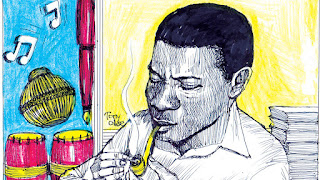
Christopher Okigbo image courtesy of The Guardian


Byron. Fitzgerald. Marechera. Okigbo. Plath. Shelley. They were all great writers who died young, some in their twenties, thirties, only one making it past forty. They were all dreamers, idealistic, adventurous and most often geniuses but sometimes unmindful of their private lives. What is it with these writers who seemed to have been destined to die young? Michael Jimoh writes on some of the world’s famous writers who died prematurely.

In August 1967, a 34-year-old Nigerian poet in battle fatigues and armed with his regulation rifle went to the warfront hoping to realise his compatriot’s dream of a free Republic of Biafra.

Three months before, on May 30 in the same year, Lt Colonel Emeka Odumegwu Ojukwu had carved out Igbo-dominated Eastern Region from the Federal Republic of Nigeria leading to the 30-months civil war.

Christopher Okigbo is Igbo by birth, born on August 16, 1932 at Ojoto in modern day Anambra state. At the start of the hostilities, he was teaching at Ibadan, capital of Western Region and an outstanding poet in the continent. With war drums sounding ever louder, Okigbo promptly relocated to the East and volunteered to fight in the Biafra Army.

Only days short of his 35th birthday, he was shot and killed in the battlefront by federal troops at Nsukka.

Of course, the federal soldiers didn’t know who he was or, perhaps, if they knew they didn’t care. To them, he was just one of the rebel enemy soldiers fighting as a secessionist in the newly declared Republic of Biafra.

Thus was the life of an otherwise brilliant career of one of Nigeria’s most promising poets cut short.

What might have been if the clarinet-playing, pipe-smoking, accomplished poet had lived much longer, up to sixty, say, seventy or even eighty? Those of his generation who did, Achebe, Clark and Soyinka were richly rewarded – a Booker, a Nobel and other highly regarded international and national prizes – for their works.

Okigbo himself had set the pace by becoming the first poet laureate in Africa after he was awarded first prize in the 1966 Festival of the Negro Arts in Dakar, Senegal. He turned it down, insisting that writers should not be classified according to race or ethnicity. Writing, he famously said then, “must be judged as good or bad, not as a product of a specific ethnic group or race.”

If he had lived longer, it is doubtful if Okigbo would have been counted out of the bigger and more prestigious prizes. Indeed, literary theorists and historians have proposed that Okigbo would certainly have been one of the early candidates for the Nobel in Literature – and with good reasons.

Okigbo already had a well-fostered reputation as one of the leading poets of his time. His productive output was going swimmingly, like the Idoto River flowing steadily in his birthplace. He would have added some more publications to the already existing ones considering his creative output in his brief existence: Heavensgate (1962,) Limits two years later and Silences the following year.

Starting off as a librarian at University College, Ibadan, where he sated his voracious appetite for reading, he contributed poems to Black Orpheus and was West Africa editor of Transition, a literary magazine. His star as a literary heavyweight was clearly ascending.

But the call to patriotic duty put an end to all that. Okigbo was only 34 when he died.

Another writer who also died prematurely, though not in the course of fighting a war except battling his own demons, was the Zimbabwean, Charles William Dambudzo Marechera, born on June 4, 1952 in Vengere township of Zimbabwe then known as Rhodesia.

Dambudzo had a hardscrabble early life but was a gifted child, a special endowment that will take him to privileged institutions such as the only Catholic school for students like him and then New College, Oxford England.

Spotting short dreadlocks long before it became faddish among young men and women all over the world today, Marechera was as gifted as they come but was also reckless and without restraint in his personal life.

Departing Africa for Europe on a scholarship, Marechera tried to remember what he left behind at home, recalling that “I suddenly remembered that I had, in the rude hurry of it all, left my spectacles behind. I was coming to England literally blind…I was on my own, sipping whisky and my head was roaring with a strange emptiness…I think that I knew then that before me were years of desperate loneliness, and the whisky would be followed by other whiskies, other self-destructive poisons.”

A confirmed non-conformist weighed under the burden of colonial rule with all its segregationist laws, Marechera never really outgrew his disenchantment with the Western world and all that it represented. His “Dambudzo Performance” wherein he suddenly snapped at an award night in his honour at The Guardian Fiction Prize in 1979 is the stuff of legend.

The year before, he had written and published House of Hunger, considered the Bible of visceral literature, an unvarnished creative piece straight out of his guts aptly dubbed “gut-rut.”

Like Okigbo did in Dakar eleven years before, Marechera became the first African writer ever to win The Guardian Fiction Prize in 1979. Publishers in Europe (England and Germany) breathlessly anticipated future masterpieces from him. They never came. Parceled off from London, Marechera found his way to Cardiff, Wales, where many more whiskies followed.

It was while in Wales that a vicar in Cardiff who witnessed, firsthand, Marechera’s constant inebriety wrote to his publisher James Curry of his concern about the Zimbabwean writer. “I would doubt if Mr. Marechera will be alive for very much longer – he hardly eats and only drinks.”

It turned out to be quite prophetic. On his return to his natal country, Marechera pub-crawled shebeens there, wrote there, slept there and became destitute before dying of complications from AIDS in 1987 at 35.

Writers dying prematurely isn’t quite a novelty. Why it is so is not exactly clear. Could it be a date with destiny? Or just plain carelessness on the writer’s part?

No one exemplifies this more than Romantic poet, Percy Bysshe Shelley. He was a month shy of his 30th birthday when he drowned in his own sailing boat, Don Juan, in the Gulf of Spezia Italy.

Could the boat accident have been prevented or was it a death foretold? The answer to both questions is yes.

In the late afternoon of July 8, 1822 Italian port authorities had warned the poet and two companions of a possible foggy weather when he set sail from Lerici to Livornio. Apparently, the poet’s wanderlust got the better of him.

As for the second question, Shelley himself had foreseen his possible demise upon the waters of Italy. In his celebrated poem, “Adonais,” Shelley writes that “The breath whose might I have invoked in song/ Descends upon me; my spirit’s bark is driven,/ From the shore, far from the trembling throng/ Whose sails were never to be Tempest given;/ The massy earth and sphered skies are riven!/ I am borne darkly, fearfully afar…”

In a publication by The Guardian of London of January 23, 2004, Richard Holmes looked into the circumstances surrounding the death of Shelley and concluded that the “sudden tragedy set a kind of sacred (or profane) seal upon his reputation as a youthful, sacrificial genius.”

Also considered “a youthful, sacrificial genius” was the untimely death of Shelley’s contemporary, rival, friend and compatriot, Lord George Gordon Byron, an unrepentant, unapologetic sybarite. He was born privileged, a lord, in January 22, 1788 in London. Gifted beyond measure, Byron’s personality and poetry would capture the imagination of Europe for years, culminating in his teaming up with the Greek nationalist fighters where he died of fever.

In March 1812, Byron’s first canto – Childe Harold’s Pilgrimage – was published to wide acclaim and reception, prompting one critic to comment that the poet “woke to find himself famous.”

Published in 1819, Don Juan, for which Shelley’s skiff was named, even had more public reception and appeal. Byron’s popularity rose correspondingly all over Europe. His scandalous relationships with men and women rose almost in equal degrees, famously fathering a child with his half-sister.

At this stage in his career and personal life, Byron was having the time of his life despite being hobbled by a clubfoot. It didn’t stop him from traipsing or boating across Europe, Italy, Portugal, Spain, Turkey and then Greece where, in his bid to aid the Greeks gain independence from Turkish rule, Byron died of fever in Missolonghi on April 19, 1824. He was just thirty-six.

Across the Atlantic from England, the United States of America has had its own share of gifted writers biting the dust early. The most famous instance is none other than Francis Scott Fitzgerald himself, famous for The Great Gatsby, Tender is the Night, This Side of Paradise, etc.

If there was one gifted writer who had the greatest potential to become great among his contemporaries, Fitzgerald was it. He counted among his close friends Earnest Hemingway, Edmund Wilson, John Dos Passos. Born September 24, 1896 in Saint Paul Minnesota, Fitzgerald showed early promise in school before proceeding to Princeton where he became a prominent member of literary and dramatic societies.

Not unlike much gifted individuals without much focus on academic life, he soon left Princeton, joined the army and then started penning short stories. Initially, success as a writer eluded him until he published the immortal The Great Gatsby in 1925. Fitzgerald worked for some time as a script/ screen writer in Hollywood, mainly for cash. He was always broke and part of the reason was his extravagant lifestyle, a lifestyle he shared ostentatiously with his wife, Zelda Sayre. They were also great imbibers, with Fitzgerald depending on the bottle more and more as his creative output declined/ waned. He himself would later claim in an interview of the “crack up” he suffered because of his needless indulgence.

Fitzgerald died four days before Christmas in 1940 at 44.

The lone, famous woman among the sacrificial geniuses of literature remains Sylvia Plath, tortured poet, short story writer, novelist and spouse of Ted Hughes, a much senior colleague and fellow poet. They were married briefly for six years, a union that was mostly tempestuous with Plath complaining of abuse by Hughes.

Despite that, Plath produced enough literary works to have been awarded the Pulitzer posthumously for The Collected Poems. She also wrote her most famous work, The Bell Jar. A gifted poet, Plath is credited with beginning a new genre of poetry called the confessional poem. She was born a Bostonian on October 27, 1932 and went to prestige schools like Smith College in her natal city and then Newnham College, Cambridge in England.

Though an American, Plath lived with Hughes in England for some time. She died there on February 11, 1963. She was a mere 30.

It must be said that Plath herself suffered bouts of depression through much of her adult life, occasioned sometimes by the loss of a loved one like her father after he died, and her disappointment at failing to meet and speak with Dylan Thomas, a celebrated poet, at a literary soiree once.

What did Plath do to herself afterwards? She “slashed her legs to see if she had the courage to kill herself.” After several unsuccessful attempts at suicide, Plath finally did take her life by gassing in her kitchen oven.

So, propelled by self-destructive forces, the environment in which they lived or circumstances surrounding them, nearly all of the writers above presented themselves as sacrificial geniuses on the altar of literary creativity.

Besides, a Nigerian novelist, poet, dramatist and senior journalist, Uzor Maxim Uzoatu, has a word or two on the possible reasons for their abridged lives.

“Highly talented people,” Uzoatu began by telling THEWILL, “who achieved fame early enjoyed something of a blessing in disguise in dying early because most of their latter works becomes a parody of their earlier ones. A typical example is William Wordsworth. He lived so long that critics said he had the longest decline in English literature. Back home, someone like Okigbo, because he died early people like to remember him as a genius. But if he had lived longer people would not like to see him as a plagiarist because he plagiarized so much. Because he is dead, people will just remember the ideal.”

Continuing, Uzoatu gave the example of Johnny Rotten of the rock band The Sex Pistols who said: “Live fast, die young and have a fine corpse.”