Showing posts with label South-East Governors. Show all posts

Wednesday, February 23, 2022

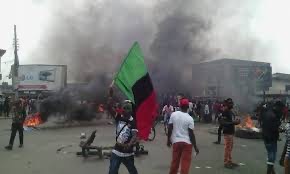
Now That The Southeast Is Burning


"Even a 90-minute trip from Onicha to Owere seems like a death wish. Those who are alive are robbed of sleep. Those unlucky are robbed of life."


Southeastern Nigeria is witnessing a baptism of blood, sweat and tears. For a region known as Nigeria's most peaceful not long ago, its slide into wanton state and non-state violence is a reality of grave concern. The actors are variegated, as are the typologies of the violence: assassinations and targeted killing of law enforcement officers; citizens terrorized by sit-at-home enforcers; indiscriminate arrests and extra-judicial killings by military forces; contract killing and armed robberies, etc.


People travelling in tinted SUVs do so at grave personal risk today. Worse still if they're travelling with police or army escort. Others going about their businesses are also unsafe. Even a 90-minute trip from Onicha to Owere seems like a death wish. Those who are alive are robbed of sleep. Those unlucky are robbed of life.


This sorry path was a destination foretold and forewarned, but there is certainly enough blame to go round. There is the inertia caused by poor governance in the region. We have governors who do not pay salaries, who owe pensioners, who do not create employment, who do not respond to the open extortion of their citizens by police officers. They also failed to respond to the loss of lives in Igbo communities at the hands of Fulani-herder militias. Their lack of legitimacy created the vacuum that Nnamdi Kanu occupied and exploited.


Read Also: Nnamdi Kanu: A visit to the Afaraukwu monument of bullet holes


Then you have IPOB/ESN, whose agents felt the only way to assert their grievances and those of the region was to burn down police stations and target security agents. It seemed like a good gamble to endure since no one loved the police, and the Fulani herders were run out of our bushes. Finally, there is Buhari's government breaching international law to rendition Kanu to Nigeria and initiate a contrived trial. Sure, the violence preceded Kanu's rendition, but his shambolic trial made it worse. One mustn’t forget the multiple jailbreaks across the region, which unleashed into the society, people who are supposed to be locked up.


At first, many in the region quickly rationalized the utility of IPOB/ESN's actions, even as the group treated the Southeast like their personal gulag. Some even believed they were exercising freewill solidarity towards the Biafran course. But the danger of riding a tiger is that one can easily end up in the animal's belly. To disagree with IPOB was to be called names and, in some cases, threatened. We heard all kinds of silly rationalizations for their crude strategies. Rosa Parks and Nelson Mandela were even dubiously cited as justification for the carnage in our land.

The escalation of danger to the present precipice reminds me of the boiling frog theory. The theory holds that the frog reacts to a pot of boiling water in two ways. If the frog is suddenly thrust into steaming water, it will immediately jump out. However, if the animal is put into water which is then boiled slowly, it will not perceive the danger. Instead, it will keep adjusting to the temperature of the boiling pot until it is cooked to death. The provenance of this claim is not known, but it serves as a relevant metaphor for how an entire region somnambulated in the face of danger until it is too late. Even politicians shamelessly sought to take advantage of IPOB's seeming popularity despite their misguided tactics. Some of us also took refuge in our silence and said nothing. We watched people conveniently declare after every attack that it is the work of the DSS. We cowardly denied the truth of our own eyes and chose the warmth of a convenient lie.


Read Also: Under IPOB's present reign, Ndigbo have the foretaste of a different Biafra


Things have now come to a head. The Southeast is now a custodian of some of the most lethal elements in the country. Too many faceless killers, too many unknown gunmen and too many unknown soldiers. Neither life nor property is safe, no matter the lies we try to tell ourselves. Without some modicum of certainty and normalcy, a society begins to fold into itself. When this happens, people and investments flee. Those who stay are often unable to commit their resources to the land. Those who flee do so with pain and trauma that may take a lot of time to heal. Slowly and steadily, such a land surrenders its promise to the dark forces that have cordoned it from light. We may act like all is well, but we are just ignoring the corpses piling up in our courtyards. It does not change the reality.


With 2023 elections fast approaching, Buhari has the Southeast region, which he hates so much, where he wants it. He knows that IPOB is now a fragmented entity, laden with internal squabbles. It cannot bring under control the violence it started. All manner of killers now operate under their logo, with or without their permission. It is a lesson of how not to start what you cannot finish.


Buhari knows that the impetus of the Biafran agitation has now been muddied, if not overtaken by an orgy of senseless violence. He needn't worry about Nigeria's territorial integrity anymore. He has taken a ringside seat to watch the region crumble and burn. Campaign season will soon commence, and politicians and their supporters will be doing so at enormous risk. An unimaginable apathy may plague election turnout. The danger is that even if people braved the climate of fear to vote, a shady INEC will have found sufficient alibi to underreport the numbers. For a region struggling to pull its weight nationally, our shackles only seem to be multiplying.


In a time like this, the age-old Igbo adage that says, "onye ajuru anaghi aju onwe ya" comes to mind, and I dare add, provides some comfort. The Southeast must rise and free itself from the pestilence of its current captors, whomever they may be.

Wednesday, March 18, 2020

An Open Letter To South East Governors’ Forum: Freedom Comes In Many Ways


Dear SE Governors,

I was constrained to write you this letter after carefully watching Nigeria’s political developments over the years as they daily unfolded.

Many of us, Igbo sons and daughters who were forced by situations in Nigeria to migrate to Europe, America and elsewhere are worried sore that the security of life and property, especially in the northern parts and by extension the entire country, has continued to pose serious challenges to our political leaders that seem to defy solution.

We are worried about the inability of our political leaders to fix the national economy and appreciate naira value.

We are concerned about the seeming unwillingness of our political leaders to fully integrate Nigerians socially, for instance, by making the study of the three major languages, Hausa, Igbo and Yoruba compulsory at the primary school level in all schools across the country. In such a way, the bridge would have been built across tribal sentiments and in less than two generations, Nigeria would be on its way to achieving true nationalism.

We are concerned that general uneasiness in the country is being manifested in several ways, despite government’s intervention efforts, and it is worrying.

As the political leaders of the Igbo nation, I do not need to remind you that all Igbo at home and in the Diaspora are looking up to you to salvage them from the circumstances that have sandwiched and trapped them in the enclave they call their country. Progressively going forward in the spirit of one united and prosperous nation has become a herculean task for them because the low or no value some people in the northern parts of the country have determined to place on human life, the lives of fellow Nigerians, is at great variance with the values and aspirations of the Igbo, and going back is just impossible. They are stuck between the devil and the deep blue sea.

Sadly, some of the simple ways the federal government should have addressed these issues were lost to tribal politics and our people have continued to suffer as a result. These issues are captured in the first and second volumes of my book “The Presidential Years: From Dr. Jonathan to Gen. Buhari”, published by Austin Macauley of London, and can be purchased online from Amazon, eBay and other major online bookshops.

As the political leaders of the South East Zone of Nigeria, I hasten to remind you that when the founding members of the South East Governors’ Forum, Chimaroke Nnamani of Enugu, Chinwoke Mbadinuju of Anambra, Achike Udenwa of Imo, Sam Egwu of Ebonyi and Orji Uzor Kalu of Abia sat for the first time, they pledged to work together, irrespective of their political leanings, for the interest of the larger segment of South East communities.

At that time, critics of the Forum alleged that the governors were not doing enough to develop the zone. They failed to attract the attention of the federal government to the deplorable condition of infrastructure in the zone, especially the roads. Even as we speak, most of the federal roads in the South East have remained nothing but death traps and many people are worried about why their South East governors have not deemed it necessary to go beyond rhetoric to, at least, embark on the repair or modernization of these roads themselves and get a refund from the federal government if there are provisions in the law to that effect.

Even judging from the now moribund joint economic ventures in the South East zone, such as the Cooperative and Commerce Bank (CCB), the African Continental Bank (ACB), the Nkalagu Cement Factory, the Anambra Motor Manufacturing Company (ANAMCO) and the Emene Floor Mills, among others, most Igbo at home and in the Diaspora are of the opinion that their governors need to be more proactive in their quest to improve the lot of the South Easterners they represent by reactivating some of these unifying ventures or building new ones.

What they expect is that a strong debate on the review of the Nigerian constitution of 1999 which was drafted by the military purely for the benefit of the north should keep resurfacing until something tangible is done to abrogate it completely and a working constitution drafted by civilians, the elected representatives of the people, is in place.

It has indeed become necessary for the leaderships of the Nigerian government to consider returning to the letters of the constitutional document which Nigerian leaders negotiated with the British government between 1957 and 1959 that granted Nigeria independence.

It was on the basis of that constitution that the three regions agreed to acquire independence as one united country. It was the foundation of what came to be known as a united Nigeria. It was a negotiated constitution. If the three regions had disagreed on the contents of the constitution, there would have been no Nigeria as it was at independence.

In 1966, the military invaded the political growth of Nigeria and aborted its democratic evolution. They discarded the negotiated constitution and introduced one that was not only un-negotiated but one they insisted was un-negotiable, and still expected Nigeria to remain united – possibly by force because they had the gun, and that was important or so it seemed at the time!

The negotiated constitution gave considerable autonomy to each of the three regions. Each region collected its own revenue and contributed an agreed percentage of its gross earnings to the central government. Each region was in charge of its roads, education, medical services and rural infrastructure.

But when the military came into the political arena, they turned the table upside down, weakened the regions economically and strengthened the centre. Like the one party system that the army is, all authority flowed from Abuja, in terms of finance and in terms of security.

The imposition of its constitution on Nigerians by the military would have been unacceptable to the leaders of the three regions at the time – Sir Ahmadu Bello, Dr. Nnamdi Azikiwe and Chief Obafemi Awolowo – and many well meaning Nigerians would agree with this.

The current constitution was drafted by the military under General Abacha and was skewed to favour the north. Before then, the regions were federating units. There were four different constitutions – the federal constitution, the eastern constitution, the northern constitution and the western constitution. That was to the extent the regions were autonomous at independence.

Each region had its own ambassador in London. He was known as the Agent-General while the federal ambassador was known as the High Commissioner. M. T. Mbu was Nigeria’s High Commissioner in London at independence. The ambassador for Eastern Nigeria was Mr. Jonah Achara. That of Western Nigeria was Mr. Omolodun. And for Northern Nigeria, it was Alhaji Abdulmalik. These were the four men who were regarded as ambassadors of Nigeria in the UK by the time the country had independence in 1960.

But now states have been created in place of regions. And even though that seems to have complicated issues more, the creation of zones by Gen. Ibrahim Babangida provides an escape route from that stranglehold that was the 1999 constitution.

My take is that we can still manage to come by something close to the regions. Each of the zones General Babangida created during his tenure as military president can now be regarded as a region so that instead of the four regions the country had at independence there will now be six regions. The same level of autonomy can be given to them as was given to the regions before and after independence in 1960.

The north can then carry on with their northernisation or Arewanization policy. The East can embark on their Eastern or is it Biafranization policy and the West on their Westernization or Oduduwanization policy. They meet at the centre. They meet at the centre to agree on their democratic norms and values in the knowledge that true democracy must be negotiated by the federating units. Anything short of that is military imposition and it is not generally acceptable to many knowledgeable Africans.

What the Igbo expect is that the second Niger Bridge should be in place before the termination of the Buhari tenure.

What they expect is that their SE governors can liaise with foreign investors to get light railway trains shuttling between and connecting the major cities of Abia, Anambra, Ebonyi, Enugu and Imo states.

What they expect is that when the Igbo say they are the best in business they should prove themselves right. If the Igbo are known to develop other communities, other countries, why are they unable to develop theirs? That is not something to be proud of, and it is down to the political leaderships of the SE to turn around the vision and focus of the Igbo to begin to look inwards.

I am being emphatic here about railway transportation between Abia, Anambra, Ebonyi, Enugu and Imo and the intra-links between their cities like Owerri, Okigwe and Orlu in Imo, for example. Our SE governors should map this in their head and see what the zone would look like with these facilities in place.

All eyes of Igbo elites at home and in the Diaspora are on you governors. They expect you to buttress the role the National Assembly would play especially in the struggle to decentralize authority from Abuja and give zones a financial autonomy that would synchronize with the original documents that gave independence to Nigeria.

It is against this background that the governors of the South East zone should decide to pursue issues affecting their people through regional integration. This calls for an honest pooling together of resources. You can arrange for any country or business enterprise to partner with you on transportation. Our people need a network of railways that would connect major cities in Abia, Anambra, Ebonyi, Enugu and Imo with their state capitals, even if they are light railways.

It is unnecessary to keep agitating for a break-up of Nigeria if our people can develop their communities on their own. They would have literally broken up without breaking up – which is the best policy for South East in their circumstances since the end of the Nigerian civil war.

Take a look at Great Britain today. There are four nations that make Britain great: England, Scotland, Ireland and Wales. Each of them has complete autonomy. They have their currencies. They have their parliaments. They have their flags. They run their systems on their own. And they all subscribe to a central government and that is what makes them great. South East governors can insist on that pattern of relationship in Nigeria. Then, the Igbo will not see themselves as living in bondage any more. Freedom comes in many ways.


Emeka Asinugo is a London-based journalist, author of “The Presidential Years: From Dr. Jonathan to Gen. Buhari” and Publisher of Imo State Business Link Magazine
Wednesday, March 4, 2020

Arresting Insecurity In South-East

Prof. Ben Nwabueze


BY OKEY MADUFORO

Constitutional lawyer and Chairman Igbo Leaders of Thought, Prof Ben Nwabueze, could not hide his anger over the killings in the South East when he spoke with reporters shortly after a meeting of the body.

Nwabueze alleged that the inability to fight insecurity in the zone was as a result of the fact that most of the state police Commissioners were from the North and did not understand the terrain, adding that some of them have compromised their duties as the chief law enforcers in their respective states.

He, on that day, urged the Federal Government to transfer senior police officers of Igbo extraction to their respective states in order to checkmate the killings in the five states of the South East.

While leaders of Ndigbo were still nursing the concept of a joint security outfit in Igbo land, the governors of the South West took up the initiative by launching what the Amotekun, which is currently jolting the country’s landscape.

Founding National Chairman of the All Progressives Grand Alliance (APGA) and National Chairman of the United Progressive Party (UPP) Chief Chekwas Okorie told this reporter that the development is an indication that the West has made a strong statement about the killings in their homes, adding that the West have declared war on all manner of brigandage being perpetrated by herdsmen and their co-travellers.

He challenged the leaders of the South East to show capacity by putting in place a foul proof plan towards guaranteeing security of life and prosperity in the geopolitical zone.

In what appears to be a pilot to the need for a regional security apparatus in the area, Present General of the Ohanaeze Ndigbo, Chief Nnia Nwodo, told reporters in Enugu that the body would no longer watch their kit and kin being slaughtered by blood tasty bandits and that the body is more determined than ever to tackle the matter head long.

Nwodo urged Igbo elders to meet with them and fashion out ways of fighting violent crime in the area and that the Ohanaeze Ndigbo would give them every assistance they needed.

Consequent, the South East Governor’s Forum led by Ebonyi State Governor, Engr David Umahi had announced the formation of a Joint Task Force (JTF) on security in the area.

According to the resolution by the five governors, it has become imperative to put up a security outfit jointly sponsored by the respective governments in Igbo land.

That the South East Governors had formed their South East Joint Security on July 28, 2019 and inaugurated her Committee on Joint Security on the August 31, 2019.

The forum took briefing from the Chairman of South East Joint Security Committee and are satisfied with all the arrangement that will lead to South East State Houses of Assembly to enact a law to back up the South East Security Programme with a name to the outfit.

“Forum had written the Federal Government in this respect and at an appropriate time, we shall be inviting the Federal Government to note the details of our Joint Security Programme.

“We wish to assure our people that we have our State Vigilante and the Forest Guards in all the South East States, who work with security agencies daily in our various communities for protection of lives and property. We, again, assure our people that the protection of their lives and property is paramount to us and we are committed to just doing that.”

Ever since the pronouncement, there have been reactions and counter reactions on the subject matter as was shown by first Republic Minister for Aviation, Chief Mbazuluike Amaechi.

“Is it now that they are coming home to the issue at stake? All the same, it is morning yet on creation day and better lait than never.

“This should not be the type of lip service that we pay to highly challenging issues.

“They should draw references and ensure that the enabling law is put in place to give it the bite that it needed and we should not begin to play politics with the security of lives and prosperity.

This is not a political party thing but a turning point in the bid to protect our people and guarantee their safety at all times.”

Former Governor of Anambra State, Chief Chukwuemeka Ezeife, noted that it was not about setting up a joint task force but the execution.

“We don’t have anything against the security initiative of our governors but how they intend to carry out this task. The West took their time to assemble the concept and thoughts together before the launching and what we saw on that day shows that they mean business.

“I hope that our own will not be more of grandstanding and so much fanfare without substance and they must be seen to be doing their job effectively and efficiently.”

Tuesday, February 25, 2020

Igbo Governors Get 90 Days To Establish Regional Security


OWERRI (VANGUARD)
--The Igbo National Council, INC, on Tuesday, handed down a 90-day ultimatum to the governors of the five states of the South-East zone, to establish a regional security outfit just like the Northern and South-West regions did.

The warning came from the statement issued in Owerri, by the INC, National President, Chilos Godsent, alongside other executives after their meeting.

According to them, failure to do so that their people would be encouraged to protect themselves from the killings by suspected armed herdsmen said to have camped themselves in the forest of the zone. 

He said: “We wish to inform the people of the Igbo Race that the proposed community policing by the IGP is meant to officially aid the framework for intelligence gathering and invasion of Igbo communities by the Jihadist. 

 “On the foregoing, the Igbo National Council (INC) request the Governors of the South-East, South-South and North-Central geopolitical zones respectively as a matter of urgent necessity to establish and officially inaugurate their regional security outfits like the South-West (AMOTEKUN) and North-West (SEGE KA FASA) within ninety days from 29th February 2020 as a sign of patriotism and commitment to the security and welfare of their citizens. 

“We note that failure for the Governors of the aforementioned geopolitical zones to adhere to this call, the Self-Determination groups in those geopolitical zones may be compelled to take their destiny into their own hands in other to protect their citizens from the rampaging Fulani Jihadist.

“The meeting supports in its totality the call by the National Assembly (NASS) of the Federal Republic of Nigeria urging President Mohammadu Buhari to sack all the Service Chiefs with immediate effect. 

“The reality on the ground has clearly shown that the present crops of service chiefs can no longer protect the lives and properties of Nigerians who are daily slaughtered like cows and chickens by Boko Haram, Fulani Herdsmen and Fulani Jihadists.” 

They continued: “The meeting condemned the wanton arrest and arbitrary detention of the elders and people of Ifite-Ogwari community in Anyamelum Local Government Area (LGA) of Anambra State for the simple reason of defending their community from Fulani Herdsmen who have continued to attack and kill members of the Ifite-Ogwari community in their ancestral land. 

“On the foregoing, INC urge the Government of Anambra State to rise up to the responsibility of protecting the lives and property of the people of Anambra State. 

“The NWC meeting urged the Federal Government to be very sensitive of the untold hardship the people of Southern Nigeria are passing through because of the border closure. On the above, INC, therefore, requests the Federal Government to reopen the southern border or otherwise close the porous Northern borders where too many smuggling activities have been taking place since the politically motivated closure of the Southern borders. 

“Finally, the Igbo National Council (INC) wish to advise the leadership of Miyetti Allah in Nigeria to urge her members who now camp in many forests in South-East and South-South geopolitical zone to immediately vacate those forests or regret their deviancy.”

Wednesday, February 12, 2020

NEWSROOM: S’East Leaders To FG: Declare Herdsmen Terrorists

Map of South East


Plans ‘Operation Ogbunigwe’ to fight insecurity
Govs adopt community policing
It’s the way to go, says IGP


BY KENNETH OFOMA

ENUGU (NEW TELEGRAPH)
--South-East leaders, comprising members of apex Igbo body, Ohanaeze Ndigbo, traditional and religious leaders, yesterday, called on the Federal Government to declare killer herdsmen terrorists and tinker with the constitution to allow digbo to establish a regional security outfit to be known as “Operation Ogbunigwe.”

The Igbo leaders made the call during a security summit, with the theme: “Strategic partnership for defective community policing in the South-East,” organised by the Nigeria Police in partnership with governors of the five states of the zone.

The event was attended by police hierarchy led by the Inspector-General of Police (IGP), Mohammed Adamu; Governors Ifeanyi Ugwuanyi (Enugu), David Umahi (Ebonyi), Willie Obiano (Anambra), Okezie Ikpeazu (Abia) and the deputy governor of Imo State, Prof. Placid Njoku, who represented Governor Hope Uzodinma.

Also in attendance were a cross section of Igbo leaders, including Ohanaeze President General, Chief Nnia Nwodo; religious leaders and prominent traditional rulers.

Nwodo, who decried rising insecurity across the country, called on the Federal Government to allow the South-East to establish a security outfit to be named “Operation Ogbunigwe” to tackle the menace.

“Section 14 of the Constitution gives the governors as chief security officers, the power to provide security for their people. If the governors are not fully integrated in the processes of community policing, including recruitment of the special constables among other things, then it is dead on arrival. What our people want is to own our domestic security. There must be a way our law will allow us to have our own Ogbunigwe,” he said.

Also decrying a situation where no police commissioner of Igbo speaking state was posted to any state of the region and posting of one State Director of the Department of State Services (DSS) of Igbo extraction to one state in the zone, the Ohanaeze President General wondered how people with a different language, religion and culture can effectively police other people with opposing features.

He consequently called for dismantling of excessive and oppressive security check points within the region, saying that he personally counted 17 of such roadblocks along the Enugu-Onitsha expressway and they all serve as toll gates for financial extortion.

The Archbishop of Enugu Anglican Ecclesiastical Province, Most Rev. Emmanuel Chukwuma, who spoke on behalf of other religious leaders, called on the Federal Government to declare killer herdsmen as terrorists.

“The Federal Government should declare Fulani herdsmen as terrorists. Our men and women don’t go to their farms any longer. Government should reduce the number of roadblocks in the South-East and reduce the number of policemen attached to politicians. Some politicians have 20 policemen, while we don’t have enough,” he said.

However, governors of the South-East in their submission resolved to adopt the Community Policing Programme of the Nigerian Police Force to solve security challenges in the zone.

Chairman of the South-East Governors Forum and governor of Ebonyi State, Umahi, who stated the position of the governors at the summit, said they were satisfied with the Inspector-General of Police strategies for the implementation of the community policing programme in the zone.

Umahi, who noted that the governors had earlier had a closed door meeting with the police boss at Enugu Government House before coming to the Base Event Center, Enugu, venue of the summit, stated: “We reached satisfactory and acceptable decisions and agreement. We can assure you that all the concerns of security challenges we have here in the South-East as presented here by the President of Ohanaeze, our religious leaders and of course our traditional fathers was not different from what was handed to us and we went through that with the IGP without letting you know the details. We assure you that all the challenges are being addressed.”

The governors noted that explanation and details provided to them by the IGP gave them the confidence to assure the people of the zone that community policing is not different from the neighbourhood watch, vigilante operation and forests guards as well as the herdsmen and farmers peace committees.

Umahi further said that the governors resolved as follows: “We decided as your governors to embrace the initiative of community policing, which is an official endorsement in line with the Police Act as part of what we are doing to safeguard the lives and property of our people. We commend the IGP so much, he is a man that is committed to professionalism. Even the roadblocks, we have discussed it and you will begin to see a lot of changes from today.

“Taking into cognisance the existing security initiative instituted by governors of the states in the South-East geo-political zone at the various local level such as vigilante group, the neighbourhood watch, forest guards among others which are in conformity with the community policing strategy, the state governors have accepted and adopted community policing as an effective tool in bringing policing to the grassroots.

“Community policing committees made up of traditional rulers, community leaders, town union leaders, religious leaders etc., within the locality will be charged with the responsibility of selecting and recruiting community policing officers that will work within the communities.

“The governors of states within the South-East geo-political zone are to reinforce and provide improved capacity for the police and other security agencies in their respective states in support of the community policing programme. This is as the states within the South-East zone will individually and periodically undertake operation against crimes and criminality in synergy with the police and other security agencies.

The Chairman of Enugu State Traditional Rulers Council, HRH Amb. Lawrence Agubuzu, who spoke on behalf of traditional rulers in the zone, said the royal fathers stand with the position of the governors.

The IGP had earlier stated that the community policing model being envisioned for Nigeria under the current dispensation is one that will draw on the legal opportunities provided by the Police Act for the engagement of special constables, who in this instance, will be engaged as community policing officers under the coordination of the Nigeria Police towards evolving a community-focused policing architecture.

His words: “Provisions for the establishment and utilization of Special Constables is provided for under Section 49 of the Police Act and they are appointed in accordance with the provisions of Section 50(1) of the Police Act.

“In view of these provisions which approve them to serve particular purposes and which also confer upon them, the powers, privileges and immunities of police officer within their localities, special constables will be trained and used as Voluntary Community Police Officers to drive the Community Policing initiative at the grassroots level.

“This event is convened within the framework of our community policing initiative and as part of the strategies of the Nigeria Police to employ an all-inclusive strategy toward aiding us in the achievement of our internal security mandate, particularly in the South-East states.

The IGP said the summit was the sixth in the series and that all ended with very successful outcomes and the strategies jointly developed as well as partnerships built have so far been effective in addressing the security threats that are peculiar to each zone.