Monday, December 13, 2021

Nd'Igbo: 10 Years Without Ojukwu


BY MAGNUS EZE AND GEORGE ONYEJIUWA


Igbo hero, Dim Chukwuemeka Odumegwu Ojukwu, who led the people of defunct Eastern Region to a 30-month war between Biafra and Nigeria, died on November 26, 2011. In commemoration of his death, founder of the Movement for Actualization of the Sovereign State Biafra (MASSOB) and the Biafra Independent Movement (BIM), Chief Ralph Uwazuruike, has consistently hosted the Ojukwu Day on November 26 at the Ojukwu Memorial Library built in honour of the Ezeigbo Gburugburu, in Owerri, Imo State capital.

The celebrations were usually marked with fanfare and have attracted the Igbo and other Nigerians from far and near. In the last decade since the Ojukwu Day began, several important personalities from across Nigeria had graced the event including the late founder of Odua People’s Congress (OPC), Dr Fredrick Fasheun; Major Al Mustapha, Chief Security Officer to the late Military Head of State General Sani Abacha and the 1996 Long Jump Olympic Gold medalist, Assistant Commissioner of Police, Chioma Ajunwa.
Breaking News, Nigerians can now work in Nigeria and get paid in US Dollars Click here to apply today .

The late Nri monarch, Onyesor Obidigwu; former Secretary General of Ohanaeze Ndigbo Worldwide; Uche Okukwu; Niger Delta activist, Asari Dokubo; former Ohanaeze Ndigbo President General and Secretary General, Dr Dozie Ikedife and Col. Joe Achuzie (Rtd) respectively as well as politicians had also graced the memorial.

Ojukwu Day has become a veritable platform where issues militating against Ndigbo are discussed and solutions proffered. Chairman of this year’s event was no less a person than Afamefuna Ojukwu, son of Bianca, widow of the late Biafra leader. The younger Ojukwu who has become the youngest chairman of the event was fittingly ushered into the arena by the Ijele masquerade, the biggest masquerade in Igbo land.

Painfully, no South East state government has in the past 10 years identified with the Ojukwu Day, this was condemned by Afamefuna. He accused governors of the five South East states of abandoning his father in death. His mother, Bianca, had raised similar issue in the past. She alleged that Governor Chief Willie Obiano of Anmabra State has not given her husband the due recognition, but using his name during elections.

Afamefuna lamented governments of states, which his father fought to defend their people turned their backs on him after his burial. He praised Uwazuruike for keeping Ojukwu’s name alive at all cost and urged the Igbo to use the 10th anniversary of his exit to look back and look deep, while not forgetting the vision planted so long ago:

“Ten years ago, when my father, Ikemba, Eze Igbo Gburugburu left us, I was a child. Yet, I can never forget the outpouring of love that you, ummu nne m, showed him. In life and in death, you stood with him.

“Since that fateful day 10 years ago, Okenwa, Chief Ralph Uwazuruike, who in his lifetime took the baton of fighting for our people, has also taken it upon himself to celebrate my father year after year. As he honoured the Ikemba in life, he has continued to honour him in death.

“In these almost 10 years, no state governor in the South East has done this incredible and noble task, despite the fact that Eze Igbo Gburugburu was our leader through a war to save us from the genocide that faced our people.

“Today, we live in a world where many prefer to forget the battles waged to bring us this far, the sacrifices of so many in this unrelenting quest to end our marginalisation and the continued fight for a just and equitable state that we can live in without oppression. Nobody without passion for his people and a spirit of sacrifice can lead us to the Promised Land, no matter how genuine their intentions may be.”

Deputy Governor of Anambra State, Dr Nkem Okeke, who was the special guest of honour, also commended Uwazuruike: “We are here today to honour the memory of a great man, a true son of Ndigbo. He was a brave man with integrity who loved his people and stood for truth all his life. I am here to show solidarity to his family and I will continue to stand by them.

“Ndigbo are great people and all we need is unity of purpose and with that we can achieve whatever we want. We must stand together and if we don’t do that, we will never achieve our desired position in Nigeria.”

The guest speaker, Prof Proteus Uzoma, presented a paper titled; “The Marginalization of Igbo Nation and the Call for Nigerian unity –The Way Forward.” He noted that the Igbo nation has continued to face enormous political and economic challenges since the instigated and imposed civil war by the General Yakubu Gowon-led Federal Military Government.

He asserted that Nigeria would only be considered normal in terms of where Ndigbo stood vis-a-vis the other ethnic nationalities politically and economically. The Professor of Philosophy noted: “The Igbo people in reality experienced an overwhelming level of disadvantages based on public policies that seemed crafted to undermine their ability to maximize political and economic potentials.

“The restructuring of Nigeria to create more states for the northern states to the detriment of the Southern Nigeria, especially, the South ast was not only an impediment politically; it impacts the economic potentials of the Igbo people negatively.

“Such policies as the failure to rehabilitate the Biafra land after the war, the 20 Pound flat refund to any Biafran who wished to convert the old currency, or deposits with bank prior to the war; the Nigerian Enterprises Promotion Decree of 1972, also known as Indigenization Decree, federal character principle, manipulated population census, creation of states and local government areas in favour of the Northern Nigeria, deliberate underuse of seaports within the Igbo axis, lack of standard international airport and other exploitative actions speak volume.

“These formed many overt and indirect actions to diminish the ability of the Igbo people to compete on a level-playing ground with other major ethnic groups. This has given rise to the current agitation in the South East for equity, justice and fairness.”

He posited that the only remedy to the current agitation both in the South East/South West is restructuring of Nigeria into a true and real federal polity as well as conceding the presidential slot to the Igbo in 2023 for equity and justice:

“The crux of the matter lies in fact that the Nigerian Federal Government has too much powers, plays dominant roles and overbearing influences that have been grossly abused, thus leading to intensified calls for restructuring, coupled with suppressed frustrations and resentment during the military interregnum; resulting in inter-communal violence now threatening the peace and unity of Nigeria.

“Come 2023 and in accordance with the gentleman’s agreement among the Southern and Northern Nigeria in 1998, power must rotate to the Southern Nigeria, and since the South West and South-South have taken their own shots to the Presidency since 1999, ‘to-be-and-not-to-be’ is the question. Will a South-Easterner be the next President of Nigeria or not?”

Bianca in a vote of thanks lauded Uwazuruike for ensuring that the memory of her late husband was kept alive: “Some other person may have given up after two years. But this is the tenth year and I am grateful for what he has been doing including the Ikemba Ojukwu Library he built.”

She called on President Muhammadu Buhari to heed the appeal of eminent Igbo elders led by First Republic aviation minister, Chief Mbazuluike Amaechi, who recently paid him a visit to ask for the release of detained leader of the Indigenous People of Biafra (IPOB), Nnamdi Kanu.


The King Of The Jews


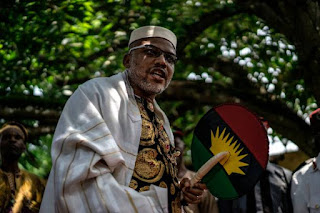
Leader of the Indigenous People of Biafra (IPOB), Nnamdi Kanu, wears a Jewish prayer shawl as he walks in his garden at his house in Umuahia, on May 26, 2017, before meeting veterans of the Biafran War. Image: Marco Longari via AFP


Biafran separatist leader Nnamdi Kanu has infused his movement with a Jewish sectarian identity in a country riven by tensions between Christians and Muslims. Is he putting Nigeria’s Igbo Jewish community at risk?

TABLET MAGAZINE

In early July, three young Israeli filmmakers—Rudy Rochman, Andrew Noam Leibman, and Edouard David Benaym—traveled to Nigeria to film a documentary on Africa’s lesser known Jewish communities. They were arrested by the Department of State Services (DSS), Nigeria’s internal security organization, on informal charges of supporting Biafran independence, and were held in custody under reportedly terrible conditions for 20 days, along with an Igbo Jewish woman. For the duration of their arrest, the Israeli filmmakers were not informed about the charge or the expected length of their detention. Their capture seems to have been prompted by photos showing them presenting a Sefer Torah to a local shul, and a shiviti to a local Igbo royal, that were shared on Facebook by political supporters of Biafran independence.

Thus did the filmmakers learn about Nigeria’s Igbo problématique in the hardest possible way: Biafra, a southeastern territory that seceded from Nigeria between 1967 and 1970, is predominantly populated by the Igbos, 2 million of whom died of starvation during the Nigerian Civil War. Jeff L. Lieberman’s 2012 documentary, Re-Emerging: The Jews of Nigeria, had drawn attention to the fledgling community of Torah observant converts among the Igbo, who consider themselves “biological” Jews, but didn’t so much as mention the issue of Biafra secessionism or Igbo nationalism.

But when the face of the secessionist movement, Indigenous People of Biafra (IPOB) founder Nnamdi Kanu, was arrested on June 27, 2021, his supporters abroad protested for his release by waving Israeli flags. In 2017, after a similar arrest and 19 months in custody, Kanu had declared himself a Jew and a “believer in Judaism” in front of the judge. In 2018, while on Israeli television, Kanu called on Israel to “come and defend Judaism all over the world.” In March of this year, his opponents within Nigeria’s Jewish community (including Chief Arthur-Regis Odidika, president of the Nigeria Jewish Community) publicly claimed that Kanu’s ethnic Igbo secessionist supporters are trying to take over the otherwise apolitical and peaceful Jewish communities in southeastern Nigeria, and accused him of un-Jewish “proselytizing” on Radio Biafra. As of this writing, Kanu remains in the custody of Nigeria’s DSS, and his trial, adjourned for the first time in late summer, was adjourned again after Oct. 21, when he pleaded not guilty to charges of “terrorism, treason, involvement with a banned separatist movement, inciting public violence through radio broadcasts, and defamation of Nigerian authorities through broadcasts.”

Kanu’s mix of Jewish identity, rock star political status, and advocacy for ethnic separatism is an unusual one. It is difficult to deny that he is advocating for an armed insurgency among Igbos, a “tribe” that numbers upward of 50 million people in a country with a total population of 206 million. Igbos have historically constituted a majority in southeastern Nigeria, have traditionally maintained “acephalous” political systems (i.e., lacking in leaders or hierarchies, instead depending on consensus among different age groups and secret societies), and have also upheld cultural traditions of matriarchy, as well as shared political power among both women and men. Today the Igbos are famous for their entrepreneurial spirit.

Beyond the well-known case of Ethiopia’s Jews, sizable Jewish communities have existed all over Africa. In Uganda, South Africa, and Zimbabwe, genetic traces of Cohenic ancestry were recently discovered, and in the Sahel, the Jewish presence goes back millennia. But no DNA evidence has yet substantiated Igbo claims to Jewish ancestry, although the claim is at least as old as the late 18th century, when it was made by the Black British intellectual and abolitionist Olaudah Equiano. In Kanu’s idiosyncratic version of history, 50 million Igbos are in fact 50 million Jews, the vast majority of whom are Christian merely because they were misled by colonialist missionaries. Estimates put the mainstream Igbo Jewish population in Nigeria at only 12,000-15,000. But in Kanu’s telling, the Igbo Jews have no intention of remaining part of Nigeria or settling in Israel, but only of bringing about the independent State of Biafra.

Behind Kanu’s grand claim is, in fact, a core group of diehards. Kanu may be an eccentric who has himself photographed in tallit and a Fendi tracksuit at the Kotel or in the custody of security agents at undisclosed airports. But Nigeria’s very serious Igbo Jewish community is earnest in its beliefs. William F.S. Miles’ 2012 book, Jews of Nigeria: An Afro-Judaic Odyssey, provides a vivid account of the fervor with which mitzvot are performed by the Igbos, from bar mitzvah celebrations and davening, to concern for the timing of lighting Shabbos candles, mikvah rituals, putting on tefillin, and even women donning wigs. Some synagogues in Nigeria are eager for a more Orthodox relationship with Torah that reminds one of some Breslov communities, in which balei teshuvah (the newly religious) make up the majority. It is no coincidence, perhaps, that the Breslov Rabbi in Jerusalem Dror Moshe Cassouto considers the Igbo a lost tribe of Israel and shares sympathetic accounts of their plight on his Facebook page.

Others in Israel have shown less enthusiasm: In 1993, the Israeli Supreme Court declared that Igbos were not Jews, and David Sperling, professor emeritus of Bible at Hebrew Union College, has said that the notion of Igbos as a lost tribe is “mythical.” Miles, who does not deny that genetic claims are unsubstantiated, argues nevertheless that in the case of the Igbos, theology should trump DNA, given the seriousness of their practical commitments and observance.

According to Igbo lore, their common ancestor is Eri, the fifth son of Gad. Igbo customs that point to a possible Judaic connection have historically included circumcision on the eighth day of life (universal for Igbo males), niddah (physical separation of married women during menstrual cycles), ritual slaughter of animals, and new moon celebrations, to name a few. For practical purposes, however, any verifiable connection to modern Judaism is a contemporary phenomenon, stretching back no further than the late 1960s. The largest denominations of Igbos today are Roman Catholic, Anglican, and Protestant (including Pentecostal and born-again) Christian. One of the more interesting questions is how a modern Jewish community of any size managed to emerge in a hotbed of fervent Christianity. Here it helps to employ a North American parallel.

Messianic Judaism, Jews for Jesus, and similar groups were originally founded with the aim of converting Jews to Christianity. Rabbis like Michael Skobac in Canada and Tovia Singer in Israel spent years trying to keep vulnerable Jews from falling prey to the theology and practices of Messianic Jewish groups, which they saw as engaged in clear subterfuge. But as they did so, they noticed a surprising phenomenon: The messianic groups were actually attracting small groups of Protestants (and other Christians), who then began to move closer to normative Judaism. Today, there is a small Noahide movement in the United States; Orthodox Judaism is the professed ideal of the community, in which most members are former Protestants.

In terms of the number of adherents, messianic groups in Nigeria far outweigh normative Jewish ones. But there has been an observable movement recently by some of the former in the direction of the latter. As a member of a Yahweh Yahshua Synagogue in the city of Umuahia and the scion of the local royal family, Nnamdi Kanu is as much a particularist religious preacher as a separatist political leader. His speeches are peppered with Hebrew names for God (his preference is "Elohim,” perhaps to signify the judgments his enemies should expect from the Heavenly Court), Shabbat, and Israel. He often talks of “this gospel of redemption,” by which he means Biafran armed struggle for independence. But he is often at pains to distance himself from the born-again movements prevalent in Nigeria. He warns against praying to Jesus, presenting him as merely a teacher, the way Unitarian Christians would. Adding to the complexity, he does not discuss the return of the Messiah, but does say things like, “In the year of the Most High Elohim, 2021.”

As an orator, Kanu rages angrily and emotionally as he attacks what he perceives as Fulani (Muslim) domination of Nigeria. He often conflates former generals, oil rig owners, political bosses, and nomadic herders all as the same Fulani. And he takes radical and progressive stances on sociopolitical issues like industrial policy and unemployment. All this appears to be at odds with the constituency of mostly peaceful and earnest Igbo Jews, who do not in any way seem to represent an ethnic secessionist vanguard, let alone a mass movement of 50 million people. According to Odidika, president of the Nigeria Jewish Community and Kanu’s opponent, what we are witnessing instead is an ethnic secessionist movement that is adopting a Jewish religious identity as a way of defining itself against the Messianic, Christian, and Muslim groups from which it seeks to declare independence.

This is, potentially, no small matter. In Nigeria, home to Boko Haram, religion is often a question of life and death, and many of the country’s political problems can take on a religious form. Kanu himself has made his Judaism an ideological weapon with which to fight Muslims (his preferred terminology for the Fulani is Janjaweed, the pro-government militant group of Darfur renown). He calls Nigeria “the zoo,” and his opponents “animals” and “midgets.” In contrast, according to the Igbo Jewish historian Remy Ilona, normative Igbo Jews do not by and large share Kanu’s hatred of Islam or Muslims.

That Kanu’s political program does have an audience likely has more to do with Nigeria’s problems writ large. Nigeria is a major oil producer, and after 2018 it became Africa’s largest economy. It is also a cultural powerhouse, whose high literature is celebrated abroad, whose music and Nollywood films have a global following, and whose vibrant press, civil society, and trade unions are the envy of West Africa. At the same time, a numerical majority of Nigerians live in absolute poverty, and enjoy only a few hours of “town electricity” on most days. Boko Haram and other extremist jihadi groups run rampant across the country, and the Nigerian Army is currently deployed (as opposed to being stationed) in 22 of the federation’s 36 states. Kidnapping, armed robbery, and government dysfunction and predation are features of everyday life. There is a lively scholarly debate about whether the country is currently a failed state, a failing state, or a “successful failed state.”

Kanu’s push for Biafran independence from the federal government thus strikes some people in southeastern Nigeria as far from insane, if not necessarily the best option. But if the Nigerian government commits the mistake of making the imprisoned Kanu into a martyr for the Igbo separatist cause, it may boost Igbo “political Judaism” in the process, perhaps similar to the way the dreaded Boko Haram rose to prominence after its founder allegedly met his death under opaque circumstances at the hands of the Nigerian police. The longer the federal government goes without addressing structural problems like endemic injustice and corruption, the exploitation of religious and ethnic differences by political opportunists will only proliferate. The majority of Igbo Jews may want to simply be left alone and out of this mess, but like other diaspora communities throughout history, they may find themselves instead at the center of a storm.

Two Penn Seniors Named 2022 Marshall Scholars

Two Penn seniors in the College of Arts and Sciences, Kennedy Crowder and Chinaza Ruth Okonkwo, have been named 2022 Marshall Scholars. Established by the British government, the Marshall Scholarship funds up to three years of study for a graduate degree in any field at an institution in the United Kingdom.


PENN TODAY
DEC 13, 2021

University 0f Pennsylvania seniors Kennedy Crowder and Chinaza Ruth Okonkwo have been named 2022 Marshall Scholars. Established by the British government, the Marshall Scholarship funds up to three years of study for a graduate degree in any field at an institution in the United Kingdom.

Crowder and Okonkwo are among the 41 Marshall Scholars for 2022 representing 33 institutions in the United States, chosen from 1,000 applicants. The prestigious scholarship, meant to strengthen U.S.-U.K. relations, is offered to as many as 50 Americans each year.

Crowder, of Landenberg, Pennsylvania, is majoring in English, minoring in East Asian languages and civilizations with a concentration in Japanese, and earning the certificate in American Sign Language in the College of Arts and Sciences. With an interest in critical and creative writing, Crowder is a peer tutor, a course-embedded writing fellow, and a Robeson High School Initiative teacher and curriculum developer at Penn’s Mark's Family Center for Excellence in Writing. She is executive editor for the Penn Undergraduate Law Journal, managing editor for the F-Word feminist literary magazine, and managing editor for The Penn Review literary magazine. In the summer of 2020, she created the collective Black Penn English, a discussion space and support group for Black members of the English Department. Crowder is the inaugural recipient of the English Department Community Award and is in the English Honors Program. An advocate for Black academic excellence, she is a member of the Gamma Epsilon Chapter of Appha Kappa Alpha Sorority Inc. and the Paul Robeson and Anna Julia Cooper Scholars Program and is the community service chair of the Onyx Senior Honor Society. Crowder plans to pursue a master’s degree in Black humanities at the University of Bristol followed by a master’s degree in English and related literature at the University of York.

Okonkwo, of Los Angeles, is majoring in philosophy and history in the College of Arts and Sciences with a concentration in moral and political philosophy and world history and minors in Africana studies; gender, sexuality, and women’s studies; and Native American and Indigenous studies. They submatriculated into the philosophy master's program and will also receive their master's degree upon graduation in May. Okonkwo is a 2021 Beinecke Scholar, an Andrea Mitchell Center Undergraduate Fellow, a Wolf Humanities Center Undergraduate Fellow a Mellon Mays Research Fellow, a Perry World House Student Fellow,  a Robeson Cooper Scholar, and a Benjamin Franklin Scholar. They have done extensive research across the humanities and social sciences throughout their Penn career. Okonkwo’s current independent research project on Igbo philosophy aims to explore Igbo metaphysics and epistemology and reshape the understanding of indigeneity as it relates to Africa. They are also interested in Igbo political philosophy and institutions and in the history of Igbo women’s war. They were an editor for the Penn History Review, a Research Peer Advisor, and founder of a digital radical reading collective. Okonkwo plans to pursue a B.Phil. degree and a D.Phil. degree in philosophy at the University of Oxford.

Crowder and Okonkwo applied for the Marshall Scholarship with assistance from the Center for Undergraduate Research ad Fellowships. Penn has had 21 Marshall Scholars since the scholarship’s inception in 1953 and seven in the past four years.

Thursday, December 9, 2021

How Young Nigerian Girls With Unwanted Pregnancies Are Forced Into Marrying Older Men, Women

 BY CHIKA MEFOR-NWACHUKWU

PREMIUM TIMES


Image via Premium Times


In some parts of South-Eastern Nigeria, there exists a tradition that encourages the families of young girls who get unwantedly pregnant to force them into marrying older men or women.

“My husband died a year after we got married,” began Chinwe Eze (not real name), a young mother of three who told the story of how she was forced into marriage when she fell pregnant for the young man that rejected her pregnancy. “I was 16 then, and he was 65.”

“My husband died on the 3rd of December, 2011,” she explained further, pointing to the wall of her sparsely decorated living room where the date ‘3/12/2011’ was written with white chalk as if to constantly remind her of the death of the elderly man whom she got married to but barely knew.

Chinwe’s countenance, as she narrated her story, was that of one who has resigned to the fate life had thrown at her. She was only a teenager living with her uncle and his wife at Aba in Abia State, South-eastern Nigeria when she was put in the family way.

“My mother was selling okpa (a traditional Igbo food). She used the little money she made to take care of me and my five siblings. My father had no job, so he left everything for my mother to do. And since she couldn’t take care of all of us with her meagre income, she sent us to our relatives to live with them,” she narrated.

Chinwe, who hails from Ezinifite in Anambra State, was sent to stay with her uncle when she was ten. Six years later, a twenty-year-old trade apprentice impregnated her. He accepted the pregnancy but wondered how he, a “boy-boy” (an apprentice), could take care of a pregnant girl. Chinwe’s uncle accepted the N20,000 that the apprentice could raise and bundled her back home to her mother.

“They brought me back home to my parents and my family insisted that I must get married. I refused, but they warned that if I put to bed at home, that I and the baby would have it rough as there was no money to look after us. I had to accept one of the elderly men who came seeking my hand in marriage. He was a widower whose wife died without giving him any issue. I was five months pregnant then,” she narrated.

Chinwe gave birth to her son four months later but the celebration of her childbirth was cut short when her elderly husband died. He was a sickly man whose family desperately wanted him to have an heir before dying; in a society that promotes male ascendancy.

After his death, Chinwe decided to return to her father’s house since her late husband’s family was not treating her nicely. She however did not get that succour she craved in her father’s house.

“My mother was still struggling. I tried to join her in the okpa business but things were not working. My late husband’s family started pressurizing me to come back. I weighed the two options and decided to go back,” she added.


But the option Chinwe took came with a price. Her husband’s family promised to take care of her and her son in exchange for her breeding more babies for her late husband.

“They told me that one of my husband’s brothers would be the one to be sleeping with me. I had to do as they instructed. I now have two more children, a boy and a girl,” she further narrated.

For eleven years, Chinwe, now 27, has had no life of her own as she survives on the little income her husband’s family provides her with. She explained that she wanted to start a business but her family opposed the decision.

“I was learning how to sew when I first got pregnant. Now, even if I want to go back to the trade, who will sign the agreement for me? Who will pay for my training when my husband’s brother seems not to care?” she asked rhetorically.

Chinwe’s life mirrors the condition of many other girls who were forced into marriage on account of “unwanted” pregnancies. These hapless girls have become easy prey to elderly men and even women who desperately want to have their own heirs. They are unceremoniously married off to such people to breed babies for them. In some parts of South-east Nigeria, this practice is seen as normal due to the elevated status given to the male child by customs and traditions.

Randomly sampled opinions across South-eastern Nigeria suggest a woman in the region is duly recognised and is customarily elevated by virtue of her birthing at least one male child. And this makes her fulfilled as she would be accorded more respect than her counterparts who are unable to achieve the same.

In Bondage

While Chinwe was in her own case forced into an unceremonious marriage, Ngozi Asogwa (not real name) was deceived into it. A native of Nsukka in Enugu State, Ngozi got pregnant at the age of 17 in 2016. Her family accepted to marry her off to a man whom she had never seen before. The sister to the said husband approached Ngozi’s family members and told them that her brother had asked her to act on his behalf. Even while they were sceptical about the whole affair, the woman persuaded them to accept the offer by insisting that her brother who resided in Onitsha was busy with his business and would be back as soon as he could.

The woman then came with her family members and performed the marital rites, and months later, Ngozi gave birth to a baby girl. The woman then returned and took her and the baby to her own home where they were to stay and wait for the arrival of the supposed husband. Two years went by, and no husband showed up. This got Ngozi and her family members worried. In spite of this, the woman continued to calm them with the same tale of the man being busy in Onitsha. One day, Ngozi managed to get hold of her supposed husband’s phone number and called him, and that was how she got the shock of her life.


“The man told me that he knew nothing about me and the baby. He then informed me that he was already married. That was how we got to know that the said man had been married for years with no issue and that his sister, the one that approached my family, wanted desperately to help him get children,” she narrated in tears.

Now, Ngozi wants out of the sham marriage but the woman who paid her supposed bride price is insisting that Ngozi’s family must pay back the whole money she spent for the marriage, including the bride price, she said.

“She told my family that we will have to pay her N273,000. Where will I get such money from? I am in bondage right now, and I don’t know how to free myself from it,” she lamented.

Ngozi who is only 22 is now determined to start a new life, but with the issue of the unpaid money still hounding her about, she has not been able to move on.

“If I go back there, the next thing is for them to insist that I give them more babies and they won’t even care how I make the babies. That is not what I want for my life. Any man that comes for me will run away because of this issue. The woman is heartless. She should at least collect a little sum of money and let me be,” she lamented.

Ngozi’s brother, Michael Eze, said “all we want” is money to pay off the woman holding his sister.

Many girls who get pregnant while still with their guardians are not only forced into marrying elderly men but also women who are in desperate need of children, especially male children. A research work published in the Pan-African Studies journal of 2012, revealed that woman-to-woman marriages in Igbo Land were not contracted in response to the sexual emotions or attractions of the couples, but simply as an instrument for the preservation and extension of patriarchy and its traditions.
Sleeping with random men to breed babies

Kosarachi Amadi, a native of Umunachi in Anambra State, was forced to marry a woman at age 15.

“I wasn’t really forced per se,” she said. “I just looked at my condition and decided to jump into the marriage. My mother gave birth to me when she was 14. She wasn’t married then. Growing up, I knew I wasn’t accepted in my family. So, when I got pregnant, I decided to find a home for my baby. I didn’t want the baby to pass through what I went through.”

Kosarachi explained that the young man who impregnated her was only 16 at the time and could not take care of her. His family was not interested. So, when an elderly woman approached her family for her hand in marriage, she hurriedly accepted.

The woman in question had lost her husband some years back and had no children, so she married Kosarachi to “fill her compound with children”. Kosarachi further revealed that she slept with any young man that appealed to her and eventually had six more children for the woman that married her.


“Although I was still young, I understood what I was there for. Mama (the woman that married her) didn’t care where the children come from. All she wanted was to have so many of them, and she takes care of us. So, what do I care?” she asked rhetorically.


She however lamented that with her kind of lifestyle, she has had to treat sexually transmitted diseases (STDs) several times.
More challenges for girls forced into marriage

Chioma Okeke, the Executive Director of Shoulder for Gender Support and Development Initiative (SGSDI) in Anambra State, who has worked with girls that were forced into such marriages, revealed that these girls are prone to diseases and that they easily spread it because they sleep with multiple partners.

She added that many of them are living in abject poverty and have had their lives muddled up by the situation.

“It is pathetic! Many of the women who have passed through this condition are elderly now, but they are still in pain. Yet the society is still condoning this sort of thing. I feel the women involved should come out and speak up against a practice that destroyed their childhood,” she said.
Why do such marriages persist?

Mrs Okeke attributed the reason for the continuity of this sort of marriage to the culture of the people which mandates that every child “must have a father whose name he will bear.”

“They will tell you that it is against their culture to have an illegitimate child in their house. They maintain that every child must have a father,” she said.

She added that the solution to this concern is to ensure that there is a drastic reduction or outright elimination of cases of unwanted pregnancies in the area since the menace is clearly skewed against girls who fall pregnant unwantedly. She then advocated that sex education be taught to children early enough at home as that would help expose them to the realities of their life. She expressed worry over the fact that many families are still uneducated and uninformed about sex-related issues which eventually translates to their children not knowing much about sex education.

“Some families see it as a taboo to discuss these issues with their children. It was so in our time. Nobody taught us. My mother then would tell me that if any man crossed my leg, I would get pregnant because I had just started menstruating. This was the type of education we got from our mothers. It is a pity that this later generation is doing the same. They should wake up!” she said.

Mrs Okeke harped on the need for everyone in the South-east of Nigeria, including religious and community leaders, to speak up against the practice because it negatively impacts not only the girls but on everyone in the society.

“When it is happening to other people, you will think it has nothing to do with you. Your husband, son, or brother might be one of the people sleeping with these girls, and he will bring the infection or disease back to you. We have to come out and speak up,” she said.
Is it Culture?

In an interview, Nnadozie Anene, an 80-year-old community leader in Abatete, Anambra State, explained that the practice has been in existence long before he was born. He stated that because the Igbo tradition places a higher premium on the boy-child over the girl-child, such practices would continue to exist.

On why many girls with unwanted pregnancies are pushed into early marriages, the octogenarian said that children born out of wedlock are usually treated disdainfully and that to prevent that and ensure that such children (particularly the boys) are not born illegitimately, such marriages are contracted.

“The young girl is forced to marry, sometimes even to a woman who doesn’t have any children, so that the girl’s child will become hers and be eligible for some rights and properties in the family of his adopter,” he said.

Also speaking on the same issue, another community leader from Nibo in Anambra State, Patrick Okpala, added that such a practice varies from community to community.

“In my hometown in Nibo, we accept a girl and her pregnancy because one cannot tell what the child would become in future,” he asserted.

Mr Okpala however added that sometimes, it is because of the uncertainty of the child’s destiny that some families do not allow the child to be born into their homes as such a child could, for instance, grow into a very prosperous person and even outshine the male siblings of the pregnant girl and command more respect.

“There is currently a case in my village where such children are struggling for the ownership of land with their mother’s siblings. They have become wealthier and are insisting on getting the same share of land as the legitimate children in the family,” he narrated.
What the government is doing

The Co-Chair of Anambra State Child’s Rights Law Implementation Committee (ASCRIC), Hope Okoye, stated that the committees are working assiduously to ensure that practices that violate the Child Rights Law and the Violence Against Persons Prohibition (VAPP) Law are eliminated in the state.

Mrs Okoye, who is also the Coordinator of the VAPP Law Implementation Committee in Anambra, said they were working with the local governments and community leaders to set up a response team that would ensure that gender-based violence of any form is eradicated and that justice is served to the survivors.

“We are also planning on identifying endemic communities where child marriage is prevalent so that we will carry out sensitization on the provisions of the Child Right Law and the VAPP Law. We take advantage of the existing platforms and liaise with communities and then sensitize them. Sometimes, we go to their market and churches to create the awareness,” she added.

Mrs Okoye, who is also the Executive Director of the Integrated Anti-Human Trafficking and Community Development Initiative (IATCDI), urged families whose daughters had unwanted pregnancies and are finding it difficult to take care of the babies, to give them out in adoption.

“The Ministry of Women Affairs is responsible for facilitating the processes of adopting a child. There are people who are ready to officially adopt a child through the ministry. The ministry still reserves the right to revoke the adoption if anything goes wrong. People are ignorant of these facts, and that is the reason they would want to push out their girls with unwanted pregnancies,” she concluded.

Monday, December 6, 2021

Obiara Kara… He That Must Dominate


BY TONY IWUOHA

SUN NEWS ONLINE 


I have a grouse against Ndigbo. I am Igbo, so I have a grouse against myself too. We are fools, by choice.

There is this wild plant, which my limited knowledge of botany fails me to identify properly. However, my people call it Awolowo (I don’t know why) or obiara kara. It grows too fast and speedily occupies any expanse of land where it sprouts. Obiara kara means the one that comes to dominate.

That is where the Igbo foolishness begins. They are obiara kara, who come into other people’s land and begin to dominate. They assume a sense of worth and become overlords in a strange land, expanding to the left and to the right; front and back. They leave their father’s land in tatters and build up other people’s lands.

Strangely, their hosts never invest in anything in Igbo land. They make their money there and go home to invest in their own lands. But not so for the foolish Igbo. He feels at home anywhere he goes, not minding that Nigeria is not home for him. I’m not talking about nebulous Biafra, mind you; I am just saying east or west, home is the best. I am saying nowhere is a man safer than in his father’s house or community.

However, the Igbo go offshore to places like Lagos which they stupidly believe is no-man’s land. They buy up swamps, even rivers, fill them up and build mansions. They maintain their own roads, as deliberately ignored by the host governments . They feel they have arrived and even begin to have weird political aspirations, dictating who rules the area. And, as witnessed in the last election in Lagos, they are given brutal lessons on how not to behave in another man’s land.

There was an outcry in Lagos recently when the Federal Housing Authority, FHA, demolished some property belonging to the Igbo. The reason given is that the buildings were built on unapproved sites or not approved at all.

On the face of it, the demolishers are right. Nobody should build on unauthorised locations. However, the question is where these authorities were when the buildings were being constructed. Where were they when the builders were paying certain bills as regards the building, such as tenement rate?

It would be interesting to know how shops and business places built by government, local or state, and sold to the Igbo are also often demolished as illegal structures. This is not the first time this is happening to Igbo property. Sadly, the foolish Igbo would still pay for the cyclic demolitions, even if they shift to another place.

We need to properly situate one thing. The Igbo are Nigerians, no doubt, but they need to apply common sense like other Nigerians. Part of the argument against the Biafra quest is that the Igbo would lose their humongous investments offshore. This fear is not unfounded even though it is not enough to enslave a people for life. However, the question is if the Igbo really need Biafra to survive and whether Bifara would heal their foolishness, as further evidenced in the destruction of the Biafra economy by locking it down. There is definitely much to think about, as there is no wisdom in burning down the Biafra space they want to enthrone. Is there really no better way to Igbo renaissance than confronting the hyena with bare hands?

The non-discerning spirit of the Igbo makes them vulnerable. They invest heavily in property outside their homeland but are envied by those who sell to them, later lamenting that the Igbo are taking over their land. Thereafter, under different guises, the Igbo are dispossessed of the properties but never willing to learn from history, they keep on buying and losing to the unofficial Nigerian policy to checkmate them economically.

It makes sense to encourage Ndigbo to invest in their lands. The reasons they are not doing so are justifiable fears but regardless of those fears, it is still safer to invest at home.

Contributing to the contentious debate, Chief Pascal Egerue, an insurance guru and president of Nsu Elite Congress, a think tank for Nsu town in Ehime Mbano Local Government Area of Imo State weighed into the matter.

According to him: “Where aku (wealth) resides depends on return on investment and entry and exit purpose. We didn’t take wealth to these cities but just our brains and skills. For those that have made money, exit strategy is important but should never be a total exit as long as you still have reasonable returns. Convertibility is more important.”

On the clamour for Igbo people to invest at home, Egerue said “it is a risk that has to also be properly evaluated so that you don’t on the altar of uneconomic altruistic consideration lose the little you have.”

He itemised some of the “obvious and hidden risks in investing at home, which need dispassionate discussion as:

The Omonile system whereby the traditional rulers look the other way while the youths in their domain chase away investors through all manners of illegal taxes; property devolution problems and issues and cost of acquisition of property in the South-east, which is far higher than acquiring the same in some places in Lagos, Abuja and Port Harcourt where the appreciation is higher.

He identified the reason cost of land is high to the effects of ‘Ego mbute ‘ (proceeds of frauds) and Diaspora money as well politicians that want to create illusions of industrialisation and employment generation and have the fund to buy off any land in town at irresistibly high cost, among many others.

Egerue also noted some of the hidden risks, most of which we must bear in mind, including urban status of some communities; unfortunate lack of skilled and honest labour in the rural communities; lack of patience and staying power by the youths, who would rather plot their exit from day one by being dishonest in whatsoever assignment you give them because of the notion that the investor has too much money and the opportunity has come for them to take their own; dangerous gossips in the village about any person they consider affluent, heaping everything on the person’s head, such as labeling him a ritualist and cultist or that he has blood money and all manners of idiotic things.

He pointed out that all these would likely get worse, as mkpurummiri (crystal meth) enters the stage, with its attendant disruptions and restlessness, which has laid a siege to Igbo land and unfathomable carnage.

I do not agree any less with Egerue when he said: “We Igbo are most times victims of our attitude. FHA allocated buildings in Festac and made specifications. Our Igbo young men bought up all the buildings and spaces and turned them into eye popping mansions. Why won’t jealousy and vindictive attitude set in to antagonize them?

“The question we need to ask ourselves is this, with all their billions of Naira and dollars, where are the mansions owned by the Indians, Lebanese and Chinese in this country? Most of the time, we Igbo invite what comes to us. It is important that we begin to order very well our priorities. We also need to recover our culture of prudence and humility so that our enemies will look away from us while we burrow into the economy, get much of it and invest in saner climates where ever it is.”

The most plausible thing for the Igbo to do is to soberly reflect on their lot in this country and shorn themselves of all proclivities to loquacious acts that expose them to hate and targeted malice. They should cut down on their investments offshore while we the South-east governors should collaborate on a regional level and in concert with state lawmakers, evolve policies that would make the region investment-friendly.

The security challenge must be addressed frontally and those claiming to be fighting for Biafra must not drive away investors through self-atrophying campaigns. No reasonable person sets fire to the roof of his father’s house and expects his enemy to help him to put it out. Rather than do that, the elated enemy would rather seize the opportunity to pour gasoline on the raging inferno. That is why the Igbo is fast becoming a scorched earth and inclement for investment whether by sons of the soil or outsiders.


The Mkpuru Mmiri Scourge In The South-East

TRIBUNE EDITORIAL

Image via Youtube


ONE of the many lucid indications that Nigeria is ebbing dangerously into a dysfunctional society is the pervasive use of illicit drugs by many of its young people. There is hardly any geopolitical zone in the country where the use of one type of illicit drug or another is not a veritable issue of concern. It is a grave development that has the potential to imperil the country’s future. Currently, many communities in the South-East are reportedly grappling with the pernicious effects of the consumption of an illicit drug called mkpuru mmiri in the local parlance, which in literal translation in Igbo language means ‘seeds of water’. The pharmaceutical name of the illicit drug is methamphetamine and its use has been linked to various aberrant, anti-social and criminal behaviours by some young people in the zone. Cases of young boys raping grandmothers are on the rise, an indication that life has really broken down and moral values have become warped and twisted in that part of the country.

The drug is also believed to be a booster to the unknown gunmen whose level of atrocities in the South-East have become quite concerning locally and internationally. In other words, there seems to be a correlation between the use of illicit drugs and the spate of youth restiveness in the zone. Also, quite an intolerable number of young people in some Igbo communities are said to be having mental issues which tend to impair the quality of their decisions, judgments and actions because of their consumption of the drug. Thus, young people hitherto reputed for being diligent and meticulous at weighing various options before making decisions now seem to have become junkies, largely unconscious of their environment and lacking the mental capacity to evaluate the likely consequences of their decisions and actions. They are now uncharacteristically prone to violence and susceptible to taking precipitate actions because of paranoia and the hallucinatory effects of the use of narcotics, notably mkpuru mmiri.

Worse still, this prohibited drug seems to be readily available, very ‘potent’ and somewhat cheaper than some other hard drugs in its class. And that perhaps accounts for its popularity among young people in the zone. Again, there are indications that many of the laboratories that produce the dangerous drug are located in the South-East and they are reportedly owned by some members of Mexican drug cartels which came to set up the laboratories in the country in 2016. It should, therefore, not be surprising that the deleterious effects of drug use and abuse are palpable in the zone

In trade and commerce, the people of the South-East are arguably the most proficient and enterprising segment of the Nigerian society. It is rather sad that many of the young people in that part of the country have now embraced the destructive culture of illicit drug consumption that promises to dampen their otherwise impressive productivity and whittle down their economic importance if corrective actions are not taken swiftly to contain the menace. And that will be in addition to the consequences on the society of the ongoing wanton destruction of life and property in that part of Nigeria being orchestrated by misguided youths, most probably under the influence of narcotics. Unfortunately, while it is pretty easy to start the use of illicit drugs and become addicted, combating the threat of drug addiction is not a piece of cake, especially for a narcotic like mkpuru mmiri that can be accessed by users with relative ease. Thus, pragmatic solutions, far beyond mere rhetoric, outcries, lamentations and press releases will be required to rein in the scourge of mkpuru mmiri in the South-East.

There should be an all-of-society approach that will bring on board all stakeholders, including the family, religious, traditional and community leaders, and officials of the subnational governments to chart a new course out of the extant quagmire. We note the outcry by leaders of different hues to check the scourge of mkpuru mmiri but they will need to up their ante as the menace has continued to burgeon despite their efforts to curtail it. The National Drug Law Enforcement Agency (NDLEA) is also called upon to increase the tempo of its law enforcement activities in the South-East with a special focus on this narcotic. It must locate and destroy all the laboratories producing the drug, cut the supply chain, and make the felons behind its production and trafficking to face the wrath of the law.

Just as we recommend concerted actions by the relevant stakeholders to combat the use of illicit drugs, we also recommend the same for tackling socioeconomic issues such as youth unemployment which, to a large extent, birthed the consumption of narcotics among the youth to begin with. For many youths, the consumption of hard drugs, including mkpuru mmiri, is their own way of escaping from the frustration and hopelessness staring them in the face within the socioeconomic environment. For instance, a crop of gainfully employed young people and those who can see positive indications that they would be ultimately employed are most unlikely to indulge in illicit drug use. What obtains now is a quintessential case of an idle mind becoming the devil’s workshop. And of course, it is axiomatic that poor people who strongly believe that they have nothing to lose now or in the future would not mind to taking precipitate actions.

Truth be told, the current efforts aimed at stopping the use of mkpuru mmiri can only provide transient respite from the consequences of hard drugs use in the South-East. An enduring panacea to the scourge of illicit drugs in the zone and elsewhere in the country will depend largely on how effectively all tiers of government work in concert with other stakeholders to address the socioeconomic factors that made the consumption of narcotics attractive to the youth in the first place. No amount of official application of force to control the use of illicit drugs among the youth will be efficacious as long as socioeconomic circumstances within the domestic economy continue to force the majority of them to become or remain non-economic actors.

Sunday, December 5, 2021

Notes On Igbophobes, Igbo-Haters And Igbomaniacs (2)

BY DOUGLAS ANELE


Douglas Anele


Most Nigerians do not know that at independence and before Alhaji Tafawa Balewa’s government began implementing the merit-destroying northernisation policy Igbo people also dominated the officer corps of the Nigerian army whereas northerners populated the junior ranks and Non-Commissioned Officer (NCO) cadres.

The historian, Max Siollun, in his book Oil, Politics and Violence: Nigeria’s Military Coup Culture (1966-1976), corroborates this when he reports that “in the ethnic stratification of the officer corps, between 65-70% of the army majors were Igbo.”

Expectedly the northernisation programme led to a steep drop in the quality of new intakes into the army as northern leaders insisted on an ethnic quota system of recruitment. As a result 60% was given to the north, 15% each to the eastern and western regions, while the remaining 10% went to the mid-west.

That is not all: the British colonial administration ensured that the bulk of critical military infrastructure and installations were located in the northern region, which consolidated the military advantage of northern Nigeria over the south. Alexander Madiebo, in his highly informative work, The Nigerian Revolution and the Biafran War, draws attention to the potential dangers of citing most military installations in one region.

He also informs that “in the name of ‘ethnic balance’ military hospitals were staffed with doctors trained in Kano for about three years in preference to doctors of southern Nigeria origin with internationally recognised diplomas.”

The warning by Madiebo about the lopsided military installations in the north played out with deadly effect during the civil war as the newly formed Republic of Biafra under Lt. Col. Chukwuemeka Odumegwu Ojukwu from the very beginning could not muster up to one-tenth of the military resources available to the Nigerian side.

After the war, successive northern military dictators reinforced the policy of exclusion against Ndigbo in the army which ensured that the Igbo never returned to the enviable position they occupied before the quota system of recruitment was introduced.

Northern consolidation of its stranglehold on the military, including the exclusionary attitude of post-war military governments towards Igbo people,is understandable. One of the proximate consequences of armed conflictis that extremists amongst the victors always insist on treating the defeated side with negative triumphalist impunity in order to exact maximum revenge, a situation that encourages animosity and lays the psychological foundation for future conflict.

At any rate, it is not surprising that a sizeable number of Ndigbo still bear grudges against northerners and the Yoruba for the genocidal Biafran war whereas most Igbo-haters are convinced that the Igbo deserve whatever ill treatment they have been getting for the same reason, all of which are inimical to the growth of genuine national consciousness and feeling of oneness in the country. In my opinion, for Igbo people generally the deep psychological wounds of the civil war have not completely healed more than fifty-one years after it ended.

An important point Igbophobes and Igbo-haters often overlook when accusing Ndigbo of dominating everywhere in the 1950s and 1960s before the second military coup is that the Igbo got their preeminent positions largely on merit.


In other words, it was not the outcome of an arbitrary quota system implemented to favour Igbo people in particular. That is why there is no documented evidence of a discriminatory arrangement or quota system which gave them undue advantage over members of other ethnic groups, unlike the northernisation policy we talked about earlier which was deliberately and decidedly pro-north.

Let me say it without equivocation: Ndigbo as a group have a reputation for industry, hard work and hunger (some say obsession) for individual success rooted in self-confidence and can-do attitude.Any non-Igbo reading this will probably dismiss my claim as prejudice arising from ethnic chauvinism.

But the facts are there and the truth should not be concealed or coated with politically correct platitudes to create a false impression of belief in One Nigeria or just because those who dislike Ndigbo for no good reason might not be comfortable with it.

More than members of any other ethnic group in Nigeria Ndigbo are everywhere contributing substantially to the development of their places of domicile. In most major towns and cities outside Igboland, after the indigenes Igbo people come second demographically and in terms of building meaningful lives for themselves and others living in the same area.

If you do not believe what I just said then ask yourself this question: What would Abuja, Ibadan, Kaduna, Kano, Lagos and other prominent towns across Nigeria have been without the Igbo? The honest answer is that those cities would be emaciated shadows of what they are right now.

That is the main reason why Prof. Tekena Tamuno, the noted historian, describes Ndigbo as the makers of modern Nigeria. To reiterate: generally the Igbo, sometimes referred to as the Jews of Africa, are the most industrious, success-driven, ambitious and resilient people in Nigeria.

Of course, this does not mean that every Igbo has the right combination of these qualities or that the attributes in question are non-existent in the Fulani, Hausa, Kanuri, Nupe and so on. There are industrious and lazy people in all ethnic groups, but Igbo culture seems to be more radioactive to indolence or persistent laziness in individuals than the rest.

But what is responsible for the Igbo character, that is, the ensemble of attributes that made Ndigbo stand out and succeed acrossNigeria despite daunting challenges? Prof. Chinua Achebe provides an insight into the issue when he explains that aside from their numerical strength “Igbo culture, individualistic and highly competitive, gave the Igbo man an unquestioned advantage over his compatriots in securing credentials for advancement in Nigerian colonial society.

Unlike the Hausa [and the] Fulani he was unhindered by a wary religion, and unlike the Yoruba he was unhampered by traditional hierarchies. This kind of creature, fearing no god or man, was custom-made to grasp opportunities, such as they were, of the white man’s dispensations.”

What Achebe is describing here can be rendered in more prosaic terms as the behavioural and psychological advantage a typical Igbo derives from the social character of Igbo peoplein general or, in other words, the essential core of the character structure of majority of Ndigbo which emerged from the basic experiences and mode of life common to the people themselves.

Without any iota of doubt there are many Igbo with a different character structure from what was referred to a moment ago as the Igbo character. Still, the personal character of such a deviantis a variation of the essential general character traits and arises from the accidental variables of birth and life experiences as they differ from one individual to another. The same thing, that is, the phenomenon of deviancy, applies mutatis mutandis to members of other ethnic nationalities in Nigeria.

Notwithstanding the intellectual and psychological advantage Igbo culture confers on the individual which promotes the drive for success and achievement, a serious weakness in the Igbo character which sometimes threaten to overshadow the positive attributes deserves serious attention.

Experts in the relevant disciplines affirm that there is a natural inclination for successful human beings to be arrogant, condescending to the less successful, unduly overbearing, and blind to their own weaknesses and vulnerabilities.

employed in the north. As we observed earlier, after the Biafran war members of the dominant faction of the northern conservative military-civilian establishment in the corridors of power continued the Sardauna’s apartheid policy against the Igbo.

For them, Ndigbo are lower class citizens that should ingratiate themselves before Fulani caliphate colonialists in order to make any headway economically and politically at the federal level, and the obnoxious quota system was a readymade tool for that.

Apparently without lowering standards it would have been virtually impossible for northernersto compete and outperform Ndigbo in various aspects of human endeavour that depend on individual initiative, creativity, industriousness and self-reliance.

This is very evident especially in the education sector where cut-off marks for admission at various levels of formal education are deliberately lowered to accommodate underperforming northern candidates whereas Igbo candidates with far better scores are denied admission.

In the informal sector Ndigbo have continued to play the role of primus inter paresin the economic development of prominent northern towns and cities in spite of obnoxious crippling policies together with periodic violence or pogrom targeted against them.

On the other hand aside from recent increase in the number of cattle dealers in the south-east due to opportunities provided by selfish bulimic factotums of the Fulani oligarchy like Orji Uzor Kalu, Hope Izodinma and Dave Umahi majority of northerners in Igboland are barely managing to survive as beggars, low-grade artisans, gatemen, petty traders, okadariders and kekeoperators who mostly live in very squalid conditions.

Consequently if all the northerners in Igboland were to pack and go to their respective states, it would make a tiny mark, not a dent, in the lives of the people whereas if people of Igbo extraction had left the northen massesome time ago as ordered by a rag-tag collection of irascible northern youths, the negative economic impact on the north would have been serious.

This claim will irritate northern Igbophobes and Igbo-haters who often shamelessly and falsely claim that Igbo people put insurmountable obstacles that prevent members of other ethnic groups from establishing and progressing in Igboland.

They conveniently forget that Ndigbo face even greater obstacles than the ones they are referring to and, yet, they continue to soldier on because of two main reasons: one, their indefatigable can-do attitude and, two, they take the concept of One Nigeria seriously.

That said, with the decades-olddivisive policy of Igbo exclusion by the northern ruling cabal and their acolytes from the south epitomised in the odious nepotism of President Muhammadu Buhari, it is time for Igbo people to begin a critical re-examination ofwhat it really means to be an Igbo in Nigeria.


---------------------------------VANGUARD

Notes On Igbophobes, Igbo-Haters And Igbomaniacs (1)

BY DOUGLAS ANELE


DOUGLAS ANELE


An Igbophobe is someone who for obscure or unconscious irrational reason(s) has a morbid fear or distrust towards an Igbo. On the other hand, an Igbo-hater is a person who hates or thoroughly dislikes Igbo people generally for certain reasons, to the extent of preventing them from gaining employment even on merit.

According to my definition, Alhaji Ahmadu Bello, late Sardauna of Sokoto, manifested the mentality of an Igbo-hater when explained to a foreign journalist that he would not employ Ndigbo in the northern civil service because the Igbo are too ambitious and always want to dominate others wherever they find themselves. In other words, an Igbo-hater hates the Igbo for being successful in spite of all odds.

One would describe an Igbomaniac as an Igbo or an avid admirer of Ndigbo from another ethnic group that has an exaggerated opinion of the positive character traits of Igbo people while downplaying the negative ones; someone whose attitude towards them is mirrored in Dr. Nnamdi Azikiwe’s remark that “the God of Africa has specially created the Igbo nation to lead the children of Africa from the bondage of the ages.”

As an Igbo, a self-conscious one at that, sometimes I try during personal silent moments to understand why the Igbo, despite their famed industriousness, unsurpassed accomplishments, capacity to turn nothing into something anywhere they are domiciled, creative imagination, and fearlessness have consistently played second or third political fiddle especially to the Fulani and the Yoruba.

I recognise that the pace of Igbo decline in the geopolitical architectonic of Nigeria has accelerated since the defeat of Biafra over fifty-one years ago, but I just cannot fathom why the so-called Igbo leaders as a whole seem very unwilling to unify and do something concrete about it.

In his little book, The Trouble with Nigeria, Prof. Chinua Albert Achebe claims that Nigerians will probably achieve consensus on no other matter than their common resentment of the Igbo. Now, although Igbophobes and Igbo-haters might detect a whiff of hyperbole in that assertion or dismiss it by claiming that the globally acclaimed novelist was making mountains out of molehills, there is doubt in my mind that any objective observer of Nigerian history since independence to date would definitely conclude that the most prominent ruling elite or power blocks outside Igboland have deliberately put manmade obstacles to prevent Ndigbo from actualising their potentials as a people let alone acknowledge that Ndigbo are the makers of modern Nigeria and give them their due in that regard.

In other words, instead of seeing the Igbo as extremely important equal partners in the flawed Nigerian project and work alongside them to build a solid, economically viable and politically stable nation, the most powerful wing of the military-civilian establishment in the core north, south-west and south-south see Ndigbo as rivals that must be contained and, if possible, suppressed and subjugated.

Without a doubt, the intentional policy of Igbo marginalisation is one of the reasons why Nigeria is stymied in a futile Sisyphean cycle of mediocrity and chronic underdevelopment despite her impressive human and material endowments.

Of course, this does not mean that giving Ndigbo the position they really deserve will automatically turn Nigeria into an El Dorado. On the contrary, the point being made is that punitive immediate post-war policies against Igbo people several of which still remain today, such as the twenty pounds policy; the Indigenisation Decree of 1972; the hideous Abandoned Property programme; banning Igbo dominated businesses such as importation of okrika (second-hand clothing)and stockfish; ceding of mostly oil-bearing parts of Igboland to other non-majority Igbo-speaking states; sinister exclusion of the Igbo from the most consequential loci of power and authority particularly in the security apparatchik; as well as deliberate refusal by northern heads of state and their enablers to cite capital-and-labour intensive industries and infrastructure such as refineries, seaports, international airports, industrial and power plants in Igboland have had serious negative boomerang effects on the country.

But some foolish, selfish and morally disabled Igbo sons and daughters in positions of authority and influence have contributed to the sorry state of Igboland. Since 1970, with the possible exception of late Chief Sam Mbakwe, Mr. Peter Obi, and to some extent Dr. Chris Ngige, most of the governors that had emerged in the south-eastern states deserve life imprisonment with hard labour for the grossly incompetent manner they have managed available scarce resources in their states.

Despite the criminal neglect of Igboland by successive administrations at the federal level, Igboland would have been the cynosure of all eyes in terms of economic development powered by massive investment in human capital and infrastructure had these people made optimum use of the funds from federal allocation and internally generated revenue.

Any reasonable Igbo with a simulacrum of self-respect and dignity will feel ashamed and disappointed at the quality of governance by political leaders in Igboland especially since 1999. In my home state, Imo, there has been a blizzard of poor quality leadership which has grown progressively worse culminating in the astonishingly crooked emergence of Hope Uzodinma as governor.

Let me put it this way: irrespective of the truckloads of exculpatory rubbish in the media by crumb-eating puppets and hirelings of governors of Imo State from 1999 to date, there is conclusive evidence of lack of good governance and recycling of mediocrity throughout that period. Presently, it is unrealistic to expect Uzodinma to provide responsible leadership given his ignoble antecedents – you cannot give what you do not have.

His willingness to serve as a factotum to Fulani caliphate colonialists who dredged him up from the forth position and made him governor has sealed his fate as one of the worst governors to preside over Imo. Dave Umahi of Ebonyi State, like his Imo counterpart, believes that ingratiating himself with President Muhammadu Buhari and his fellow Fulani caliphate supremacists would help his political ambition after his tenure as governor.

Unknown to him, no sensible person will trust completely anyone willing to betray the collective interests of his people for temporary selfish political and pecuniary advantage. Therefore, Umahi will eventually regret his bad political choices that placed his people at the mercy of those oppressing them.

Concerning the governors of Abia, Anambra and Enugu states, the major difference between them and the ones mentioned earlier is that they have not caved in completely to the pressures from Fulani conquistadores to take over the ancestral lands of their people – not yet.

Unfortunately, they have also not spoken out with the characteristic courage of the Igbo against violent attempts of Fulani terrorists, surreptitiously backed by some in, and outside government, to make large swathes of their states’ homeland for nomadic Fulani.

Needless to say, it is the leadership vacuum across Igboland in the face of a resurgent Wahhabi Islamism moving down southwards that necessitated the emergence of Nanmdi Kanu and the Indigenous Peoples of Biafra (IPoB) whose message of liberation from the threatening Fulani enslavement resonates with a vast number of people throughout Igboland.

Had the governors and other political leaders from Igboland lived up to their responsibilities, Kanu and his organisation would not have been so popular at the grassroots and beyond.

Back to the question of the resentment and hatred of the Igbo by a significant number of their compatriots from other parts of the country, Prof. Achebe argues, correctly, that the hatred and resentment arose from the unequalled successes Ndigbo achieved in the professions, education, and economic advancement before independence and the outbreak of the civil war.

In fact, at independence, the Igbo dominated the top echelons of federal public service and statutory corporations, which led to the accusation that they were monopolising essential services to the exclusion of other ethnic groups.


---------------------------------VANGUARD


Thursday, December 2, 2021

DRUG EPIDEMIC IN IGBOLAND: Anambra Youths And The Fight Against Methamphetamine


The increasing addiction to hard drugs, especially methamphetamine, popularly known as crystal meth, glass and ice or Mkpurummiri in local parlance, by youths in Anambra State has reached a worrisome crescendo. However, some communities and its youth leaders have risen to fight the hydra headed monster, which is touted to be root cause of armed robbery, rape and other criminalities, reports David-Chyddy Eleke

In a drinking joint in Awka, two young men occupied a table, close to this reporter. Their discussion was about a certain Vivian. One of the men told his friend that he believed Vivian (supposedly his girlfriend) was not normal.

“She spent a night in my place the other day, and all through, I noticed she never slept,” the guy complained. “At about 2am, she woke me up and told me she thinks there is someone outside my door, trying to burgle it.”


The young man said he stayed awake for a while and noticed nothing, and as he made to go to bed again, Vivian looked through the window and said she was seeing a lot of people trooping into the compound. He tried observing too but saw nothing. This reporter listened as the young man’s friend questioned him if he observed Vivian take anything that was not what he offered her? Their conclusion was that Vivian may be on hard drug.

The case of Vivian is same as many young people today, including ladies. Investigation by THISDAY showed that there are a lot of substances young people take to heighten their level of happiness, and most of it, even though dangerous to their health and body organs, also give them a false sense of happiness, as much as elevating them into hallucinations and higher realm, as could be seen with Vivian.

Merely unwrapping some pieces of Tom Tom sweets into a bottle of Lacasera drink has been discovered to be be used by youths to give themselves false sense of happiness, just as pawpaw leave soaked in hypo bleach, or urine collected and left for days can also intoxicate.

Unwholesome Trend of Methamphetamine

Methamphetamine is one of such substances which is regularly abused by youths. Checks showed that the substance which is also called crystal meth, glass or ice has also acquired a local name; Mkpurummiri, and has proven to be the most commonly used among hard drugs today, just as is now very rampant in communities in Anambra State.

Investigation showed that it has same effect as cocaine, but even though it is much more destructive and addictive, it is far more cheaper.

Mkpurummiri is a synthetic (man-made) chemical, unlike cocaine, for instance, which comes from a plant. It is commonly manufactured in illegal, hidden laboratories, mixing various forms of amphetamine (another stimulant drug) or derivatives with other chemicals to boost its potency.

It was gathered that common pills for cold remedies are often used as the basis for the production of the drug. The meth “cook” extracts ingredients from those pills and to increase its strength combines the substance with chemicals such as battery acid, drain cleaner, lantern fuel and antifreeze to manufacture it.

It comes in clear crystal chunks or shiny blue-white rocks. Usually, users smoke mkpurummiri with a small glass pipe, but they may also swallow it, snort it, or inject it into a vein. Experts say its users have a quick rush of euphoria shortly after taking it, but it is dangerous, and can damage one’s body and cause severe psychological problems.

A source who spoke to THISDAY, and who claims to have friends that indulge in the substance in Awka said: “Mkpurummiri has the same level of addiction like cocaine, but what is more fascinating about mkpurummiri is that it is cheap, and that makes it even more addictive than cocaine. This is because it is very highly affordable. For just N500, you can buy a dose of mkpurummiri or even more, depending on how the dealer sells in your area.”

THISDAY gathered from investigation that there are several ways of consuming the hard drug. A source who spoke to THISDAY on condition of anonymity said some local and unprepared users who are taking the drug for the first time use foil to wrap the hard drug, before using lighter to melt it, then making a hole in the foil, through which they slot a pipe to sniff in the drug.

It was also gathered that some people preferred to melt it, then use syringes to inject it into their bodies. “This method is mostly used by those who have become so reliant on the drug. Others just melt it and sniff it through their noses. But people who are accustomed to it acquire a glass pipe, with which they consume it, while others use electric bulbs, whose heads have been removed to melt and sniff it,” the source said.

War against Mkpurummiri

Given that the high number of cult activities, rape and armed robbery have been attributed to abuse of the substance, these has led to a total declaration of war on it by most communities in Anambra State. Many communities are correctly fighting the use of the drug in the state including: Enugwu Agidi, Ekwulobia, Umudioka, Oba, Obosi, and many more.

Declaring war on the drug, indigenes of Umudioka, a community in the Dunukofia Local Government Area of Anambra State, through a press statement signed by the President-General, Umudioka Improvement Union, Chike Odoji, said indigenes and non-indigenes resident in Umudioka were prohibited from taking mkpurummiri, Indian Hemp and any other illegal substances, all of which had been coded in local parlance by their consumers.

The statement read, “This is to announce to all indigenes of Umudioka and non-indigenes living in Umudioka that henceforth consumption, smoking and sales of Mkpuru Mmili; Isi na Awa Agu; Aju Achu Enwe; Stonch; Indian Hemp; and other substances/illicit drugs have been proscribed in Umudioka and her environs.

“Soonest, UIU (Umudioka Improvement Union) in conjunction with NDLEA, anti-cult and other relevant law enforcement agencies will commence a manhunt for all the dealers and consumers within Umudioka. You are therefore advised to stay away from any known bunk that deals on the above-prohibited items. We will not spare anyone once apprehended no matter how highly placed.”

If youths of Umudioka were lucky to get a warning, then, some drug addicts in other communities were not, as war on users was immediately declared, and suspects rounded up for interrogation and punishment.

The trend in many communities in Anambra State is the flogging of consumers, and on a daily basis, videos of youths who have been apprehended, tied up in trees or pillars at village squares of village halls have been surfacing on the social media.

Anayo Nwafor, a young man in his 20s in Enugwu-Agidi was one of the unlucky users of mkpurumiri. THISDAY gathered that in early November when the community declared war on consumers of mkpurummiri, Anayo was among several youths apprehended for being addicted to the drug. The punishment is usually flogging, and right at the village square, youths tied Anayo and flogged him to unconsciousness. He later died as a result of the flogging.

Leaders of Enugwu-Agidi who addressed journalists in a press conference in Awka told the sad story of the painful demise of Anayo. The Enugwu-Agidi Town Union National Public Relations Officer, Hon. Dumebi Onubuiyi, told journalists that the town union had embarked on peace missions across the community since it came into office few weeks ago, until the ugly incident of the death of a youth occurred in the community the previous week.

“We heard of the sad event that took place of one Anayo Nwafor that was apprehended with illicit drug material; the one that they call Mkpulummili. The youths instead of consulting us, manhandled him and he eventually gave up the ghost.

“The boys that are involved are youths of the community. We are trying to lay our hands on them to hear from them. But since this sad event happened, they have not been seen anywhere. We have involved the police, the DSS and other security agencies in the matter.”

Also last Saturday, youths of Ekwulobia in Aguata LGA also went to town on a war against the hard drug. THISDAY gathered from a resident of the community, Afam Ogbaji that four youths were arrested by members of the town’s central vigilante, and were held at the town hall, where their matter was being deliberated as at the time of filling this report.

Ogbaji said: “There are some communities in Ekwulobia that have very notorious drug joints. Those are the villages were you will find some of the craziest youths in Ekwulobia. I joined them to a raid of one of the villages, but I later left when the Central Vigilante were going to another village.

” Right now, four youths have so far been arrested. I hear that while some people want them to be flogged, others are asking that they should be handed over to NDLEA. They have not concluded,” Ogbaji said, while talking to our correspondent. The effort has remained on as on a daily basis reports of communities’ fight against the scourge keep coming in.

Stakeholders React

Meanwhile, some stakeholders have condemned the flogging of addicts, saying that flogging is not a form of rehabilitation for drug addicts. Former Senator Representing Anambra South and governorship candidate of the All Progressives Congress (APC) in the just concluded election, Senator Andy Uba added his voice on how he feels the scourge could be tamed.

Uba in a press statement he published on his verified Facebook page said: “One of the greatest threats today in Igbo land, especially in our dear state, Anambra is drug abuse among youths. Various communities’ youth leadership have adopted flogging anyone found to be taking the METH (Mkpulu Mmili).

“The question has been, will such beating solve or stop someone that is already addicted to that? My view is that we should embark on advocacy, reorientation and rehabilitation programmes among other things as approach against the new threat from consumption of ‘Mkpulu Mmili’. The government and civil society organizations should lead this strategy.

“In Anambra State, Ministries of Health, Youth, Women affairs, LGA etc should synergize and coordinate the advocacy, reorientation and rehabilitation of youths on issue of Mkpulu Mmili menace. In Anambra State, we have in existence, a well organised local community administrative system (Town Union). Community system, which remains a major means through which the above listed State Government Ministries and Civil organizations can effectively manage the growing ‘Mkpulu Mmili’ abuse in the state.

“The rehabilitation content should accommodate training them on various skills for productive purposes.We cannot be facing such challenge and the state government agencies that should initiate intervention will be busy in Awka while the labour force of the state is under threat due to drug abuse. You cannot separate the growing consumption of Mkpulu Mmili from violent crime that is creeping into our state.

“There is need for the government to takeover the narrative on the issue of Mkpulu Mmili in the state. If Awka is too busy to look into the happenings in various communities, why not devolve powers to LGAs who are closer to the people? I therefore, call for new policy regime in confronting this threat as flogging mkpulu mmili users won’t solve the scary challenge in Igboland,” Senator Andy Uba said.

Mr Peter Obi, former governor of Anambra State also waded into the matter. Obi in a press release decried the scourge, while proffering solution to the problem. He said: “It would be irresponsible on the parts of the elders to keep quiet in the face of the ugly stories emanating from different parts of the country on the new trend on hard drugs among Nigerian youths.

“While commending various groups that have spoken on the menace, especially some towns that have been trying different methods to arrest the disturbing trend, I call on the NDLEA to devise a new strategy that will involve working closely with the government of various town unions across Nigeria towards arresting the new development.

“I recognise the great efforts the NDLEA was making in the fight against drug abuse, but the rapidity and openness with which the youths are embracing the condemnable acts is a sign that something is fundamentally wrong with the society and I call for the society to seek and correct those fundamental wrongs as lasting panacea to the menace.

“The United Nations Office on Drug and Crimes (UNODC) has earlier reported that Nigeria has the highest drug abuse prevalence in the world, with 14.4 per cent of Nigerians presently engaged in drug abuse. The situation will possibly be worse now with the recent spate of drug abuse among Nigerian youths. A timely action by the government and the concerned agencies will help save the youths from the ugly trend.”

Also reacting, the Indigenous People of Biafra (IPOB) threatened to go after distributors and consumers of the hard drug in the Southeast. The group described the development as very strange and completely unacceptable.

In a statement by its Media and Publicity Secretary, Emma Powerful, IPOB blamed security agents for the drugs’ prevalence in the North, vowing not to allow same in the South-east. While accusing some security agencies of complicity in the racketeering of the hard drug, the separatist group called on communities to ensure they report those involved in the madness to its office for proper torturing.

The statement partly reads, “We note with utter displeasure, a very ugly and disturbing trend among some youths in Biafra land who have resorted to the consumption of destructive hard drug methamphetamine popularly known as Mkpuru Mmiri. This development is very strange and completely unacceptable. It is this same hard drug that renders Almajiris in the North useless, and we won’t allow this madness to creep in or fester among Biafran youths.

“IPOB hereby declare war against this nonsense. We shall go after those taking or distributing this harmful illicit drug. Henceforth, anyone found peddling, consuming or in any way involved in the distribution of this illicit drug shall be decisively dealt with. Biafran youths are known for their enterprising spirit, entrepreneurship and diligence.

“IPOB will not allow evil men and unpatriotic elements to ruin or destroy the future of our youths with Mkpuru Mmiri. While we commend communities who have already risen to curb this evil, we solicit useful information about those behind the distribution of this illicit drug so we will teach them in the language they understand.”

What the Authorities are Doing

THISDAY visited several government institutions to find out what they were doing to arrest the scourge of hard drug in the society. The state Commissioner for Health, Dr Vincent Okpala who spoke to our correspondent said: “A small ministerial committee has been put together to study and design a community based intervention plan for the ongoing epidemic. Our design will involve every political ward and draw support from relevant law enforcement agencies like NDLEA, Police and Civil Defense.

“With respect to treatment, the states psychiatry hospital is available. We have also reached out to state based clinical psychologists to explore adaptable CBT programs. Cutting the supply chain is key. His Excellency (Governor Obiano) is committed to sanitising our drug distribution system in line with National drug distribution policy. Achieving the Coordinated Wholesale Center in Anambra as intentioned by the Federal government will truly help us achieve the later and the government is committed to this.”

The state police command also stated that it has been worried about the new trend and was working to ensure that the scourge of drug in the state is broken. The Police Public Relations Officer of the command, DSP Toochukwu Ikenga while interacting with THISDAY said: “Drugs is the oxygen that drive most crimes and bad behavior exhibited by individuals. It is an unfortunate situation that youth engage in drug taking to serve whatever purpose or satisfaction.

“The Anambra State Police Command has frowned at this ugly development and we have since joined a deliberate program by the police high command called Police Campaign Against Cultism and Other Vices (POCAVCO), a program targeted to sensitise the youths of dangers of drugs and others vices. We are also planning a town hall meetings in different communities and among other strategies to deal with the situation.”

Meanwhile, the job of fighting drug circulation rests squarely on the shoulders of the National Drug Law Enforcement Agency (NDLEA). A visit to the Anambra office of the agency was unsuccessful. It was gathered that the public relations officer of the command was away on a course in Jos, while the commander of the agency has been transferred out.

A staff who refused to disclose his name said: “The new commander just arrived the state yesterday, and has not even started work. She is a woman, and most of us have not met her yet. You may need to give her some time to settle down before four check back again.”


-------------------------------------THIS DAY