Friday, January 21, 2022

Obi Cubana: From Grace To Grace

Obi Cubana


BY MAJEED DAHIRU

Through a mutual friend, I met Obi Cubana for the first and last time at his Ibiza restaurant sometime in 2008; a year before the opening of his Cubana night club in 2009. I was publishing a soft sell magazine that was focused on making celebrities out of the bourgeoning Abuja businessmen, politicians and entertainers. I felt that the celebrity scene in Nigeria was overtly dominated by Lagos “boys” and “girls” whilst Abuja with a lot of success stories were grossly under reported and not well celebrated.

One of such success stories was that of then 33 years old Obinna Iyiegbu, aka Obi Cubana. Long before he recently became world famous, Cubana, who was fondly called “Okpole” by his friends and associates, was a successful food, entertainment and hospitality entrepreneur. His flagship business was the popular Ibiza restaurant, bar and night club. Ibiza is located on the very busy Porthacourt crescent of Garki Area 11 in the heart of Abuja city.


After many years of selling street foods from open parks and gardens to neighbourhood corner shops, Cubana, a political science graduate of University of Nigeria Nsukka, who chose entrepreneurship over paid employment, opened his Ibiza restaurant on a plot of rented land in Abuja sometime in 2006. Starting on a temporary structure of wooden frame, which was covered with plain roofing sheets on a floor that was barely covered with chippings of gravel, there was nothing so attractive or special about Ibiza restaurant except its food.

At Ibiza, Cubana and his team of dedicated staffs offered to the eating public the best of culinary services with specialization on the very rich cuisine of Nigeria’s south east region. Assorted dishes like Abacha, Nkwobi, Isi ewu, Ukwa, Ji akukwu nni, Utala na ofe nsala, ofe olugbu, ofe ora, ofe akwukwo, etc., were readily available on demand during the day and night. For lovers of sea food, Cubana introduced the innovation of “point and kill”: any specie of choice from his large pond at Ibiza and it will be served hot on a dish in quick time.

Ibiza was and is still one of the most popular destination for Abuja night crawlers as in addition to the food, all manner of drinks and alcoholic beverages are readily available on demand. The opening of Ibiza restaurant coincided with a period of relative economic prosperity in Nigeria, massive infrastructural expansion in Abuja and a boom in the housing construction sector of Nigeria’s federal capital city.

With an annual GDP growth rate of 6% in 2006 and general improvement in the economy at the time, there was a substantial restoration of Nigeria’s middle class with a reasonable margin of disposable income, many of whom resided in Abuja. With the surge in Abuja’s urban population, Ibiza became for many a kitchen away from their mother’s kitchen at home, where their cravings for the most delicious and sumptuous native Nigerian delicacies are served.

In addition to the prevailing clement economic climate at the time, Cubana along with his well-motivated staffs worked very hard to build, sustain and expand his customer base by his continuous innovation through massive reinvestment into his business to give it a competitive edge in the food and hospitality industry of Abuja. Also, Obi’s reputation as an amiable, humble and generous young man attracted massive good will and well wishes from people across the country.

These qualities combined to transform Ibiza from a shanty vendor to a food, entertainment and hospitality edifice, and Cubana from a tenant to the landlord of Ibiza premises. It was this phenomenal success story that led me to the young business man and seeking to feature him on the cover of the second edition of my magazine.

However, my meeting with Cubana wasn’t as fruitful as I had hoped. Whilst he received me warmly, Obi Cubana was a bit media shy and appeared more pre-occupied with quietly growing his business and we bade each other farewell on a friendly note and promised to keep in touch. By the following year when he opened his Cubana night club on the highbrow Adetokunbo Ademola crescent of Abuja, I knew I saw Cubana’s today; yesterday.

It was Cubana’s night club that separated Abuja men from Abuja boys due to its exclusivity and class. Before the opening of Cubana, it was a common happenstance for a “Daddy” who was supposed to be away on a business trip to “Lagos” to bump into his young “brother in law” who was supposed to be in school, in a night club. Obi’s Cubana solved this problem by meeting the need for privacy and fun for this category of high profile night crawlers.

Once again, Obi’s Cubana will make the difference by becoming the place of choice for Abuja’s super rich, middle age night life patrons away from the glare of their children, nieces and nephews. Therefore, when some people expressed doubt about the legitimacy of Obi Cubana’s money, after the carnival like burial ceremony of his late mother in his home town of Oba, Anambra state, where naira notes of different denominations rained, some of us who knew him before the Oba event didn’t have such doubt.

Like every one of us, Cubana is not without sin. But the notion that behind every wealth is a big crime may not always hold true in every case. Cubana is not the richest man from Oba, Anambra or even Nigeria. He is simply a manifestation of the Igbo philosophy of “onye nwere nmadu ka onye nwere ego” [he who has people is richer than he has money]. Cubana’s charity begins at home with family, friends and the general public.

And what played out at Oba was an open show of love and support in appreciation for a successful young man who remained level headed, kind and genuinely generous despite his astronomical economic rise. Judging From his humility and friendly association with people of different status [both high and low] including those that are lower than him in terms of material possessions, Cubana also personifies another Igbo philosophy which says “onye kakwam akolamu onu” [he that is richer than me should not mock me].

And for those who understand Igbo cosmology, Cubana’s phenomenal blow out after the Oba burial carnival from obscurity to global fame and subsequent his rise from grace to grace is actually an answered prayer of a dying mother for her beloved son who spared nothing to make her comfortable and happy in her life time. He has never been interested in spotlight. In fact, before his mother’s burial, only close friends and business associates knew the big masquerade behind the Cubana brand.

Cubana has been making entrepreneurial strides behind the scenes. The much-talked-about burial of his mother brought him out of his “hidden” because a golden fish has no hiding place. A lot of naysayers who doesn’t understand Obi’s success story started ascribing the tag of “overnight success” to him; as if he emerged from the blues. But Cubana has truly paid his dues to build the Cubana brand to what it is today.

-----------------------THIS DAY

Thursday, January 20, 2022

Chukwuma Soludo: Time To Rebuild Igbo Politics

Charles Chukwuma Soludo. Image: Twitter


BY UCHE UGBOAJAH
 ucheugboajah@gmail.com

A few days ago, Professor Chukwuma Soludo, the governor elect of Anambra State released the list of members of his transition committee. In that list were names of very distinguished Nigerian men and women from all walks of life and beyond the geography of Anambra State. The quality of the membership of that committee to be headed by Mrs. Oby Ezekwesili has set the entire Southeast buzzing for the right reasons. For many, Soludo even before being sworn in has offered a dizzying peep into what to expect from him as governor of arguably the most prominent state in Igboland. That Igbos were grinning from ear to ear after Soludo’s victory at the polls was not for no reasons.

The quality of governance and leadership in the Southeast has dropped significantly at least in the past eight years and the evidence of the repercussions therefrom are littered all over the Igbo political ecosystem.

Clearly, this is not the best of times in Igboland of Southeast Nigeria. A part of the country largely known to be one of the safest in the past has lately become one of the most dangerous places with its consequences on livability today. Instead of the famous buying and selling in the cities of Onitsha, Aba and Orlu, the amazing fabrication of motor spare parts and other technological effervescence in Nnewi, the cool and enlightened ambience of Enugu, the entertainment and jollying in Owerri, what obtains in the major cities of the Southeast today is the destruction of lives and property. The orgy of violence started with the renewed agitation for a separate country by some young people, under the auspices of Indigenous People of Biafra (IPOB) headed by the fiery Mazi Nnamdi Kanu.

When Kanu started out with his group, many people in Igboland were not bothered for a few reasons. First, their anger against the country Nigeria is mightily justified.

The kind of marginalization or even outright neglect of the Southeast region in the governance of the country over the years is inexplicable. Since the civil war ended up until now, it is difficult to point at a few federal government presences anywhere in the region. To add to that, it was as if the system was stacked against the young people in the Southeast. From the 80s many bright Igbo chaps (including Nnamdi Kanu) with high JAMB scores could not be accepted in any Nigerian university because of what Oby Ezekwesili as minister of education termed, the funneling syndrome. Unfortunately, there were even fewer federal institutions in the region, being part of the systemic marginalization. Thus, there were too many qualified candidates for limited admission spaces in universities. How do you expect to command loyalty from young Igbos in Nigeria when they saw that their 270 score in JAMB could not guarantee them admission in a Nigerian university of their choice while they watched their counterparts from other regions, especially, the North comfortably accepted with scores below 200? Even after managing to fight through school, the odds get even higher for them in securing jobs even against less qualified fellow citizens.

Perhaps, the second reason many Igbos did not pay attention to Mazi Nnamdi Kanu and his IPOB group in the beginning was due to the fact that they were non-violent. To many, especially those who experienced the nastiness of the civil war, the young people were merely romanticizing with war. But all that changed when the Federal Government resorted to a very muscular response to these young people. As many of them began to be mowed down in scorched-earth military operations under a very intolerant Buhari government, it was a no-brainer that these young people became increasingly more agitated. When government decided against facts on the ground to declare IPOB a terrorist group, it appears that in conformity with the psychological theory of labeling, the group has apparently owned up to that identity. The Southeast has thus degenerated to a war zone today with killings and destruction of both public and private property attributed to “unknown gunmen”. As government continues to point fingers at IPOB, the group has consistently insisted that it knows nothing about the attacks claiming that the government is using its security operatives to deploy violence in the Southeast just to justify its tag of “terrorists” on them.

Yet, it is important to recognize that IPOB is not only fighting the Federal Government; it is against any form of constituted authority in the polity – be it state, local government or traditional authority. Beyond that, IPOB in a significant manner has become a metaphor for the failure of politics and political leadership particularly in the Southeast. In any discourse on terrorism in the Northeast and the growing banditry across the Northwest, one factor that experts continuously highlight is the presence of large swathes of ungoverned spaces. In the case of the Southeast, it is not difficult to see that what we have is the presence of ungoverned states, not spaces. The way IPOB has seized authority from the governors in the region, issuing orders and expecting compliance can only confirm this assertion. The governors appear powerless, helpless and clueless on how to confront the emergent security problems in their region beyond running to an even more clueless and vengeful Abuja.

When governors of other regions in the South were brainstorming on how to secure their peoples, what did the Southeast governors do beyond mere hand-wringing and empty pronouncements? For example, the so-called Ebubeagu outfit they claimed to have set up to confront insecurity in their region only exists in their infertile imagination. Even in the larger forum of Southern governors, many of the Southeast governors do not consider the Meeting important enough; they prefer to see it as an anti-Buhari gathering and would rather send their deputies anytime they meet probably to spy for Abuja. Indeed, the governors in Igboland today appear to be lacking in inspiration; they are diffident, vacuous and jejune in their policies. Yet, it is proper to clarify here that not all the governors are equally yoked. A couple of them from the old Anambra may not be as terrible as their other colleagues.

Whatever the governors are, they are products of the nascent Igbo politics.


Before the civil war, politics in Igboland was a nobble service which attracted decent men and women whose only goal was to improve the life chances of their people. It was not for the nouveau riche or people of questionable background as today. The Azikiwes, the Mbonu Ojikes, the Mbadiwes, the Okparas, the Akanu-Ibiams, the Ikokus, the Mokwugo Okoyes and their like were all great men of high intellect and integrity who stood for the interest of their people. Sadly, the civil war dealt a deadly blow the Igbo body politic. Although the brilliance of the oasis of men like Sam Mbakwe concealed greatly the negative impact of the civil war on Igbo politics during the interlude of the Second Republic, it did not take time for the decay to front-load in the quality of governance in the Southeast since 1999.

Yes, there is this argument of how the Igbos quickly and admirably recovered from the devastation of the war and rebuilt their land as if the war was merely episodic. Even then, the question remains, at what cost? Our politics and society have been broken by that unjust war levied on our people. Before the war, Igbo value system was primarily based on honest hard-work, knowledge, and community spirit.

After the war the near absence of opportunities appeared to have driven our people to far flung places within and outside the country in search of lucre and survival lacking in the eastern landscapes. In this quest for survival, many Igbos ended up outside Igbo land doing all manner of businesses both dignified and undignified. Some of them even ended up as contractors supplying all manner of products when they are not pimps to big Alhajis and even sissies all in the name of succeeding. The way the immediate post-war Nigeria was organized, for an Igbo man to get any contract or big job from the Federal Government, he had to submit to the suzerainty of perhaps an influential northerner. It was that bad. And you must have heard Chief Arthur Eze for instance, justifying recently, his loyalty to the northern establishment by claiming how all his wealth was by the grace of northerners who favoured him with contracts.

This economic incarceration of the people of the Southeast after the war has profound consequences on post-war Igbo politics, especially now. One of such consequences is the lack of autonomous capacity of Igbo politics. What this means is that many political decisions that will affect Igboland unfortunately are taken outside of Igboland. These decisions include who becomes governor of an Igbo state, who is appointed minister from Igboland and who represents Igbos at the senate, among others. I am sure you listened to how Senator Orji Uzo-Kalu said in an interview that General Babangida told him in 1999 that he wanted him to go to Abia State and become a governor. And only very recently, after Imo people had voted their choice of governor, the powers that be outside Igboland hiding under the judiciary disrobed them of their sovereignty and installed a governor they never voted for. These are just a few examples. But the most worrying consequence of this lack of autonomous capacity of Igbo politics in a democracy is that you now have governors, ministers and senators in Igboland who do not owe any loyalty to the people but to the external forces that propel them.

When last did you hear a governor in the Southeast defending the interest of his people as Nyesom Wike daily defends the interests of Rivers people? How many Igbo ministers in President Buhari’s cabinet had lifted a voice over the unrest in their region? Instead, you will hear a governor questioning the right of a citizen who doesn’t own a car to ask question about a flyover being constructed with his tax money. You will also probably hear another governor recite repeatedly like catechism how the insecurity in his state is “an attempt to bring down the government of President Muhammadu Buhari.” Yet, another will bore you with stories of how he loves President Buhari and how they share a father and son relationship – forgetting that federalism is not a father-son relationship but a brother-brother relationship.

Lest we forget, Peter Obi did a fantastic job as governor of Anambra State and for sticking out his neck to serve only the interests of Anambra people he was “impeached” by the ‘bridgeheads’ working on the promptings of outside forces. He also stood his ground to ensure that Willie Obiano succeeded him as governor in line with the zoning principles of the state. Obiano can have all his sins forgiven for having the presence of mind to support a strong character like Chukwuma Soludo to take over from him. An inherently bad governor would rather have his son-in-law take over from him the way Rochas Okorocha planned in Imo State. But the story in Enugu, Ebonyi, Imo and Abia states in the past eight years reeks of near collapse and absence of governance. Is it, therefore, any surprise that Mazi Nnamdi Kanu has moved in to fill the vacancy of leadership existing in the South-East?


Yet, there is renewed hope in the Southeast. Soludo is coming! Although elected to govern Anambra State, this great character is expected to provide leadership in the entire Southeast by a domino effect. He is well educated; he is not one of the roughnecks that have been troubling our region. He knows his people and his people know him. He may not solve all the problems, but in Soludo, Anambra people have provided the entire Southeast the ground to rebuild its politics. In electing Soludo, Anambra is telling the entire Southeast that background checks are necessary in choosing our governors, senators, and other representatives. Yes, it is important that those who present themselves for elective positions in the Southeast going forward must show evidence of sound education and untarnished record of service in the public or private sector. Interestingly, many of those who contested the last Anambra gubernatorial election satisfied those conditions unlike in Imo State where the nondescript appear to be having a field day since Governor Achike Udenwa. And it is showing in the poorer quality of governance in the eastern heartland.

In 2009, I had a chance meeting with Professor Soludo when he ran for governor under the PDP. I told him in the office of the political adviser to the PDP national chairman that I would prefer to see him run for President. I went ahead to support his candidature then with a Guardian opinion piece titled Anambra: Who is afraid of good governance? Even today, I am asking in a more general sense, who is afraid of good governance in the South-East?


In a couple of months Soludo will be sworn in as the next governor of Anambra State. As he mounts the saddle, he must remember that he is carrying the hopes of not just Anambra people but the entire Southeast region. He must equally understand that there are many cynics and naysayers lining the roadside and offering prayers and sacrifices for his failure if only to prove that good education and solid background alone are not sine qua non of good performance in government.

Professor Charles Chukwuma Soludo must disappoint all the roughneck politicians in the Southeast and post an excellent performance. In doing so, he would be laying the foundation for the rebuilding of Igbo politics and pointing the trajectory to Igbo political renaissance. In Soludo, Igbos are reaffirming their belief in the age long philosophy of politics and good governance, “Onye Uru Anaghi Achi Obodo.”

Sunday, January 16, 2022

INTERVIEW: KELECHI NWANERI: USING CULTURAL SYMBOLS TO TELL STORIES

Kelechi Nwaneri. Image: Youtube


Every work of art that Kelechi Nwaneri puts on display has a unique feature- the use of uli, nsibidi, both ancient forms of communication to tell stories.

His interest in reviving the culture has earned him the attention of international art enthusiasts including a place in Ted Lasso. Guardian Life speaks to him about his career switch, Ted Lasso and NFTs.

You studied Agricultural Extension and are now an artist. Let us in on your interest in the arts.

I became completely interested in Arts in my 3rd year in the university after I decided to be an artist. A lot fuelled this decision, but mostly because I knew I had the basic talent to draw. I was firstly drawn to Pencil Hyperrealism. Over time, I started to find all forms of art interesting.

One thing that particularly strikes art enthusiasts is your use of Igbo iconography. Can you shed more light on this?

The intention has always been to find a way to always leave my identity in my work, a feel of Africa, Nigerian and Igbo. Use of symbols like Uli and Nsibidi and several cultural ideas in my work helps me achieve this.

In hindsight, did you see yourself doing this full time? Will you say that your degree has influenced some of your works?

Not until my third year, I never thought about being an artist as per time or full time. I wanted to be a Pilot when I was little, then a Doctor when I was in Secondary school, but I ended up reading agriculture and now I’m an Artist. I think my immediate environment always influences my work more than any other thing.

In what ways do you think your work has created an impact on society?

Having my work featured in a TV series like “Ted Lasso” (Season 2, episode 11) has drawn the interest of people to my work to the marks and the Igbo culture eventually especially with projects like “Myths” already completed. As you may also have noticed, that Igbo Iconography can’t be easily missed when observing my works.

What is your most important work and what makes it tick?

To me, “Carry you home” (2019) is my most important work. Not just because of the way it was used in “Ted Lasso” but because of what it means to me. That point in that painting was the end sad and beginning of better times for me.

Whose work inspires you the most?

I get inspired by different artists at different times. Picasso, Van Gogh, Kerry James Marshall, Dali, Uche Okeke, Yinka Shonibare, and the list goes on and on.

With the coming of age and appreciation of the arts, what is the future of the preservation of African vis-à-vis Nigerian stolen and ancient arts?

As rightly said, I believe art from the continent is receiving the biggest attention at the moment and this has seen the rise of several institutions across the continent that aim to grow and preserve the arts. Places like Zeitz Mocaa, South Africa, Black Rock, Senegal, Yemisi Shyllon Museum in Lagos all serve this aim and with this projected growth, I’m certain that more institutions and individuals that share this same goal will spring up. I’m believe all art that was stolen during the colonial era will be returned in due time.

What is the future of the creative (art) industry, NFTs?

Personally, I don’t think NFT is the future of the creative art industry. Although they are so important now and are here to stay, I don’t think they are here to replace anything or are the future of anything. To the best of my knowledge, it is just using digital Art that is put in a system that allows you to earn and grow earnings from it and it is a thing of its own. I love the idea of being able to animate and digitalise my work; it gives me fresh approaches to saying my stories. This is the idea about NFTs I appreciate the most.

Wednesday, January 12, 2022

Politics Of Bitterness, Cause Of Crisis In Igbo land; Way Out —Igbo Stakeholders


Igbo should reject self-serving, greedy politicians

•Less emphasis should be laid on money politics — Bishop Onuoha

•INEC should play according to rules —Ahamba, SAN

•Winners, losers should embrace dialogue — Abia CAN scribe

•Winners take all should be discouraged — Cleric

•S-East should go for only men of honour — Ex-commissioner

•Politicians should know they must return to the people after political tenure —Enugu monarch

•Politics should not be seen as do-or-die affair — Ebonyi monarch


By Anayo Okoli, Chimaobi Nwaiwu, Peter Okutu, Ugochukwu Alaribe, Chinedu Adonu, Chinonso Alozie, Ikechukwu Odu, Steve Oko & Emmanuel Iheaka

IGBO SOUTH EAST (VANGUARD) -- The security crisis in Imo State and by extension, the South-East region, has unarguably been narrowed down to be politically induced. From some confirmed accounts of political disagreements and power tussle among politicians and bad governance from the political leaders, it is safe to conclude that the cause is rooted in politics of bitterness.

It was, however, unfortunate that some traditional rulers were caught in the crossfire in the fight between politicians and they became part of the victims.

Perhaps, it could be as a result of their sycophantic nature; playing politics against their prescribed role of being apolitical. As we approach another political season and election year, what would Igbo politicians and people do to get it right and avoid politics of bitterness, see it as game not a do-or-die affair?

According to a prominent Ebonyi monarch, Eze Moses Okafor Ngele, the traditional ruler of Ishiagu Kingdom, Ivo Local Government Area of Ebonyi State, politicians should not see and treat politics as do-or-die affair but a friendly battle between brothers and sisters. If it does not favour you this time, it could be your luck next time.

‘Politics should not be seen as do-or-die affair’

“We need to be careful and play politics with wisdom and the right counsel from the elders. Politics is an important aspect of humanity. Through the game of politics, leaders at different levels emerge at various seasons and times.

“We should oppose the politics of do-or-die. We are all brothers and sisters created by God in His own image. We should play politics with the mindset that one day, we will also return and reside among and interact with those we have led.

“As monarchs, when politicians come to us stating their political ambition, our own is to advise and pray for them. There is need for us to be apolitical.

“Many crisis and killings going on in the South-East could be seen as politically motivated. So, we need to be careful and play politics with wisdom and the counselling of the elders,” Eze Ngele said.

A clergy, Pastor Brutus Edafe, in his view, faulted the manner some politicians go about the business. He said some of them employ high-handedness, overbearing nature and nefarious activities in their art of politicking, actions that most times, put them at logger heads with their people. He advised politicians to know that there is life after politics.

“We are encouraged to join politics so that we can contribute to leadership and development and cause a change in our society. However, politicians need to play the game according to the rule.

“Some politicians can no longer travel to their respective villages and states because of the evil they committed while playing politics. Politicians need to know that their people are watching them.

“So, they need to know that there is life after politics. 2023 election is not the end of life or the world. There is no need for killing, kidnapping and other evils associated with politics, to be unleashed on the electorate.

“I advise them to be cautious of their actions, be mindful of their language and avoid anything that could cause crisis in their communities, local government areas and states because of the approaching 2023 general elections,” Edafe admonished.

Misplaced priority

The Methodist Archbishop of Okigwe Archdiocese, His Grace, Most Rev. Biereonwu Livinus Onuagha, in his response blamed the problem on misplaced priority, saying that Nigeria has made politics the easiest way to become rich, doing little or nothing. He lamented that Nigerians now see politics as the most lucrative and easiest job anyone can do in Nigeria.

According to Bishop Onuagha, because of that, anybody, including criminals and idiots do everything possible, foul or fair, to go into politics as they see it as the only way they can make money quickly and effortlessly, for that matter.


“Unfortunately, almost everything in Nigeria is possible; through any dubious means, one can become anything. Academic excellence is no longer tolerated, it is no longer valid, because a politician can come up tomorrow within one or two years, he becomes a lawyer, becomes anything people struggle and read for years to become, just because he can throw money around. So there is no more regard for excellence in this nation, and that has affected our political landscape terribly.

“Politics in the truest sense of it is to serve the people and not to serve individuals. Unfortunately, Nigeria politics is self-serving or serving few individuals and not the people.

Only few states in Nigeria are serving their people, the rest are filled with people who are serving themselves and unfortunately too, they are clinging to power without letting go.

“The worst part of it is that our traditional rulers who are supposed to be custodians of traditional principles, are bought over by these greedy and money-minded politicians and they simply compromised and could no longer exercise their traditional authority over the politicians.

The politicians threaten their thrones with all manner of insults, ranging from suspension and sack which ordinarily is not in the powers and duties of politicians. That is why what is happening in Imo State is politically-masterminded.

“When people accuse the Indigenous People of Biafra, IPOB, of having hand in the crises in Imo State and other states in the South- East, I laugh. I have to tell you this that IPOB is 100% free from whatever is happening in Imo State and other states in the South- East. I say it again that IPOB is 100% free from whatever is happening in Imo State; what is rather happening in Imo State is just politicians who want to hold sway, feeding their boys and arming them to keep them perpetually in power. They saw IPOB agitation for the restoration of the State of Biafra as an opportunity and propaganda to cover their evils by pointing accusing fingers at IPOB. But their accusations are no more tenable, they don’t hold water any longer as they have started exposing themselves and the roles their compromised security personnel are playing in the crises in Imo and other South-East states.

“IPOB has long defined their aims and objectives; and that is simply, agitating for the restoration of Biafra and they are not for political activities. Even when you talk about governorship and everything, they don’t want it; they will rather ask their people not to be part of it. You talk about Presidency, they don’t want it, so anybody who is talking about IPOB having a hand in what is currently happening in Imo State is only trying to blackmail Nnamdi Kanu and IPOB.

“Every right thinking Igbo man will always understand and have already understood; that it is a game plan by those greedy and money-minded, power-drunk politicians to accuse IPOB and Nnamdi Kanu as a cover, to get whatever they are looking for in the states and at Abuja. Unfortunately, it will surely boomerang one day; some people say it is already boomeranging.

Less emphasis should be laid on money politics — Bishop Onuoha

“So, for me, if there will be peace or if they want peace to reign in Imo State, South-East and by extension, Nigeria, less emphasis should be placed on money politics. America plays money politics but it has not destroyed democracy; it does not destroy individuals, communities and their states. Everybody who is into politics in America is there to serve the people and when you don’t serve the people, you are removed immediately. But in our own case, whatever you do in office as far as you are loyal and friendly to the powers-that-be in Abuja and throw money around, you are there untouched and free to commit anything unlawful and unacceptable, you are covered.

“They have employed divide and rule tactics and sowed seed of discord in the various tribes. Unfortunately, they have divided us to the point that anybody trying to get us together will be seen as an enemy and non-performer and therefore, it will be difficult for us to come together again. But one day, Nigerians will come together against those greedy and self-serving politicians, and that is the day our emancipation will begin.

“However, for the people in Imo State and politicians in Imo State and South-East at large, they should think and work for the people otherwise, I urge the people to sack them. The Imo people, if they know what is good for them and their state, should sack all those politicians causing them sleepless nights, they do not deserve the offices they are occupying.

“Power is in the hands of the people and they should use it against bad politicians, those bad eggs occupying seats in the states and at the federal level; they have the weapons in their votes and they should use it wisely against the politicians and render them perpetually powerless. If they allow the politicians to take away the powers in their votes, they will become slaves forever in the hands of those politicians, if they want to remain slaves to the corrupt and greedy politicians in Imo State and Igbo land, let them continue to remain slaves,” Bishop Onuagha charged.

INEC should play according to rules— Ahamba, SAN

A Senior Advocate of Nigeria, Mike Ahamba, in his opinion, urged the Independent National Electoral Commission, INEC, to be strict and follow diligently its rules in conducting elections and avoid anyboy manipulating them.

He was of the view that politicians who could not win elections forced themselves on the people by bribing INEC officials to write results for them. The senior lawyer said if the INEC officials refused to be induced with bribes, it would go a long way in curbing the excesses of politicians.

“What I can say, you remember that some people say there will be no election in Anambra State and there was an election. When the time comes, the situation will sort itself out.

“If you are playing and if you see the election as a game, you must stick to the rules for it to be peaceful. The people playing the game and the referee which is the Independent National Electoral Commission, INEC, must act according to the rules.

“Once that is done, there will be no problem; even when somebody knows he is not good enough; he knows he will not win, what he does is to go to INEC, to write results and declare him winner.

“The point is that if people can play according to the rules, and the law dealing with people who do not, then we don’t need much time to get it to what we all desire on how it should be done right,” Ahamba said.

Contributing, the Secretary of the Christian Association of Nigeria, CAN, Abia State chapter, Dr. Okey Mgbeahuru, called for the spirit of brotherhood among politicians, urging winners and losers in every election to embrace dialogue to resolve differences between them.

Winners, losers should embrace dialogue —Abia CAN scribe

He explained that the winner-takes-it-all syndrome has continued to bring bitterness and rancour between contenders in every election. To boost peace and smooth governance, Mgbeahuru called on the winner to extend a hand of fellowship to the loser who should also embrace such a gesture and assist the winner in governance.

He further charged the political class to always play politics by the rules and shun violence in a bid to acquire power.

In his word: “In every political game, there must be a winner and a loser. The winner should extend a hand of fellowship to the loser, while the loser on the other hand, should embrace such a gesture and assist the winner in governance, rather than resort to war and strife. We should remain one even after elections because no one has the monopoly of knowledge. No one should be thrown away in the scheme of governance, for two good heads are better than one. We should play the politics of today to see tomorrow.

“The year, 2023 is another remarkable year in the annals of our country, Nigeria. Its significance is not just the number, but it is an election year. It means that Nigeria has successfully completed another four years of democratic rule and set for another general election to elect leaders from different political parties.

“This change in leadership is solely determined by the people. Regrettably, the context of general election in Nigeria is practised on the contrary. The political class heats up the polity with animosity, hatred, malice, bitterness and rancour.

“The assumed elite political class stops at nothing to ensure that their desired objectives are met. In a bid to acquire power, they sponsor thugs who resort to destruction of lives and property of their opponents. But they forget that, according to the scriptures, leaders are made by God. This is evidenced by His choice of leaders during the Old Testament era in the Bible.

“Leadership, politically, is now a do-or-die affair in most countries of the world, contrary to the tenets of the game. Democratic leadership should be the obvious choice of the people and not through the use of force.”

Also, a renowned politician and chieftain of the All Progressives Grand Alliance, APGA, Chief Chris Ejike Uche, believes that only men of honour can see politics as an opportunity to serve and not a do-or-die affair and admonished that such men should be elected to govern the people.

S-East should go for only men of honour — Ex-commissioner

Uche, an erstwhile Commissioner for Housing and Urban Development in Imo State, described as worrisome what he termed political animosity in South-East Zone, and charged the people of the zone and Nigerians in general to go for professionals with proven track record of leadership training and honour, saying that it is the only way the political narrative could be changed in the region.

“The dice is cast and the political shenanigans are ongoing. The present situation in the South-East is disturbing. Many see politics as a do-or-die affair. They don’t see it as service. I am calling on them to sheathe their swords.

“If we want Igbo Presidency, then we should come together. We can’t get it by being in disarray. The animosity should be shelved and we should know the right person and support him.

‘Life will surely continue after the elections’

“We must appreciate the fact that we are brothers and that life will surely continue after the elections. We need people with deep knowledge of the economy and international relations.

“Nigerians should be wary of robbers camouflaging as politicians. We don’t need people with no record of leadership training; we need technocrats. We don’t need professional politicians, what we need are professionals in politics, men of honour. That is the only way the tension can reduce and the narrative changed,” he submitted.

In his contribution, the traditional ruler of Iggah Ancient Kingdom in Uzo-Uwani Local Government Area of Enugu State, Igwe Herbert Ukuta, has cautioned against politics of rancour and bitterness ahead of 2023 elections.

He cautioned violent and bloodthirsty politicians to bear in mind that they would return to their people at the end of their political career, warning that it would not pay them to kill and maim those they were supposed to be leading just to grab political power.

He also frowned at recycling of old politicians in different offices, adding that there should be level-playing field for all political aspirants to contest elections in an atmosphere devoid of intimidation and harassment of any sort.

The monarch also urged the Federal Government to stop interfering with the politics of different states and allow people their fundamental rights to freely choose those that would represent them in political offices.

“What is the point of being violent with your brothers and sisters during elections? It is either you win or lose. If you force yourself into political office, it becomes violence.

“Politicians should remember that their positions are tenured, and that at the end of it, obviously, they must go back to their people. How are they going to live with them if they are turned to enemies in order to force themselves into political office?

“To stop political insecurity in Nigeria, the Federal Government must stop interfering with the politics of the states. Let the elections be free and fair so that the electorate, the people at the grassroots would have a voice because they are the people that suffer the effects of bad governance.

“Another thing that can breed political violence is the politics of recycling political leaders. Nobody has the exclusive right of occupying political office for life. Our politicians should allow level- playing field for all political aspirants because nobody knows who God wants to use for the liberation of His people in politics. Our old politicians should give the younger ones a chance to showcase their political prowess in an atmosphere devoid of intimidation of any kind.

“The violent stock is not supposed to be in politics because one cannot be killing and maiming those he is supposed to be leading. We need serious political orientation in this country for things to work out well. The Ministry of Information and the National Orientation Agency are no longer at their best in their respective duties.

“INEC should also go back and study the meaning of being independent. It cannot continue writing election results in the parlor of any politician who bribed the commission, thereby stealing the people’s mandate; that is another cause of political violence, especially, if the people knew that they didn’t vote the person who was declared winner,” the monarch explained.

‘Politicians should sign a peace agreement’

The Co-Chair of Interfaith Peace and Dialogue Forum, Bishop Sunday Onuoha, stressing on the Imo situation, said there is need for President Muhammadu Buhari to summon all political gladiators in the state to Aso Rock and compel them to sign a peace pact as part of measures to lessen the killings in the state.

The cleric who described the killings as senseless and unacceptable said time had come to hold the political elite in the state accountable.

His words: “These killings are evil and unacceptable. I call on the President to invite all the political gladiators in Imo to the Villa, and not allow them to leave until they sign a peace agreement.”

Bishop Onuoha also challenged faith leaders with unquestionable character to step in and broker peace among the political warlords in the state.

He argued that since the gladiators are members of various faith organizations, faith leaders should help to call them to order.

Still speaking on Imo situation, the National President of the Prime Ministers Association of Nigeria, High Chief Uche Akwukwuegbu, appealed to politicians in Imo to sheath their swords especially as the election come nearer.

He also urged the political players in Imo State to allow the incumbent Governor Hope Uzodinma, a chance to govern, arguing that there can be only one governor at a time.

“The political elite should give the governor a chance to rule. You can’t have two governors at the same time. They should allow him to govern and complete his tenure no matter how he came in”.

Chief Akwukwuegbu advised politicians to eschew politics of rancour and bitterness.

Renowned political scientist, Prof Obasi Igwe, in his opinion, urged politicians to shun hiring youths for political thugs and embrace free and fair election to maintain peace and progress after elections.

He also tasked the youths to learn to hold leaders accountable, condemn and refuse to participate in cultism, bribery and corruption, kidnapping and other social ills.

“Register to vote and be voted for and ensure that the vote counts. The youths must spearhead the struggle for a modern democratic secular state of equal civilized laws and equal applications, a single judicial system based on Common Law and insistence that crimes of any sort, especially those that are electoral or related to corruption, life and property, are severely punished.

“Above all, short of a violent revolution, the youths must insist on good governance, including free and quality education, and well remunerated jobs, as the ultimate guarantors of security in any part of the East and beyond”, he said.

Sunday, January 9, 2022

INTERVIEW: It Was Easy For Mum To Pocket Lots Of Money At NAFDAC But – Late Dora Akunyili's Daughter Chidiogo

PUNCH INTERVIEW

Chidiogo Akunyili-Parr. Image via Ndini


Chidiogo Akunyili-Parr is a daughter of the late former Director General of the National Agency for Food and Drug Administration and Control, Dora Akunyili. She speaks to GODFREY GEORGE about her mother’s personality and core values as well as the recent passing of her surgeon father, Dr Chike Akunyili

Please tell us a bit about yourself and your work.

My name is Chidiogo Blessing Akunyili-Parr. Akunyili means ‘my cup overflows’. Chidiogo means ‘God is gracious’. My middle name is Blessing. So, my name in full means: God is gracious with blessings and my cup overflows. I am one of the six children of the late Dora Akunyili, a former Director-General of NAFDAC (National Agency for Food and Drug Administration and Control) and Minister of Information, and the late Dr Chike Akunyili. I am an author, speaker, and consultant with a passion for human development and connection.

I attended Queens College, Yaba, Lagos. I left Nigeria after graduating in 2001 to study International Relations and French at the University of Pennsylvania, US. I studied in Paris at Sciences Po, where I majored in International Economics. I spent the years between undergrad and master’s working internationally in Germany, China and Italy. I got a master’s in International Development and Economics from SAIS John Hopkins. This was followed by working at the World Economic Forum managing the global shapers community across Africa and the Middle East. It was in this time that I received a master’s in Global Leadership with certificates from INSEAD, Columbia University, Wharton School, London Business School, China Europe International Business School and Cornell Tech.

Having lived and worked across five continents, I speak seven of the world’s languages – Chinese, English, French, German, Igbo, Italian and Spanish. I am a fellow at the Harambe Entrepreneur Alliance, an Atlantic Dialogue Emerging Leader and an Associate Fellow of Nigerian Leadership Initiative.

I run an initiative, She ROARs, which supports women across the world, mostly women of colour, to connect to their intuition and purpose, and we do this via coaching sessions for women to get to know and trust themselves to delve more into their power. I am always drawn to supporting women with a trust in their potential to impact the world around them. I love to inspire women to be their best selves guided by the power of their own inner voices.

What was your experience growing up with your mother, the late Dora Akunyili?

Dora Akunyili was a mother to many more people than just us, her children. In many ways, who the country saw at the peak of her strength, starting with when she went to NAFDAC, was a woman we had experienced all through our lives as mummy. We had the privilege of so many wonderful years knowing her beauty, grace and mothering ability. At the same time, it was really beautiful to witness everybody getting to know her. She was very approachable; one who didn’t take any nonsense. She was very focused and clear on her values. She was clear on what she considered to be the right thing. She supported everyone around her to find the truth of this in themselves. I was and I’m still very proud of her achievements. Being her daughter was and continues to be a blessing. I hope that sharing her story creates ripples in the pond that will keep growing as others read and react to it. Her life and mission are being given renewed energy by its being told.

As a public office holder, it’s given that she would be quite busy. Did that, in any way, affect her role in the family?

She was busy. The work, including her dedication to NAFDAC, took all of her. I consider it lucky for us because we (her children) were a bit grown when she went into NAFDAC. This was especially as she dedicated so much of herself to it. I, for example, was in my last year of secondary school, so I was old enough to allow her to fly without feeling like I was losing her or feeling the strain of her absence.

It was good that she could have the time to focus on the work and this did not affect the relationship we had with her. It was a thing of pride and beauty to watch her blossom into the woman that she was, and to see how she stayed strong. At some point, she was even awarded ‘Man of the Year’.

She was loved because of the staunchness of her belief and her dedication to the work that was at hand; the belief that every life matters and that we have a responsibility to each other; and that supporting the well-being of one person is supporting the well-being of everyone. She lived her life by this, hence the title of her memoir: ‘I Am Because We Are’, capturing her belief and dedication to being her brothers’ and sisters’ keeper.

What lessons did you learn from her that has shaped you into the woman you have become?

This is a great question. Witnessing my mother’s life has been a lesson on knowing yourself and knowing what your beliefs are, and never compromising. She taught us to know and trust in the importance of the work we want to do, so we are not swayed by the wind. Even though the world may want you to compromise; even though they may have a different idea of how you should behave or who you should be, the list extends to bribery and corruption, it is important that you know yourself and know what matters. This is the truth of my mother’s lessons. She taught us to have deep trust in ourselves as God’s creation. She was very strong in knowing herself, and trusting the hand of God in her life and how God was guiding her in the work that she did. We have to trust that our work matters, no matter how small; and even if you think nobody will see the goodness or integrity of what we do. Think of the money she returned in London. It is important to do the right thing even if nobody sees it. It was very easy for her to have pocketed a lot of money at NAFDAC and nobody would ever know. They would still see her as a great woman who did a good job. But she would always say to us: “Even if no one saw it, God sees!” She was not interested in doing anything that went against who she was or against her God, which would, in turn, negatively impact the work that she did.

During the course of her career, she confronted some powerful forces, whose interests conflicted with her own mandate. Were you at any point scared for her life?

Truly, we all were. It is a lot to have your mother shot at by armed men. We were behind her in the convoy that day when she was shot. It was a very scary day for us. But while everybody else was scared for her, she was not afraid. It was a fascinating thing. If anything, her only fear was when my little brother was threatened by some potential kidnappers who went to his school. One time, too, her brother was kidnapped and it was linked to her. These were what I think scared her. But when it came to her safety, she trusted that God would protect her, because what she was doing was in line with what God commands. This trust was also founded on having gone through many near-death experiences in her life, and each time God would show up and rescue her. She believed truly in God’s favour.

Would you say she covered much ground before her passing in June 2014?

Only 59 years of age at the time of her passing, she was indeed very young. One thing I can say was that she wasn’t ready to die. She really struggled with death because she believed that her work was not done. This was a very important point for her, that she had a lot of work to do in Nigeria, and she wasn’t done with this. She wanted to stay alive much longer to do this, but God had other reasons. I hope and believe that her memoir, “I Am Because We Are,” is God’s answer to her prayers and a continuation of her work. I also hope that its message reaches the good people of Nigeria who need now, more than ever, to once again be inspired.

There were some controversies around her death. Some said she was too educated not to be aware that she had cancer; others thought it was black magic…

I think it is one thing to be diagnosed while it is another to hope for the best. We hoped and trusted that she would be healed. That was something that she was communicating publicly. She had deep trust that she would be healed. Ultimately, that didn’t happen. I am not sure what the controversy per se was but I would say there was a desire to live, and that was something that she communicated till her passing. I think that this whole juju narrative came from the fact that people did try to kill her for so many years and didn’t achieve their goals. There were people who tried to reach her in ways like black magic, so to say. So, I understand why people would say things like that. There is no truth in that being the cause of her death. My mother’s own juju was the Holy Spirit and her holy water coupled with her pure spirit and clean hands, which I think were stronger than anything out there. She knew that she was protected. She died, not naturally, because cancer is not the natural way of dying. She was unwell; she battled with cancer and finally succumbed to it.

In what ways has her name opened doors for you?

The doors that I see opening are those of people’s hearts she touched. I think very few people can say that they have touched so many people on such a large scale as she did. Once there is openness to people’s hearts, there is this openness to be brother and sister to them. It is a really special experience for me and my siblings.

I have met people who I don’t know but regard me as a sister. They regard us, Dora’s children, as their siblings, because they regarded my mother as mother and as someone they loved and genuinely cared for. That door is priceless. It is such a beautiful gift to have a human connection with another, especially someone you don’t know. It is deeper than anything. I trust that this book can allow a deepening of these connections that exist in people’s hearts, so the tress she planted would germinate and bloom.

Was she an early riser?

Yes, she was an early riser. She would wake up, pray with her rosary, and wherever possible, go to mass. She had a routine of taking a walk or doing some stretches followed by getting ready for the day, which would begin with her reading the newspaper over a drink of orange juice. She hardly ate breakfast.

Did she tell you about her love story with your dad, the late Chike Akunyili?

(Laughs) It was my dad who shared their love story with me as part of capturing the story of my mother and writing her memoir. I had a beautiful interview with my father about their love before his unfortunate passing, and I am so grateful for this because you don’t always know your parents’ love story and I might never have. I had my dad tell me for long hours about the story of how they met and all the years they spent together. They had a really beautiful life together. There were struggles, but at the core, they had a beautiful friendship. I am so grateful for the journey of writing the book to capture this story. It is indeed sad that my father had to pass but I am just very trusting that this book can honour his life.

Last year, we witnessed the passing of your father in very gruesome circumstances. How did you feel knowing that all he ever did was serve Nigeria?

Undoubtedly, it is one of the most awful things that anyone would ever have to experience, not least of all, my father. I don’t think that pain would ever go away. I’d like to think that his death might have touched something in our hearts to really understand that we are at the edge and would topple over if we keep going at this sad trajectory. In his death, he gave a gift of deep warning, a warning for the country. This is not a sacrifice that he was willing to give, or a gift that he gave willingly, but ultimately that is what his death has been in the way that I have seen it. I hope and pray that his death is not in vain, and I know that if we take that deep look at ourselves and why this is happening and find the part of us that is ‘Good people, a great nation!’ We must recognise that there are some aspects of our leadership that suggest otherwise. But it is not the full story of who we are. There is something very special about the Nigerian spirit of resilience and capacity as people. This is something I have not seen in many places. We have all these blessings, and it is not by accident that it is Nigeria that has a Wizkid, Chimamanda (Ngozi Adichie), Wole Soyinka, (Chinua) Achebe, Ngozi (Okonjo Iweala), Dora Akunyili and other incredible people coming from this one country. We are better than our current reality allows for us to see and experience.

What kind of a father was he to you?

My father was a typical Igbo father. He was a disciplinarian. He was also very generous with his time and attention. He himself was a very disciplined person. He would never let any ball drop. He was a very caring man; he loved my mother deeply. He was so proud of all of us and he showed it. He was a proud father. He was someone who dedicated himself, just like my mom, to serve his community as a health care provider working as a surgeon for many decades. All my life, I have known him at the hospital. I knew him as one who did his work with a smile and he was very wise too. A lot of people leaned on his wisdom.

What is the inspiration for your new book, I Am Because We Are, which is centred around your mother’s life?

At the core, I believe in the power of stories, they help us to understand each other. I believe that stories can heal and support the inspiration that we need to step into our full potential. It gives us the necessary support, especially to the extent that my mother’s life was dedicated to the betterment of Nigeria. Her story even after death continues to carry the inspiration and the possibility for this work, which she started, to continue. That is why I wanted to tell her story because she dedicated her life to something that she felt she didn’t see through. This was a heavy burden on her shoulders on her deathbed as she continued to bemoan that she had still so much work to do for the people. In telling her story, I am empowering others to find the Dora in themselves, because we need a million Doras for us to truly shift the country in a way that we can bequeath to our children a better Nigeria. Writing this book, for me, was a way of empowering my mother in a way that time didn’t allow. This is a continuation of her work. I really hope that this book is received with the intention with which it was written – that it should serve the country the way that my mother, Dora Akunyili, did.

Why the title “I Am Because We Are”?

The title of the book really guided the essence of what guided my mother. It was the belief that everyone is sacred and everyone matters. It is about the philosophy of Ubuntu, which is something I spoke about in my John’s Hopkins graduation speech. My mother had listened to it then, and I remember her singing and dancing to the title, ‘I Am Because We Are’. So, that stayed with me. At the core, this is a philosophy of our shared humanity. It is a reminder of our interconnectedness. It is something that my mother held very dear. It encapsulates her life.

Looking at Nigeria of today, would you say your mother would be pleased with the state of the nation?

It is a tough question because I love that I am part of a country that honours those that did the work. I am glad for Nigeria on how it honours my mother even in her death and how it honoured my father with his passing. I feel sure that her life’s work can inspire us, the younger generation, to keep going, because giving up will be us accepting that we failed as a people. That is not just the option that is available to us at all. We have no reason to take that route, and I think that her life was an example to show us the way.

Would you say the country is where your mother would have loved it to be?

I just had my father killed, so I think the answer is clearly a no. I don’t think any Nigerian alive would tell you that we have done enough. That is why I am talking about planting seeds. We need to reject the mediocrity of our current situation and our leadership behind it. The failures are just too much. Too much is going wrong to say Nigeria has done enough. Which matrix are we using for that? I trust that we have the capacity to do better. We have to truly know that we are that change. What can you do? What can you support? What can you say no to? What should you say yes to? How can we show up for each other? It is a drop in a pond that makes an ocean. I know that we are a massive country, and each person steps into their potential, unlocking their truest selves, a lot can happen.

You just became a mother to a lovely daughter late last year. What lessons would you love her to learn from your mother’s life?

Oh my! It is such a gift! A friend had told me how being a mother would allow me to better write my mother’s story. Becoming a mother, coupled with my experience with loss and grief has allowed for a depth in connecting with my mother even in death. Motherhood is a beautiful reminder of the connections that exist between us all, including between me and my mother, my father and our ancestors. It is such a beautiful thing to realise that all those that were here before us are with us. I see all that in the eyes of my daughter. I am grateful that she gets to be in a world where we are beginning to rewrite our own stories and challenge the status quo. I would love that my daughter learns to honour who she is. This is something my mother always did. I want her to know that she can make any change no matter how people might say it is not possible. She can do the impossible if she is called to do so. She should trust her passion and be guided by her spirit/her inner guidance and God, and be true to who she is. No matter what, she should not let anybody compromise her. This is something I think she (mother) would have loved for her.

What inspired your mother’s fashion sense?

My mother over time overwent an evolution in her fashion. In the 90s, she used to wear western suits and the like. At a point, we saw that she found her truest self in our native attire, and she popularised it. Her favourite was a long skirt with a three-quarter length tops; always very colourful, never dark colours and complimenting jewellery and perfume. She loved her African wax fabrics and supported many tailors (laughs).

What was her favourite meal?

My mother liked fish pepper soup. She liked roasted snails and softly roasted corn with ube (pear).

How about your dad?

My father liked groundnut and banana mix as a snack. He loved ‘point-and-kill’ and suya, which he always got us as a treat. He also enjoyed his soups.

Did you always know that you would be a writer?

The inspiration to write my mother’s book is the first thing before the ‘being a writer part’. I heard a voice that felt like my mother’s with the inspiration to ‘write my story!’ I felt it and said yes to it. But then the questions and fears arose. Do I know how to write a book? Do I have the time? Will it be good enough? I have always written as a means of expression, but never on such a scale. I always honour when the spirit guides me. This felt like such a moment. As such I leaned into trusting in this. I am so grateful that this is a book that I got to write. I cannot imagine a more beautiful tribute to a woman who gave so much to so many people.

Would you say that your mother was a feminist?

I think her generation did not use that word but she was someone whose record shows her to be a strong proponent of women. She had a conversation in a BBC interview where she was not shy, despite the pushback from the interviewer, to share that she experienced women as less corruptible than men. As such, she always believed in uplifting and entrusting as many women as possible with positions of power. She saw the capacity of women as incredible agents of change. She might not have used that language, but she imbibed it in the way she empowered women and the way she ran NAFDAC, the ministry and all the spaces in between. She was very conscious of women’s visibility. She made sure she nurtured and rewarded the potential that women have. This is her enduring legacy and I am proud and happy that the ‘Women Development Centre’ in Anambra Sstate bears her name.

Saturday, January 8, 2022

Community Key In Nigerian Memoir

Chidiogo Akunyili-Parr. Image via Chidiogo


Everyone has a back story, a series of events that led to potentially life-changing choices. In I Am Because We Are, Chidiogo Akunyili-Parr tells the story of her mother Dora’s life as a Nigerian politician and activist working to combat the trade in fraudulent drugs, and finally as a dying woman in need of medical care. Throughout the story runs the African principle of ubuntu, which holds the importance of the community over the individual.

Akunyili-Parr is currently based in Toronto, where she works as a writer, consultant and speaker. She is also the founder of the community organization She ROARS, which is dedicated to helping women of colour achieve their objectives. Much of her work revolves around the principle of ubuntu.

I Am Because We Are is written in the first person, mainly from the perspective of Dora Akunyili and then from her daughter Chidiogo’s viewpoint. The book covers many important aspects of Dora’s life, including her experiences during the Biafran War and the consequences, positive and negative, of her parents’ decision to send her to live with her grandmother. Although many aspects of her life were hard, these experiences also helped to shape the person she became.

Many of the choices that Dora Akunyili made were responses to the circumstances she encountered. Knowing that Nigeria is the source of many fraudulent drugs, she decided to become a pharmacist so she could help explore alternatives to contaminated and often weakened pharmaceuticals. When her younger sister, a diabetic, died from taking tainted insulin, she decided that counterfeit drugs would be the focus of her work.

Taking on the task of ridding Nigeria of this problem involved making people aware of the issue and then trying to make changes at a high level. For many years, Akunyili worked with NAFDAC, the National Agency for Food and Drug Administration and Control, in Nigeria. Government positions followed, together with death threats and an assassination attempt. Finally, Akunyili found herself needing medical care and treatment herself in her struggle with cancer.

Throughout the book is a strong thread of family and community. While her marriage was flawed, Akunyili’s relationships with her six children remained strong, even as the family dispersed to the United States and other parts of the world. Her connections with some of her siblings also helped to give her strength in difficult times, including both successes and failures.

Dora Akunyili narrates her own life and death before the perspective shifts to the narrative of her youngest daughter, Chidiogo. Dora draws in the perspectives of her siblings, as well as the traditions of the Igbo tribe, to which the family belonged, and her Christian faith.

Chidiogo’s narrative in the final chapters includes musings both on how the book came together and on her siblings’ reactions to their mother’s death. In accordance with her mother’s wishes, the story is also about healing, both physical and emotional, that people need in the situations they encounter.

I Am Because We Are is a compelling story, especially for readers interested in international politics and campaigns. Some of Dora Akunyili’s speeches are included in the book, giving readers a sense of the ideals that drove her.

Even for those who may not be overly interested in politics, I Am Because We Are is an engaging family story with enough twists and turns to keep readers motivated to continue to the last page.

-----------------------------THE WINNIPEG FREE PRESS

Ifeyinwa Joy Chiamonwu, “Genesis” At 24th Street. Jack Shainman Gallery


Image courtesy of Shainman Gallery


Iam a vessel of my Igbo ancestors.

I am here to tell our stories and to preserve the rich cultural identity and traditions of our people. I do not take for granted, this responsibility. This is a journey of a lifetime. This exhibition is the first page to a thousand pages of historical Igbo testaments.

The exhibition is an introduction to the visions of the vessel and the ancestors that speak through her.

-Ifeyinwa Joy Chiamonwu, December 2021


Jack Shainman Gallery is pleased to present Genesis, Ifeyinwa Joy Chiamonwu’s first exhibition with the gallery.

Growing up in the Anambra state of Nigeria, Chiamonwu was taught that tradition, community, and most importantly, family were values to be placed above all others. Chiamonwu has chosen to highlight these same priorities in Genesis, her first solo exhibition, a grouping of works on paper and canvas showcasing her family members and close friends as representations of mythological Igbo deities, customs, and cultural beliefs both past and present.

Born in 1995, Chiamonwu recounts witnessing the recession of many of her close-knit, Igbo community’s tribal traditions and cultural practices, and in response has shaped her practice in order to preserve them. The range of Igbo identities worldwide is vast, and Chiamonwu has chosen to focus her expression on the kinds of physical, tribal objects and cultural figures that played such a large role in her childhood and are close to her heart when she thinks of her community. Over the years she has made an effort to spend time with local elders; to listen to and protect their stories through her artwork so that she can subsequently share them with this and future generations, locally and around the world.

Paintings like Nne Mmiri (Igbo Water Goddess) demonstrate the kinds of rich myths and histories that Chiamonwu seeks to embody. As queen of the marine world, Nne Mmiri is thought to be the embodiment of beauty, fertility, and wealth. She holds her realm in her hands, sparkling and beautiful with vivacity. Accompanying her is a python; her messenger and a symbol of her strength. Along with Igbo deities, Chiamonwu also portrays quieter, more domestic aspects of her culture, such as in Umunne (Siblings). Featuring her own brother and sister as models, she contrasts their brightly colorful Ankara wrappers and adornments with the serene composure of her siblings. Most striking is the sense of their ease, contentment, and security with each other, in a way that often only comes from a life-long, nurtured bond.

Chiamonwu’s remarkable skill is entirely self-taught. Though she studied Education in college, a longstanding fascination with art since her youth led her to devote innumerable hours to developing the meticulous technique she uses today. The verisimilitude is striking, so much so that the subjects seem to exit the picture plane and enter our world as near-tangible figures imbued with warmth and life. The discipline and effort evident in each drawing and painting ultimately echoes the love and respect she has for each figure in her own life. In this way, Genesis is not only a preservation of Chiamonwu’s Igbo culture, but also a tribute to personal relationships and the unique history one has with those around them.

Opening January 13th at our 513 West 20th Street space is Down Here Below, an exhibition of work by Carrie Mae Weems, and This Tender, Fragile Thing opening at The School | Jack Shainman Gallery on January 15, 2022. Upcoming exhibitions include Barkley L. Hendricks, In the Paint at our 513 West 20th Street gallery, and Claudette Schreuders at our 524 West 24th Street space, both opening February 24, 2022.

A Reckless Israeli Film Crew In Nigeria And The Igbo Jews Who Paid The Price

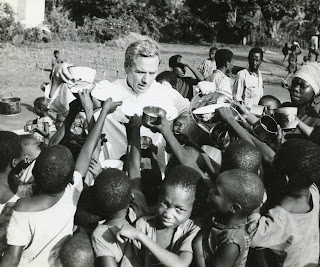
Irish missionaries distribute foods to malnourished Biafran children. Image via IMDB/Biafra-Forgotten Mission


BY IMAN SULTANA

In southeastern Nigeria, many Igbo, members of Nigeria’s third-largest tribe, believe they are of Jewish ancestry. Some of their traditions, such as circumcision and menstrual rituals, resemble those of Talmudic Judaism. The Igbo population is estimated at 30 to 35 million. Dozens of communities have become fully practicing Jews, and countless more incorporate elements of Judaism into a syncretic belief system. While the tribe’s origins remain unconfirmed, Igbo Jewish oral tradition traces the Igbo back to an African Hebrew diaspora that resided near the Niger River after the 722 BCE expulsion of the Israelites from the northern kingdom. This predates even the Babylonian exile of 586 BCE.

The Igbo are not accepted as Jews by the Israeli government. Consequently, they remain subject to ongoing threats, including severe persecution in the wake of Nigeria’s liberation from British colonialism. For example, between 1 million and 3 million Igbo were slaughtered en masse during the Nigeria-Biafra war that lasted from 1967 to 1970.

Early last summer, an Israeli filmmaker went to West Africa with a film crew to document Igbos’ stories. While there, the crew was arrested in Ogidi by the Department of State Services (DSS) on July 9 and imprisoned for approximately 20 days without trial. An elderly Igbo woman, who had welcomed them, was also arrested by the DSS and imprisoned alongside the team. After the international community got involved, the filmmakers were released and subsequently returned to Israel. A Nigerian film director and cinematographer was then arrested at the end of July for associating with the filmmakers.

Ambitious filmmaking projects that feature marginalized communities are admirable. However, outsiders must fully understand the specific risks to these communities. They must recognize when their efforts do more harm than good to the locals, lest they endanger them.

This time, heavy press scrutiny and extensive international support mitigated the worst. The filmmakers, who got the lion’s share of attention, were released within three weeks. The locals received far less media coverage, despite being the subjects of the film, and lacked the support of international embassies. Although elderly, the Igbo Jewish woman was detained for a longer period of time. Unlike the Israelis, she was not given hospital visits or Chabad kosher meals.

While the Nigerian government clearly violated basic human rights, the filmmakers also contributed to the fallout. They traveled to Nigeria claiming to aid the locals and while there, frequently posted about their experiences on social media. Some of their posts contained overtly political undertones and disclosed identities of specific Igbo Jews. One Instagram photo showed the filmmaker with Igbo King Eze Chukwuemeka Eri and the following description: “Israel X Igbo are locking arms.”

Irrespective of intent, this and other posts could easily be interpreted as promoting a political alliance between Israel and the Indigenous People of Biafra (IPOB) or other groups which are viewed as separatist by the Nigerian government. On paper, freedom of speech is protected under Nigeria’s constitution. In practice, Nigeria typically censors certain types of ideas, including discussions about ethnicity, political diversity, and differing views of morality. In other words, Nigeria is not Israel, the United States, Canada, or Australia; protections surrounding freedom of speech, legal representation, and other rights expected in the developed world are not widely available.

Whether or not this is moral or ideal in our eyes, it is a reality that must be recognized. The Igbo Jews have already suffered immense harm from their own government, as well as from neighboring ethnic groups. The film crew’s reckless actions further risk an already isolated and vulnerable population. Thus, the filming was in direct contradiction of the Talmudic value of communal responsibility toward the well-being of one’s fellow Jew. This is core to the Jews as a nation and a people.

The filmmakers have repeatedly condemned the Nigerian government for the arrests, without taking time to reflect on the ways in which they themselves may have brought harm upon the very community they claim to support. Two local Nigerians are known to have suffered as a result of the film crew’s lack of cultural awareness and sensitivity. The fallout of this incident could cause harm to many more.

Although it may not be possible to reverse this particular situation, it is possible to prevent similar incidents from occurring in the future. First, this film crew can reflect on the ways in which they acted irresponsibly, as opposed to milking the story on YouTube and painting the Nigerian government as the villain in an attempt to absolve themselves. Second, they can make a public statement acknowledging the specific ways in which they contributed to the situation. Third, they can do their due diligence in educating themselves about their countries of interest to ensure that this kind of voluntourism mentality does not persist, should they continue their work. Far be it for one Jew to add to the suffering of another.

This post was co-authored by Rebecca Sealfon who is a Reconstructionist Jewish writer and social media consultant who lives in New York City. She started and maintains a popular Israel-Palestine peace forum called Unity is Strength, which receives more than 1,000,000 views per year and attracts writers from Israel, Palestine, and all over the world. Rebecca has published in the New York Daily News, Smithsonian magazine, and the Daily Beast, as well as appeared numerous times on national television,


ABOUT THE AUTHOR

Iman J. Sultana is completing a Peace and Conflict Studies graduate degree at the University of Waterloo. Her specialty is conflict zones in MENA, including Israel-Palestine, Kurdistan, and Yemen. She is also interested in environmental-based peacebuilding and social entrepreneurship. In her free time, Iman administers online peacebuilding communities.

Fayetteville Law Professor Elected As Lifetime Member Of Foreign Relations Council

Uche Ewelukwa Ofodile


B Y JACOB SMITH

FAYETTEVILLE, ARK. (KNWA/KFTA)
— The University of Arkansas announced in a Wednesday, Jan. 5 news release Uche Ewelukwa Ofodile, E.J. Ball Professor of Law, has been elected as a lifetime member of the U.S. Council on Foreign Relations.

Ofodile becomes one of the few Africans and Arkansans to be elected a member of the esteemed organization.

According to the news release, she hopes to use the opportunity to bring attention to pressing issues, including sustainability and climate change; food, nutrition and water insecurity; corporate social responsibility and accountability; global governance issues and challenges; and the risks and opportunities associated with artificial intelligence and other emerging technologies.

“I am extremely excited by my lifetime election to the Council on Foreign Relations, whose activities I have followed for well over 20 years,” said Ofodile. “I have been inspired by the lives and accomplishments of the council’s esteemed members who are all visionaries and changemakers. I hope that through my involvement in this association, I can impact Africa and the world for the better.”

Ofodile also acknowledged the state’s major and growing role in global affairs, saying Arkansans must “lend their voice to weighty issues of our time from climate change to plastic waste, human trafficking, and artificial intelligence.”

She has numerous achievements on her resume, including being a Senior Fellow at the Harvard School’s Mossavar-Rahmani Center for Business and Government, as well as an Honorary Fellow of the Asian Institute of International Financial Law in Hong Kong, and an affiliated professor of African and African American Studies, at the University of Arkansas’s J. William Fulbright College of Arts and Sciences.

She also researches and writes in the areas of intellectual property law, international trade law, international investment law, and international dispute settlement. She has published numerous articles including in journals at Yale, Michigan and Vanderbilt among others.

Ofodile’s colleagues spoke on her election, giving praise to the decision.

Willam Alford, the Henry L. Stimson Professor of Law and vice dean for the Graduate Program and International Legal Studies at Harvard Law School, said, “I am thrilled that professor Uche Ewelukwa Ofodile has been chosen for membership in the Council on Foreign Relations. She is a worldwide leader in scholarship regarding the China-Africa relationship, and as someone who shares this interest, I can say that her work, which commenced long before this subject achieved prominence, is wonderfully creative while deeply rigorous.”

Shontavia Johnson, an alumnus of the law school and former student of Ofodile said, “Professor Ofodile’s scholarship, talks, and lectures around the world firmly solidify her position as both a leader in global discourse and a facilitator of law and policy change at all levels of governance.” Johnson, who is currently the associate vice president for entrepreurship and innovation at Clemson University, added, “At a time when our world faces complex issues and challenges, it is comforting to know that Professor Ofodile is positioned, through her membership in the council, to lend her voice on critical global issues and provide advice on important foreign policy choices facing the U.S. and countries and communities around the world.”

The release says with her election, Ofodile joins an organization whose members are among the most distinguished and most prominent leaders in the foreign policy arena, including top government officials, renowned scholars, business executives, acclaimed journalists, prominent lawyers, and distinguished nonprofit professionals.

Chioma Ebinama: A Spiral Shell At Maureen Paley Gallery, London (Photo Story)

Chioma Ebinama. Image courtesy of Chioma Ebinama


Maureen Paley is pleased to present the first solo exhibition at the gallery by Chioma Ebinama.

Chioma Ebinama (b. 1988, Maryland, USA and lives and works in Athens, Greece) is a Nigerian-American artist who is interested in how animism, mythology, and precolonial philosophies present a space to articulate a vision of freedom outside of Western social and political paradigms.

Raised in the United States by Nigerian Christian immigrants, Ebinama is drawn to the aesthetic of formalised religion for its potential to celebrate inner life. As she seeks to create new mythologies for the African Diaspora, her work is influenced by a myriad of sources, from West African cosmology to folk art of the global South, to the visual language of Western religion and Eastern spiritual traditions.

Her work also reflects on gender and queer identities through a figurative language that is informed by surrealism and Igbo culture among other sources. The collision of aesthetics and presentation techniques is indicative of Ebinama’s nomadic life and in recent years as she carried her practice from Mexico, South Korea, India, Malaysia and now Greece.

Her practice is centred around work on paper, yet in her travels she has collaborated with local artists to make sculptures, textiles and wearable art.

The title A Spiral Shell, is a surprise as there are no shells nor spirals in any of these figurative works. It refers to Italo Calvino’s short story, The Spiral, from his book Cosmocomics. I found this story about a mollusk to be a beautiful metaphor of what drives the desire to make things and how in the act of making we build a protective shell, a careful space for our own vulnerability against the “indiscriminate instability” of the external world.

Most people who know my work have no idea I’ve spent the past two years living in a complete disconnect from everything familiar. In 2019 I found myself houseless and studio-less. So I decided to wing it and travel. I did a short stay in Mexico and another in London, a lonesome short visit to Athens and several months living an ascetic artist’s life sharing a bed with a friend in Seoul. Somehow, I produced a solo exhibition (Now I only believe in…love, Fortnight Institute, 2020) while living out of a suitcase. At the beginning of the pandemic, I found myself stuck in Athens, which turned out to be a sort of wellspring of good fortune. I found love and decided to stay. But I struggled to make roots. No studio to ground me and no familiar faces, I was surrounded by a language that feels alien to me. Still I produced an entire children’s book (Emile and the Field, available in Spring 2022) and another solo exhibition (mud & butterflies, Catinca Tabacaru, 2021). When I began to make A Spiral Shell, I was paralysed by the fear that I didn’t have a story, unlike my other bodies of work, I had no visions to explore. So I began inward, reflecting on what had brought me to the present and making space for how traumatising change, even change for the better, can feel.

That said, work draws from everywhere. The figure in Petting a bumblebee is adorned in a wrapper decorated with a pattern taken from a Mbari sculpture, a lost tradition of Igbo culture. A Sense of Belonging, was born from the urge to make a hyper-feminine character like the pretty girls of 70s shoujo manga covers. It’s something for my child self. The Empress and The Tower refer to the two tarot cards I saw before beginning what I call my life as a seed in the wind. By sampling and collaging different cultural images, I am building a collection of positive resource states (I think ‘positive resource states’ is a term used in various behavioural therapies to develop healthy coping mechanisms for trauma) in a voice that feels truly my own in the current social climate that seeks to rapidly define blackness and the feminine in a way that is easily consumed. With this honest voice, I am reminding myself of the beauty of uncertainty, as I process my personal experience of rootlessness and change.’

Recent solo exhibitions include mud & butterflies, Catinca Tabacaru, Bucharest, 2021; Now I only believe in…love, Fortnight Institute in New York, Leave the thorns and take the rose, The Breeder Gallery, Athens, 2020 and Anunu: Notes on the Divine Feminine, Boys’ Quarters Project Space, Port Harcourt, Nigeria, 2019. Selected group shows include Never Done: 100 Years of Women in Politics and Beyond, The Frances Young Tang Teaching Museum and Art Gallery at Skidmore College, Saratoga Springs, New York, 2021 and Alien Landscape, 303 Gallery, New York. Ebinama has recently illustrated a children’s book Emile and the Field, written by Kevin Young, poetry editor of The New Yorker and director of the Smithsonian Institution National Museum of African American History. The book will be released in Spring 2022 with Make Me A World, an imprint of Penguin Random House books curated by artist Christopher Myers.


Exhibition view, Chioma Ebinama: A Spiral Shell at Maureen Paley Gallery, London, 2021

Chioma Ebinama, The Empress, watercolour and sumi ink on paper, 100 × 140 cm, 2021

Chioma Ebinama, Igba Gharie (ambivalence), watercolour, sumi ink and coffee on paper 65 × 45 cm 2021

Credit: Art Efuse