Thursday, February 24, 2022

What, Exactly, Do Nigerians Want From Ndigbo?

BY IKECHUKWU AMAECHI


THE usual refrain on the lips of Nigerian leaders, particularly those who successfully prosecuted the brutal civil war against the breakaway Biafran Republic is the indivisibility of the country.

One of them, General Ibrahim Babangida, in an interview with Arise Television on August 7, 2021 to mark his 80th birthday anniversary, put it rather bluntly: “When we were in the military, we talked about certain issues about Nigeria: the unity of Nigeria as far as we were concerned was a settled issue.”

While it would have been good if the unity of Nigeria was a settled issue, happenings in the country tend to suggest otherwise unless the unity Babangida and his ilk talk about is the agreement by those who won the war to exclude those that lost.

Otherwise, what kind of unity is it in a country where a people that constitute a significant percentage of the population are hated and despised not for any crime committed but for simply being who they are – Igbo. Two recent events prompted this reflection.

First, was the shameful conversion of the sacred altar of God by a Catholic priest as a launch pad for his vitriol against Igbo congregants in his parish.

On Sunday, February 6, Rev. Fr. James Anelu, the priest-in-charge of Holy Trinity Catholic Church, Ewu-Owa Gberigbe, Ikorodu, Lagos State, abruptly, without provocation, stopped the singing of soul-lifting Igbo choruses and songs during a service he was conducting.

In a video that went viral, the visibly angry clergy pontificated that the excesses of Ndigbo must be curtailed if they are to be kept from “dominating other people in this parish”.

And what was the crime of the Igbo parishioners? They were joyfully singing and dancing to the altar of God during the second collection.

To the embittered and resentful priest, singing Igbo songs in a Catholic church in Yoruba land is an act of domination.

He was so incensed that he uttered a heresy: The spirit of God in any place recognises only languages indigenous to that geographical location.

It is instructive that Fr. Anelu is not Yoruba. If he had enquired about the history of the Holy Trinity Catholic Church, he will probably find out that over 65 per cent of the money used in building the church and running it, including feeding him, was contributed by Igbo parishioners.

Barely 24 hours later, an obviously embarrassed Alfred Adewale Martins, the Catholic Archbishop of Lagos, issued a “disclaimer” directing Anelu to proceed on “an indefinite leave of absence”.

In the suspension letter which he personally signed, Archbishop Martins urged all “Catholic faithful to hold on to the faith and continue in our worship of God as one big family united in love and not separated by language, culture and race”.

I doubt if Anelu, wherever he is now, is penitent. He is simply consumed by hate. He is a victim of prejudice. And we commit a serious error of judgement if we think he is an outlier.

The second incident happened in Yola, Adamawa State. An Igbo businessman, Vincent Umeh, who lives in the state, bought a house from a willing seller, Ismail Mamman. Today, he cannot live in the property not because of any infraction of the law but simply because he is Igbo.

A Deputy Commissioner of Police, DCP, Ibrahim Baba Zango, currently serving in Lagos, says it is an insult for an Igbo to be his neighbour in Yola.

Umeh should reverse the purchase deal or face bitter consequences, including risking his life, DCP Babazango decreed. “We are a homogeneous community, I don’t want you; you can’t be my next door neighbour, I swear. What sort of insult is this? Can any Northerner move now to the South-East, say Onitsha and just bump into any neighbourhood to buy a property; just like that?” DCP Babazango asked Umeh on phone.

Such chutzpa may strike some as bizarre. But it is not. Just like Fr. Anelu, DCP Babazango is also not an outlier.

That is the humiliation Ndigbo are subjected to in their own country every day. From Lagos to Sokoto; from Bayelsa to Kebbi, they are being harassed every day for daring to invest and own properties in their own country.

Most times, some of these harassments are state-sanctioned. For instance, two weeks ago, the Kano State Sharia police, Hisbah, destroyed nearly four million bottles of beer in a crackdown on alcoholic beverages. The bottles were crushed into the ground by bulldozers in front of cheering crowds. After the bulldozers had done the job, Hisbah operatives then lit the crushed remains on fire and allowed the blaze to burn into the night.

“Kano is a sharia state and the sale, consumption and possession of alcoholic substances are prohibited,” the head of the religious police, Haruna Ibn Sina, crowed after supervising the mindless ruining of people’s lives.

Most of these businesses being destroyed are owned by Ndigbo. There is no law in Nigeria banning alcohol. Nigeria is deemed a secular state, yet Sharia law trumps the Constitution when Igbo businesses are involved. Nobody raises a whimper in defence of the right of the people to do legitimate business in their own country.

The irony is that just like Fr. Anelu who is sustained by offerings made by his Igbo parishioners, Hisbah officials are paid with money raised from the Value Added Tax, VAT, paid on the same alcoholic beverages they destroy with glee.

Those who blame Nnamdi Kalu and his Indigenous People of Biafra, IPOB, mentees for preaching secession ignore the asinine antics of Fr. Anelu and DCP Babazangos of this country, the same way those who blame Chukwuemeka Odimegwu-Ojukwu for declaring an independent Biafran nation in 1967 conveniently gloss over the waves of pogrom that resulted in the killing of thousands of innocent Igbo folks, patriotic Nigerians, most of them born in the North, with no other place to call home until the well-organised slaughter began in 1966.

Between May and October 1966, more than 30,000 Igbos and other Biafrans were killed in Northern Nigeria, and between October 1966 and June 1967 more than 100,000 more were massacred. In some instances pregnant women were killed, unborn babies pulled out of their wombs and murdered as well. Many of the victims were beheaded.

Those who defend that bestiality by invoking the equally condemnable killings in the January 15, 1966 coup conveniently ignore the fact that the Military Head of State and Supreme Commander of the Nigerian Army, Major-General Johnson Thomas Umunnakwe Aguiyi-Ironsi, and the cream of the Igbo officer corps were wiped out in the revenge coup of July 29, 1966.

They also forget that long before the January 15, 1966 coup, which was conveniently branded an Igbo putsch by those who had an extermination agenda, pogrom had been the lot of Ndigbo in the North.

A report, “Chronology of recorded killings of Biafrans in Nigeria: From June 22, 1945 to September 28, 2013”, put it this way: “The first incident in which the murder of Igbo people took place in Nigeria was in Jos on June 22, 1945. Hundreds of Ndigbo were murdered by the Hausa-Fulani during the pogrom and tens of thousands of pounds sterling worth of their property either looted or destroyed. No single person was apprehended or charged by the British regime nor an enquiry set to determine the “official” cause of this gruesome act.

“The second mass killing of Igbos and other Biafrans happened in Kano in 1953. In both cases, thousands of Igbo people with their families were brutally murdered and their property looted.”

What those who raise the spectre of Igbo domination simply because Ndigbo are everywhere forget is that the people love adventure. It did not start today and it is very unlikely to end tomorrow. Many Igbo leaders were born outside Igboland. Dr. Nnamdi Azikiwe was born in Zungeru, a town in Niger State, on November 16, 1904, ten years before Nigeria’s birth after the amalgamation in 1914. Odumegwu-Ojukwu was born in the same Zungeru on November 4, 1933.

The fact is that Ndigbo love travelling. They enjoy it. That is who they are. Do they dominate their environments? No. Rather, they help in building up wherever they sojourn. That is a virtue not a vice, which should not call for envy and bad blood.

If all other Nigerians can imbibe that culture, the country will be better for it. Those who don’t want Ndigbo out of Nigeria and yet will not allow them to enjoy their full rights as citizens are the problems of this country, not Ndigbo.

Wednesday, February 23, 2022

How The media Failed Japan’s Most Vulnerable Immigrants


BY DREUX RICHARD

TOKYO (JAPAN TODAY)
- The Ministry of Foreign Affairs is a strange institution. It’s responsible for the way Japan is perceived abroad, and it decides who receives the opportunity to immigrate. But its jurisdiction over the lives of immigrants largely vanishes when they reach Japan. It’s also the most influential agency that does not play a meaningful role in developing the government’s legislative agenda. Senior MoFA officials can only watch in dismay as less prestigious agencies, including some of Japan’s most corrupt, devise legislation that erodes the rights of immigrants and damages Japan’s international reputation.

A proposed overhaul of Japan’s detention system, scuttled in 2021 after the death of detainee Wishma Rathnayake and a resulting wave of protests, was especially unpopular with Japanese diplomats. The Kishida administration has revived it anyway, with parliamentary debate anticipated this summer. Until recently, MoFA relied on the press to guard against legislative aggression toward immigrants, quietly passing sensitive information to reporters who covered the Ministry of Justice, which enforces immigration law.

According to MoFA officials who acted as my sources during the 10 years I covered immigration, their current reluctance to cooperate with journalists is related to the sense, among the agency’s staff, that the media has become “much louder, but much less effective” on issues of immigration.

The officials I spoke with traced this problem to 2019, when a detainee starved to death at a detention center in Nagasaki, following a four-week hunger strike.

The Ministry of Justice cleared the detention center of wrongdoing, issuing a report that contained several defamatory statements about the detainee. He was not, as the ministry’s findings suggested, a hardened criminal or a deadbeat father—not according to court records, not according to his family.

The report went on to claim that it wasn’t possible to return the detainee to Nigeria because he refused to cooperate with the deportation process in January 2019. But the report also documented a meeting in May of 2019 where the detainee begged to be deported. As one MoFA official dryly observed, “May comes after January.”

The death was covered in Japan’s major newspapers, as well as a variety of global outlets. All of them printed the government’s claims without attempting to verify them. Not a single reporter succeeded in confirming the identity of the detainee, a native of southeastern Nigeria who came to Japan 19 years earlier to look for work in the leather tanneries of Hyogo Prefecture. His name was Gerald “Sunny” Okafor.

An important story about the destruction of a family was overlooked. Okafor’s widow, who is deaf, struggled to raise her daughter alone after her husband was detained, pushing her to the brink of psychological collapse. Immigration officials took advantage of her vulnerability, pressuring her to file for divorce and promising—disingenuously—that it would expedite Okafor’s release.

The media also failed to uncover administrative malpractice at the detention center, which led Mr. Okafor to believe that steps were being taken to expedite his return to Nigeria. After learning this wasn’t true, he refused to receive intravenous fluids, precipitating his death. The Nigerian embassy helped the Ministry of Justice cover up these mistakes, leaving a paper trail in Okafor’s immigration file.

The success of this cover-up has undermined the best opportunity to sink the proposed immigration reforms, which were developed in response to Okafor’s death. The reforms are based on the insulting notion that the detention center could have saved Okafor if it had possessed greater powers of coercion—the power to sanction his attorneys, for instance, if they pushed too aggressively for their client’s release.

But the press has helped to turn Okafor’s death into a non-story, by disseminating state propaganda that diminishes the death’s significance, then responding to that propaganda with opinion essays instead of investigations.

“The media approaches the immigration debate as an ideological matter, rather than a test of the integrity of Japan’s institutions,” observed one MoFA official who monitored Mr. Okafor’s case. “That’s not helpful to people in government who are trying to fix the system, because it doesn’t change anybody’s mind. It only inflames existing disagreements.”

If disobeying the instructions of immigration officials becomes a criminal offense, as the government has now proposed, it will be made possible by the collapse of non-partisan relationships between trustworthy elements of Japan’s government and their counterparts in the press.

In an era of journalism where editorial decisions are shaped by web traffic and algorithms, the loss of knowledgeable sources may not strike every media professional as a matter of concern. Reporters didn’t need to speak with anyone who knew Mr. Okafor in order to write about him, or to decide that it was no longer necessary to write about him — even as parliament debated legislation that resulted from his death.

“They got the answers they needed,” Okafor’s widow observed in our most recent correspondence. “And in such a convenient way: from no one, from nowhere.”

For six years, Dreux Richard covered Japan’s Nigerian community for a daily newspaper in Tokyo. His first book, Every Human Intention: Japan in the New Century, was published by Pantheon in 2021.

© Japan Today

Japanese Media And The Ghost Of Sunny Okafor—Nigerian Immigrant Who Starved To Death In Protest

"But the press has helped to turn Okafor’s death into a non-story, by disseminating state propaganda that diminishes the death’s significance, then responding to that propaganda with opinion essays instead of investigations."


Japan’s Ministry of Foreign Affairs (MoFA) is a strange institution. It’s responsible for the way Japan is perceived abroad, and it decides who receives the opportunity to immigrate. Senior MoFA officials can only watch in dismay as less prestigious agencies, including some of Japan’s most corrupt, devise legislation that erodes the rights of immigrants and damages Japan’s international reputation.

A proposed overhaul of Japan’s detention system, scuttled in 2021 after the death of detainee Wishma Rathnayake and a resulting wave of protests, was especially unpopular with Japanese diplomats. Until recently, MoFA relied on the press to guard against legislative aggression toward immigrants, quietly passing sensitive information to reporters who covered the Ministry of Justice, which enforces immigration law.

According to MoFA officials who acted as my sources during the 10 years I covered immigration, their current reluctance to cooperate with journalists is related to the sense, among the agency’s staff, that the media has become “much louder, but much less effective” on issues of immigration.

The officials I spoke with traced this problem to 2019, when a detainee starved to death at a detention center in Nagasaki, following a four-week hunger strike.

The Ministry of Justice cleared the detention center of wrongdoing, issuing a report that contained several defamatory statements about the detainee. He was not, as the ministry’s findings suggested, a hardened criminal or a deadbeat father—not according to court records, not according to his family.

The report went on to claim that it wasn’t possible to return the detainee to Nigeria because he refused to cooperate with the deportation process in January 2019. But the report also documented a meeting in May of 2019 where the detainee begged to be deported. As one MoFA official dryly observed, “May comes after January.”

The death was covered in Japan’s major newspapers, as well as a variety of global outlets. All of them printed the government’s claims without attempting to verify them. Not a single reporter succeeded in confirming the identity of the detainee, a native of southeastern Nigeria who came to Japan 19 years earlier to look for work in the leather tanneries of Hyogo Prefecture. His name was Gerald “Sunny” Okafor.

An important story about the destruction of a family was overlooked. Okafor’s widow, who is deaf, struggled to raise her daughter alone after her husband was detained, pushing her to the brink of psychological collapse. Immigration officials took advantage of her vulnerability, pressuring her to file for divorce and promising—disingenuously—that it would expedite Okafor’s release.

The media also failed to uncover administrative malpractice at the detention center, which led Mr. Okafor to believe that steps were being taken to expedite his return to Nigeria. After learning this wasn’t true, he refused to receive intravenous fluids, precipitating his death. The Nigerian embassy helped the Ministry of Justice cover up these mistakes, leaving a paper trail in Okafor’s immigration file.

The success of this cover-up has undermined the best opportunity to sink the proposed immigration reforms, which were developed in response to Okafor’s death. The reforms are based on the insulting notion that the detention center could have saved Okafor if it had possessed greater powers of coercion—the power to sanction his attorneys, for instance, if they pushed too aggressively for their client’s release.

But the press has helped to turn Okafor’s death into a non-story, by disseminating state propaganda that diminishes the death’s significance, then responding to that propaganda with opinion essays instead of investigations.

“The media approaches the immigration debate as an ideological matter, rather than a test of the integrity of Japan’s institutions,” observed one MoFA official who monitored Mr. Okafor’s case. “That’s not helpful to people in government who are trying to fix the system, because it doesn’t change anybody’s mind. It only inflames existing disagreements.”

If disobeying the instructions of immigration officials becomes a criminal offense, as the government has now proposed, it will be made possible by the collapse of non-partisan relationships between trustworthy elements of Japan’s government and their counterparts in the press.

In an era of journalism where editorial decisions are shaped by web traffic and algorithms, the loss of knowledgeable sources may not strike every media professional as a matter of concern. Reporters didn’t need to speak with anyone who knew Mr. Okafor in order to write about him, or to decide that it was no longer necessary to write about him — even as parliament debated legislation that resulted from his death.

“They got the answers they needed,” Okafor’s widow observed in our most recent correspondence. “And in such a convenient way: from no one, from nowhere.”

For six years, Dreux Richard covered Japan’s Nigerian community for a daily newspaper in Tokyo. His first book, Every Human Intention: Japan in the New Century, was published by Pantheon in 2021. This article originally appeared in Japan Today and has been edited for our audience.

Now That The Southeast Is Burning


"Even a 90-minute trip from Onicha to Owere seems like a death wish. Those who are alive are robbed of sleep. Those unlucky are robbed of life."


Southeastern Nigeria is witnessing a baptism of blood, sweat and tears. For a region known as Nigeria's most peaceful not long ago, its slide into wanton state and non-state violence is a reality of grave concern. The actors are variegated, as are the typologies of the violence: assassinations and targeted killing of law enforcement officers; citizens terrorized by sit-at-home enforcers; indiscriminate arrests and extra-judicial killings by military forces; contract killing and armed robberies, etc.


People travelling in tinted SUVs do so at grave personal risk today. Worse still if they're travelling with police or army escort. Others going about their businesses are also unsafe. Even a 90-minute trip from Onicha to Owere seems like a death wish. Those who are alive are robbed of sleep. Those unlucky are robbed of life.


This sorry path was a destination foretold and forewarned, but there is certainly enough blame to go round. There is the inertia caused by poor governance in the region. We have governors who do not pay salaries, who owe pensioners, who do not create employment, who do not respond to the open extortion of their citizens by police officers. They also failed to respond to the loss of lives in Igbo communities at the hands of Fulani-herder militias. Their lack of legitimacy created the vacuum that Nnamdi Kanu occupied and exploited.


Read Also: Nnamdi Kanu: A visit to the Afaraukwu monument of bullet holes


Then you have IPOB/ESN, whose agents felt the only way to assert their grievances and those of the region was to burn down police stations and target security agents. It seemed like a good gamble to endure since no one loved the police, and the Fulani herders were run out of our bushes. Finally, there is Buhari's government breaching international law to rendition Kanu to Nigeria and initiate a contrived trial. Sure, the violence preceded Kanu's rendition, but his shambolic trial made it worse. One mustn’t forget the multiple jailbreaks across the region, which unleashed into the society, people who are supposed to be locked up.


At first, many in the region quickly rationalized the utility of IPOB/ESN's actions, even as the group treated the Southeast like their personal gulag. Some even believed they were exercising freewill solidarity towards the Biafran course. But the danger of riding a tiger is that one can easily end up in the animal's belly. To disagree with IPOB was to be called names and, in some cases, threatened. We heard all kinds of silly rationalizations for their crude strategies. Rosa Parks and Nelson Mandela were even dubiously cited as justification for the carnage in our land.

The escalation of danger to the present precipice reminds me of the boiling frog theory. The theory holds that the frog reacts to a pot of boiling water in two ways. If the frog is suddenly thrust into steaming water, it will immediately jump out. However, if the animal is put into water which is then boiled slowly, it will not perceive the danger. Instead, it will keep adjusting to the temperature of the boiling pot until it is cooked to death. The provenance of this claim is not known, but it serves as a relevant metaphor for how an entire region somnambulated in the face of danger until it is too late. Even politicians shamelessly sought to take advantage of IPOB's seeming popularity despite their misguided tactics. Some of us also took refuge in our silence and said nothing. We watched people conveniently declare after every attack that it is the work of the DSS. We cowardly denied the truth of our own eyes and chose the warmth of a convenient lie.


Read Also: Under IPOB's present reign, Ndigbo have the foretaste of a different Biafra


Things have now come to a head. The Southeast is now a custodian of some of the most lethal elements in the country. Too many faceless killers, too many unknown gunmen and too many unknown soldiers. Neither life nor property is safe, no matter the lies we try to tell ourselves. Without some modicum of certainty and normalcy, a society begins to fold into itself. When this happens, people and investments flee. Those who stay are often unable to commit their resources to the land. Those who flee do so with pain and trauma that may take a lot of time to heal. Slowly and steadily, such a land surrenders its promise to the dark forces that have cordoned it from light. We may act like all is well, but we are just ignoring the corpses piling up in our courtyards. It does not change the reality.


With 2023 elections fast approaching, Buhari has the Southeast region, which he hates so much, where he wants it. He knows that IPOB is now a fragmented entity, laden with internal squabbles. It cannot bring under control the violence it started. All manner of killers now operate under their logo, with or without their permission. It is a lesson of how not to start what you cannot finish.


Buhari knows that the impetus of the Biafran agitation has now been muddied, if not overtaken by an orgy of senseless violence. He needn't worry about Nigeria's territorial integrity anymore. He has taken a ringside seat to watch the region crumble and burn. Campaign season will soon commence, and politicians and their supporters will be doing so at enormous risk. An unimaginable apathy may plague election turnout. The danger is that even if people braved the climate of fear to vote, a shady INEC will have found sufficient alibi to underreport the numbers. For a region struggling to pull its weight nationally, our shackles only seem to be multiplying.


In a time like this, the age-old Igbo adage that says, "onye ajuru anaghi aju onwe ya" comes to mind, and I dare add, provides some comfort. The Southeast must rise and free itself from the pestilence of its current captors, whomever they may be.

Dance Film Depicting Igbo Creation Story Makes Pittsburgh Premiere


A still from "Obi Mbu"

BY BILL O'DRISCOLL

PITTSBURG (WESA FM)
- While exploring his African roots, Nigerian-Swedish artist Mikael Owunna discovered that even many of his family members in Nigeria had never heard some of the stories that might be considered foundational to their culture.

Take the tale he and co-director Marques Redd tell in “Obi Mbu (The Primordial House): An Igbo Creation Myth,” their 30-minute experimental dance film making its Pittsburgh premiere Fri., Feb. 25, at the Kelly Strayhorn Theater.

The story concerns the male deity Chukwu and the female deity Eke-Nnechukwu, whose relationship goes from unity in the blackness of space to a state of discord and separation that brings the world into existence. The two characters are played, wordlessly, by Corey Bourbonniere and Victoria Watford, two Pittsburgh Ballet Theatre dancers who – in photographer Owunna’s signature style – are adorned with streaks of body paint and photographed under ultraviolet light so as to suggest cosmic beings.

Owunna, who grew up in Pittsburgh, is the son of a Nigerian-Swedish mother and Nigerian father, and learned of this creation story through research, some of it conducted with Redd, an independent scholar based in Pittsburgh. But he discovered that for many Igbo people in Nigeria, colonization and other factors had erased much knowledge of traditional belief systems. That loss was further confirmed in a moving episode that followed the film’s world premiere, in September, at ClampArt gallery, in New York City.

“After the screening, an Igbo woman from Nigeria came up to me and she was almost moved to tears, and told me how meaningful it was for her to see and also learn her creation story for the first time,” said Owunna.

Owunna, a photographer with a growing international profile, began the film as pandemic project – a COVID-safe way to transition from still imagery to live performance. “Obi Mbu” was shot entirely in one small room in his Uptown studio, with movement direction by Ursula Payne, and sound design by Herman Pearl, aka Soy Sos. The project was supported by the Advancing Black Arts in Pittsburgh Grants Program, a partnership of The Pittsburgh Foundation and The Heinz Endowments.

“Obi Mbu” has no dialogue, with just a bit of on-screen text to orient viewers. “We wanted the expressivity of the movement, of the art, of the images that you see on the walls of the set to really push the story forward,” said Redd.

Since that premiere, in New York, the film has also screened in Los Angeles, and Raleigh, North Carolina. It was all part of a big year for Owunna, who also did his first public artwork, right here in Pittsburgh – including a permanent, mural-sized photo Downtown – and his first solo exhibition, in New York.

The Pittsburgh premiere is 7 p.m. Fri., Feb 25. It’s followed by a panel discussion featuring the creative team.

Admission is $10 to $25 on a “pay what moves you” sliding scale. More information is here.

Tuesday, February 22, 2022

Retooling Igbo Language In Era Of Digital Pedagogy

BY UCHENNA AGBEDO

Image: Reddit


Today, the 21st day of February 2022, the United Nations through its organ, United Nations Educational, Scientific and Cultural Organisation (UNESCO) marks the International Mother Language Day (IMLD) originally proclaimed by the General Conference of UNESCO in November 1999, a special day which the UN General Assembly ratified in its Resolution of 2002. Following that landmark proclamation, the United Nations General Assembly, had in its resolution A/RES/61/266 of 16 May 2007, enjoined Member States “to promote the preservation and protection of all languages used by peoples of the world”. The UN General Assembly, by the same resolution proclaimed the following year, 2008 as the International Year of Languages, to “promote unity in diversity and international understanding, through multilingualism and multiculturalism,” thus designating UNESCO as the lead agency for the Year.

International Mother Language Day is driven by the mindset, which not only recognises language and multilingual education as veritable catalysts for inclusiveness, but also advances the Sustainable Development Goals’ focus on leaving no one behind. This tallies with UNESCO’s position that “education, based on the first language or mother tongue, must begin from the early years as early childhood care and education is the foundation of learning”.

Contemporary times have witnessed rebounding consciousness about the centrality and primacy of language in guaranteeing cultural diversity and intercultural dialogic exchanges, strengthening cooperation and attaining quality education for all, building all-inclusive knowledge societies, preserving cultural heritage, as well as galvanising political will for deploying the limitless resources of science and technology to sustainable development. It is against this background that this year’s theme – ‘Using technology for multilingual learning: Challenges and opportunities’ – speaks to the potential role of technology in advancing multilingual education and supporting the development of an all-inclusive quality pedagogy. This represents a clarion call on policy makers, educators and teachers, parents and families to scale up their commitment to mother tongue education, and inclusion in education to advance education recovery especially in the context of post-COVID-19 pandemic. It is in sync with the 2019 Cali Commitment to Equity and Inclusion in Education and the United Nations International Decade of Indigenous Languages (2022-2032), which places multilingualism at the heart of indigenous peoples’ development with UNESCO as the arrowhead.

Digital pedagogy, which derives its roots from the Constructivism Theory, is the use of contemporary digital technologies in teaching and learning. As a type of digital education tool (also referred to as Technology Enhanced Learning (TEL) or e-Learning) that is applicable to online, hybrid and face-to-face learning environments, this innovative use of digital tools and technologies during teaching and learning, has collaboration, playfulness/tinkering, focus on process and building as its key components. One of such digital tools is the Digital Pedagogy Toolkit designed by Jisc’s Digital Practice Team led by Chris Thomson, meant to support academic staff to make informed choices about how they use technology to underpin the curriculum, provide ideas and inspiration for how staff can overcome barriers to using technology, promote current approaches in curriculum design theory to ensure technology meets the learning outcomes of the course, module or programme of study, dispel a range of misconceptions about what can and cannot be achieved by using technology. As a challenge-based approach, the toolkit presents a series of scenarios based in real-world situations that institutions have been grappling with such as delivering live online learning with students, designing engaging VLE courses or managing digital communities of practice, and describes areas of digital practice one may want to develop.

Perhaps, advocating the deployment of digital tools that provide for synchronous and asynchronous Igbo pedagogical platforms may sound outlandish or utopian in the light of near or total absence of strong web presence in most hinterland communities of Igbo land. This is not excluding other daunting challenges bordering on skills, motivation, knowledge and environmental factors, dearth of digital competencies and support staff, lack of staff’s access to required digital tools, absence of guidelines, key policies and measures for evaluating the effectiveness of online delivery, for instance, as well as monitoring and managing learner expectations.

Nonetheless, as herculean as these challenges may sound, digital pedagogy remains the way to go. There is no viable alternative course of action for rolling back the digital pedagogy revolution ignited by digital technologies. Following a rash of school closures in 2020 precipitated by the COVID-19 pandemic, many countries around the world employed technology-driven solutions to ensure continuity of teaching and learning. The ugly experiences of many learners in developing societies such as Africa, who lacked the requisite Virtual Learning Environments (VLE) that would have facilitated distance learning, might have diminished the pedagogic relevance of technology. However, it is a proven fact that technology holds all the aces in addressing a great deal of education’s greatest challenges today in the light of its pivotal role in reinventing equitable and inclusive lifelong learning opportunities for all as guided by UNESCO’s core principles of inclusion and equity, hence the strong emphasis on mother tongue education, which represents a key component of inclusion in education.


The foregoing underscores the urgency of exploring technologies and their potential in enhancing the role of teachers in the teaching and learning of the Igbo language.

Herein lies the inescapable option of Igbo digital pedagogy if the language and its owners hope to escape the rampaging proboscis of globalisation currently gobbling up their rich tapestry of cultural heritage, and indeed all the valuable resources that are of strategic importance for preserving their unique modes of thinking and expression, identity construction, in-group integration, education and development.

The gloomy UNESCO report suggests that a language disappears every two weeks, taking with it an entire cultural and intellectual heritage’ with not less than 43 per cent of the estimated 6000 languages spoken in the world being endangered.

Regrettably, the Igbo language belongs to this hapless league of endangered languages, whether considered from the theoretical prism of Joshua Fishman’s (1991) Graded Intergenerational Disruption Scale (GIDS), which recognises the degree to which intergenerational transmission of the language remains intact as the key factor in gauging the relative safety of an endangered language or Lewis & Simons’ (2010) Expanded Graded Intergenerational Disruption Scale (EGIDS) that evaluates a language’s literacy acquisition status, identity function, state of intergenerational language transmission, vehicular and a societal profile of its generational use.

Going by the UNESCO’s template for global assessment of the state of world’s languages, Igbo falls within Level 7 of both Fishman’s GIDS and Lewis & Simons’ EGIDS and meets UNESCO’s criterion for fitting into an ‘endangered language’ frame, which states that “the child-bearing generation knows the language well enough to use it with their elders but it is not transmitting it to their children.”

It is in the light of the unfolding scenario in the global linguistic ecosystem that we have observed elsewhere that language endangerment is a serious social problem, which has elicited clarion calls from renowned language scholars for owners of such languages to develop renewed interests in their languages as one effective way of reversing the ugly trend.

In particular, foremost Nigerian linguists, Ayo Bamgbose (Professor Emeritus) and Professor Nọlue Emenanjọ (of blessed memory) had expressed a consensual view that “the fate of an endangered language may well lie in the hands of the owners of the language themselves and in their will to make it survive”.

As it concerns the Igbo language, Centre for Igbo Studies (CIS), University of Nigeria, has been in the vanguard spearheading fine-honed advocacy for reimagining Igbo studies. Its Igbo Ezue colloquium – a linguo-cultural renaissance featuring homecoming of Ndigbo in Homeland and the Diaspora cum maiden international conference – slated for the last quarter of the year 2022, represents one of such practical steps towards igniting emotional commitment in Ndigbo to promote, develop and sustain their language and cultural heritage.

Furthermore, we argue for the practical implementation of the mother tongue policy of UNESCO. As it concerns Igbo in our educational institutions, for instance, we call for the immediate formulation and implementation of a policy that makes Igbo language a compulsory subject in primary/secondary schools in Southeast states and a credit pass in Igbo as a precondition for admission into tertiary institutions in Igboland; mounting of Use of Igbo as a course in the General Studies programme of tertiary institutions in the Southeast region of Nigeria; reward system in form of scholarship schemes for students who elect to study Igbo in higher institutions and automatic employment on graduation.

These steps align with the consensus among language scholars and researchers that appropriate measures must be taken to ensure the maintenance of languages by way of revitalisation and spare them the frightful prospects of endangerment, attrition and outright death. The case of Igbo is not different.

Therefore, as the world marks this year’s International Mother Language Day, it presents an auspicious moment for Ndigbo to reflect on the endangered character of their God-given language (for which almost everybody is currently bemoaning listlessly) and make a resolute commitment to change the unsavoury narrative through the instrumentality of digital pedagogy, which accords Igbo a rightful place in education systems, the public domain and digital space; as well as practical implementation of the UNESCO’s mother tongue policy as it concerns the Igbo language, literature and culture. Perhaps, in this way, the significance of International Mother Language Day would have rubbed off on Igbo and by extension reformatted its motherboard; rebooted its floundering gait; rekindled its dwindling embers; and re-gigged the waning interest of Ndigbo in their mother language.

Agbedo is a Professor of Linguistics and Director, Centre for Igbo Studies, University of Nigeria, Nsukka.

Saturday, February 19, 2022

Killings By Unknown Gunmen: Is South-East Becoming A Failed Zone?

BY STEVE OKO, VANGUARD


The resurgence of the activities of the ominous unknown gunmen in the South-East geopolitical zones in the recent weeks is becoming worrisome.

Unknown gunmen became a phenomenon in the zone in the aftermath of the #EndSARS protests in 2020, got to an alarming height up till mid-2021 but began to show a downward curve before the end of the same year.

However, with the recent incidents in some communities in the zone particularly Imo, Ebonyi, and lately Abia (a hitherto relatively peaceful state), it is no longer in doubt that the unknown gunmen are on the prowl again in the region which prided itself as the most peaceful, enterprising and resourceful in the country.

The inability of the government to unravel the mystery behind this or to unveil the real identity of the masterminds of this group has also not helped matters, and in fact, is to blame for its persistence.

There has been a blame game between security agencies and the agitators of self-determination in the zone on who is behind the octopus masquerade and whose interests it serves.

While Government continues to point accusing fingers at the Indigenous People of Biafra, IPOB, the pro-Biafra group has not minced words in their allegation that security agents in collaboration with some “treacherous governors” in the zone are sponsoring the activities of the group to disrepute, discredit and demonise IPOB, and ultimately justify the on-going clamp down on the group especially the Eastern Security Network, ESN.

There have also been allegations that the festering insecurity in the zone is politically motivated.

The mode of operation of these unknown gunmen in some instances leaves members of the public more confused on who actually is behind the mysterious masquerade.

For instance, could security agents really be the ones killing their colleagues to create a certain impression?

But another disturbing poser is: could agitators of self-determination truly be burning down houses of fellow folks as recently witnessed in Imo communities and in the Mgbowo community of Enugu State where men in security uniforms were conspicuously observed in a viral video carrying out these atrocities with impunity?

Who are truly the people behind the mysterious unknown gunmen?

Despite the narratives of each of the sides, the fact remains that South East is burning! The fire is ragging so fast that if nothing urgent is done to extinguish the inferno, the entire zone will soon be consumed.

In less than two weeks unknown gunmen killed security agents on roadblocks in Enugu, a number of houses in Umuonyeoka Community in Ihitteafoukwu, Ahiazu Mbaise Local Government Area of Imo State were burnt down by armed men suspected to be law enforcement agents.

The “unknown gunmen” reportedly razed residential houses belonging to one Sonyval and Chinonso Madu, siblings of one Mr Uche Madu, who is alleged to be a member of ESN.

According to reports, the unknown gunmen stormed the area in seven cars shooting sporadically before heading to the Uche Madu compound.

A community source, who pleaded anonymity, told newsmen that “they came to apprehend Mr Uche Madu and when they couldn’t get him, all hell was let loose and they allegedly descended on the country home of his siblings, Sonyval and Chinonso Madu, which they set ablaze without allowing even a single pin to be evacuated from the building.”

Following the magnitude of damage inflicted on innocent folks in the community, the House of Representatives had mandated the Inspector General of Police, IGP; as well as the Chief of Army Staff, COAS, to investigate the incident and ascertain the true identify of the masterminds.

Despite denials of any involvement by the security agencies in the atrocity, what doesn’t add up is how armed men in seven vehicles would storm a community, operate for about two hours unchallenged, and disappear into the thin air without a trace.

It is certainly an ominous sign of a failed state!

There have also been calls for a probe of the alleged involvement of the operatives of Ebubeagu regional security outfit in the mystery unknown gunmen.

A coalition of South-East Youth Leaders, COSEYL, has called for their arrest describing their actions as “wicked and barbaric.”

The youth group while condemning the overzealousness of the security apparatus, expressed displeasure on the alleged jungle justice being meted out to suspects.

COSEYL in a statement by its President-General, Goodluck Ibem, over last week’s incident in Imo State called for the investigation and prosecution of the group over the barbarity.

”We are not in the stone age where anyone or persons will wake up one morning, accuse someone of being a criminal and kill the said person.

“We are in the 21st century where we have the rule of law and the constitution guarding the people and government activities as regards governance. For Ebubeagu security operatives to wake up and start killing Igbo youths in whatever guise is totally unacceptable.

“Most of the houses in the affected communities have been burnt down and destroyed while the little few persons who escaped being killed have run away leaving those communities empty without anyone or animal sited anywhere. Those towns are now ghosted communities, without any living thing.

“One of the disturbing incidences in the community was a situation where a woman received matchets cuts in her head, hand and other parts of her body because of her inability to provide her husband or tell the Ebubeagu operatives where her husband went to.

“This is unbecoming of a sane society. Ndi-Imo and Ndi-Igbo must rise and condemn in its entirety this despicable act by these so-called Ebubeagu security operatives.

“The courts remain the last arbiter and no one has the constitutional right or powers to take the life of another man at will. It is unlawful and a criminal act to torture, maim or kill anyone on the premise of being a criminal.

“Houses and properties that were destroyed in those Communities, which court gave such orders? These operatives just assumed the duties of the courts and went ahead to destroy peoples homes and assets without recourse to the law of the land. Too sad.

“We warn those Ebubeagu security operatives to stop forthwith the extrajudicial killings now and we demand that those found wanting or culpable of extrajudicial killings in Imo State should be made to face the music. Enough said,” COSEYL warned.

South-East governors are yet to be forgiven by the people over the shabby way and manner they handled the inauguration of Ebubeagu contrary to the yearnings of majority folks that preferred a regionally coordinated security outfit. The governors are being accused of hijacking the Ebubeagu outfit and working in cahoots with the federal government to suppress the opposition and also use them to identify and spy on key supporters of the growing agitation for self-determination.

Unfortunately, the governors seem to be more consumed and preoccupied with their 2023 ambitions instead of genuinely and selflessly addressing the menacing security challenges in the zone.

Some of them have also not really delivered nor used their advantaged position to better the lots of their people, a sad commentary that accounts for the growing loss of confidence in the governors.

It’s only those who want to massage the truth that may still argue between the governors and promoters of self-determination agitators who truly calls the shots in the zone.

If the truth must be told, the governors have since lost the confidence of the people due to underperformance, insincerity and non-commitment to the cause of the zone.

As if those were not enough, the recent invasion of a Cattle Market in Omumauzor, Ukwa West, Abia State where about eight persons were killed and some others wounded in a midnight raid by armed bandits, are all pointers that South East is boiling.

The revelation by Gov Okezie Ikpeazu when he visited the scene where he disclosed that the yet-to-be-identified attackers did not come from the immediate community according to preliminary investigations, yet threw a challenge that much remains to be done by the intelligence community on the sources of the rising insecurity in South East.

So far, nobody has claimed responsibility for the attack just as the motive of the invaders is yet to be known.

Although Government had announced some measures including siting a military base in the area to boost security in the environment, how these measures would prefer a permanent solution to the unknown gunmen malady remains a mystery.

Kidnapping for ransom has become regular around Abia North and Okigwe axis where a number of abductions by armed bandits have been witnessed in recent times.

Students and lecturers of Abia State University Uturu, Marist Academy Uturu, as well as innocent commuters plying the Uturu Isuikwuato route, have variously fallen victims of these hoodlums suspected to be Fulani herdsmen, thus compounding the sources of the festering insecurity in South East.

Worried by the ugly development, Co-Chair of Interfaith Peace and Dialogue Forum, Bishop Sunday Onuoha has blamed the intelligence community for the persistence of the activities of unknown gunmen in the South East.

Bishop Onuoha told Saturday Vanguard that it was either the intelligence community was not alive to its responsibilities or the government was not making use of the intelligence at its disposal.

He said that the persistence of the unknown gunmen saga in the zone was suggestive that there was a leadership failure in the country.

“If the intelligence community cannot gather intelligence to unravel those behind this, it then means we don’t have a country”, the cleric lamented.

He urged Government to quickly engage those who feel aggrieved in the zone and genuinely address their grievances in the interest of national peace.

“ If there are people who are angry, what stops the Government from engaging them in a dialogue to resolve their grievances?” He queried.

Meanwhile, the police have said the force was not yet overwhelmed despite the resurgence of unknown gunmen in the zone.

Zonal Police Public Relations Officer in charge of Zone 9, Umuahia, Mr Kingsley Iredibia, told Saturday Vanguard that the force was making efforts to put the challenge under control.

He said that police were synergising with other security agencies including the Ebubeagu security outfit to contain the challenge.

The Police Spokesman expressed hope that the challenge would soon be permanently overcome.

How long shall the zone wait for the much-expected federal succour or intervention?

Should South-East governors, the political elite and other critical stakeholders sit complacently and watch the zone go on flames?

Wednesday, February 16, 2022

After The Holocaust, Now African Slavery Also Hits Instagram

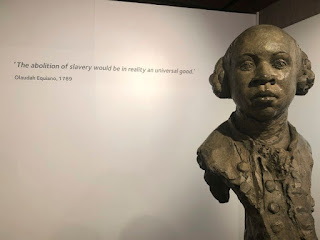
A sculpture of former slave and later abolitionist writer Olaudah Equiano, on display at the International Slavery Museum in Liverpool, England. Now his story is also being told on Instagram. Credit: AP Photo/Russell Contreras

Three years after generating hundreds of millions of views by recounting the tragic story of a teenage girl during the Holocaust, Equiano.Stories hopes to do the same for another traumatic historical event

On the eve of Holocaust Remembrance Day in 2019, billboards suddenly appeared along Tel Aviv’s highways featuring a hand holding a cellphone behind barbed wire and the question “What if a girl in the Holocaust had Instagram?”

Nearly three years on, very different-looking billboards but with a similar message have started appearing in the city. This time, a young African boy holds up a smartphone with a text reading: “1756. I’ve been kidnapped into slavery. And I’m recording it all,” inviting viewers to follow @equiano.stories on Instagram.

Signs have also gone up across Chicago Transit Authority train stations, in the midst of Black History Month in the United States, advertising Equiano.Stories as a new “feature film exclusively on Instagram.”

Those 2019 billboards kicked off the campaign known as Eva.Stories, a fictional Instagram account for a real girl: a 13-year-old Hungarian Jew called Eva Heyman. Based on the diary of the real Eva, the Eva.Stories account took followers on a journey through posts on the popular platform Instagram Stories. They experienced her life until the Nazis invaded, her forced move to a Jewish ghetto and, ultimately, her deportation to Auschwitz in 1944.

The high-budget effort was a viral success, with hundreds of millions of views globally, translation into various languages and an additional account on Snapchat. It also sparked a fierce debate over whether bringing the Holocaust to Instagram was an innovative way of bringing history to a new generation in their online comfort zone, or represented a cheapening and dumbing-down of Holocaust education.

Now the creators of Eva.Stories are bringing an equally sensitive historical trauma, African slavery, to the social media platform as well.

Yvonne Mbanefo, a British-Nigerian historian and cultural consultant for entertainment and media projects, recounts that when the team behind Eva.Stories – led by Israeli-American billionaire entrepreneur Mati Kochavi, and his daughters Maya and Adi – asked her to help helm the Equiano project, the controversy surrounding the original gave her little hesitation.

“It actually turned out that my daughter had seen Eva.Stories. When I told her about this company that approached me and that they have a novel concept of telling stories to young people on Instagram, she said, ‘Oh, I’ve watched it!’ So it really intrigued me that a Black teenager in London would watch a film about Holocaust and love it so much. I knew it would be a winner if we could do the same for slavery.”

What really sold her on the idea, Mbanefo says, was the fact that the project the Kochavis conceived would establish the character of Equiano as a happy child in his Igbo village – the pre-colonial Nigerian culture Mbanefo specializes in – and feature the details of his culture and life, before his horrific journey into slavery begins.

“Stories like this usually begin in enslavement. This one was starting from freedom. That was what really intrigued me,” she says.

‘Very natural progression’

Like Eva.Stories, the Equiano narrative is built around a real-life experience. Olaudah Equiano was kidnapped as a young boy from an Igbo village in West Africa, in 1756, enslaved and brought to the Caribbean.

The real Equiano bought his freedom when he was about 20 years old, moved to London and published a bestselling and influential memoir in 1789. His book, “The Interesting Narrative of the Life of Olaudah Equiano,” is credited with helping to end the practice of slavery in Britain.

In the Instagram videos, photos and posts, Equiano shares details about a joyful village life in Africa with his followers. They will accompany him as he is kidnapped from his home and witness the brutal existence on a slave ship bound for the Caribbean.

Equiano.Stories went live on Instagram on Wednesday, with more than 500 short videos, stills and posts to be uploaded on an hourly basis as the main character speaks directly to followers. According to its creators, Eva.Stories garnered some 300 million views within the first 48 hours of its release, a figure they hope to match or exceed.

Following their Holocaust narrative with a story about slavery felt like a “very natural progression,” says Maya Kochavi, the 30-year-old co-founder of Stelo Stories, the Kochavi family’s company that is based in New York and Tel Aviv.

“We began with something that was our story – our holocaust, the Jewish Holocaust. And we moved to the African holocaust: it felt like the right next step. We knew going into ‘Eva’ that so many kids don’t know enough about the Holocaust and that it was not being taught enough in schools … and [there’s] a lack of interest because it feels like something that happened so long ago. And we were very passionate about changing this. And we know the same is true for slavery: that it’s not taught enough and kids don’t know enough about it,” Kochavi explains.

The Equiano.Stories film was shot on a Hollywood-level movie set in South Africa, where the village and slave ship were recreated in detail. Before filming began, Mbanefo first traveled to Nigeria, to a village as close to Equiano’s as possible to prepare herself mentally and to conduct research. Heading down to South Africa and entering the slave ship set for the first time, she says she “put on the chains that the slaves wore” to gain a deeper understanding of the suffering her character endured.

The experience of filming was not only emotional for her. “During the filming of the slave ship scenes, every single person on the film set cried at one point – from the actors to the security people to the snake catchers we needed to keep snakes off the set,” she recalls. “It was an amazing environment where color didn’t matter. Everyone just wanted this thing to work.”

Like Eva.Stories, the Equiano project is certain to spark debate. Does the use of a social media platform to relate the painful and tragic history of slavery degrade the dignity of those who suffered? Or is it an invaluable tool that will help a new generation process history more effectively than merely reading about it in books or hearing a narrative intoned to them in a traditional documentary format?

Maya Kochavi says that, for her, that debate is obsolete, conducted by those who haven’t watched the “Eva” project, which in her eyes proved the effectiveness of what she sees as a new “genre” of storytelling.

“One of the reasons we think that people today can really connect with Equiano, regardless of the fact that he lived 300 years ago, regardless of their culture and where they come from, regardless of how much they know about this story, is because the genre essentially creates a kind of universal language,” she says, holding up her smartphone for emphasis.

“Kids will say, ‘Equiano may look different from me, but he films his life the way that I film my life.’ I believe that creates a connection between us across time and space and culture. It creates a universal language, and the really powerful way that kids today … will relate to this boy.”

‘Community of creators’

Any potential criticism of white Israelis initiating such a project has been anticipated and blunted not only by Mbanefo’s central role in the collaborative endeavor, but the fact that Stelo Stories developed the project in close cooperation with Chicago’s DuSable Museum of African American History – the nation’s oldest independent museum of Black history and a Smithsonian affiliate.

“We don’t believe in having one voice tell a story,” says Adi Kochavi, 33. “Each one of our stories has a community of creators. We have partners in Yvonne and the museum, and we’ve been working with them for the past two years on every aspect of this film.”

On the same day Equiano.Stories dropped, the Chicago museum planned to unveil an exhibition featuring a handcrafted replica of the thatched-roof huts seen in the film, surrounded by African art and interwoven with interactive digital experiences and screens showing scenes from the Instagram experience.

Another educational dimension of the project are short lessons embedded in the Instagram posts, explaining what viewers see in the film, both historically and culturally, which followers can access by clicking mid-clip for more information – an interactive element that did not exist in the “Eva” project. Another interactive addition is an accompanying app where Equiano fans can use a “mixed reality AI-dance tutorial” that will teach them the steps of the Nigerian dances seen in the film.

Both Eva.Stories and Equiano.Stories were funded through the deep pockets of the sisters’ billionaire father Mati Kochavi, whose mega-deals in security and infrastructure have underwritten a series of media endeavors. Most prominent among these is the media and technology company Vocativ, run by Adi.

According to the sisters, “Eva” and “Equiano” are the first two installments in a planned series of 10 interactive stories of young people from history. The third installment, featuring a 14th-century Italian musician, has already been filmed and will be released this summer.

Once the Stelo Stories brand is established, the sisters say, they will transition to a more traditional business model. The first two projects involved “topics that are so incredibly sensitive, we didn’t want to make money from either one,” they say.

For the team that worked on the project for more than two years – and saw its release delayed for over a year due to the COVID-19 pandemic – its release felt like anticipating the birth of a baby, Mbanefo says.

“I can’t wait for this to come out – not just for white and other non-Black people to watch and learn from, but also for Black people,” she says. “Even in Nigeria, not many people who are from the Igbo community know about the story of Olaudah Equiano. We live in a world where everything changes so quickly. Young people need role models, and there are very few Black role models. So I believe this project will help young people reconnect to a new role model they can learn from.”

When Eva.Stories was released in 2019, Maya Kochavi recalls, “We could see through the reactions that people just cared about Eva so much. … We’re hoping that people will love and care that deeply about Equiano, and through that care about the story of what happened to him.”

Outrage In Igboland Over Desecration Of Ozo Title By women

Ozo titled men in Igboland. Image via Vanguard


•Women do not and cannot take Ozo title —Nzuko Ozo •It's willful desecration of Igbo values •Ozo initiation can’t be done in foreign land •It's abuse of Igbo tradition for women to parade with Ozo title —Abia monarch •The women just acted Nollywood, which contradicts lots of Igbo customs and tradition —Emeka Onyeso •An aberration and naked exhibition of emotional depression —Prof. Agu •It's a mere joke from people seeking media attention —Ozobu •S-East residents now relocating to other places

By Anayo Okoli, Dennis Agbo, Ugochukwu Alaribe, Chinedu Adonu, Chinonso Alozie, Ikechukwu Odu, Steve Oko & Emmanuel Iheaka

ENUGU (VANGUARD)
—THERE was outrage recently across Igboland, particularly among elders, traditional rulers, Ozo title holders, titled chiefs, leaders and stakeholders, over an online viral video showing some Igbo women in the Diaspora, specifically in the United Kingdom and Ireland, who claimed to have been initiated into the prestigious Ozo title society, a respected title that is an exclusive reserve for men of integrity and honour. In the video, the Igbo women also claimed to have formed a group they called ‘Umunwanyi Ozo Prestigious Chieftaincy Association, UK and Ireland’. The action sparked off a barrage of angry reactions and condemnation from Igbo leaders, who are well versed in culture and tradition. However, the recalcitrant women were said to have withdrawn the titles and apologised.


Apex Igbo socio-cultural body, Ohanaze Ndigbo, in reaction to the video, invited some leaders of the United Kingdom branch to find out what actually happened. The leaders, during the briefing, confirmed that the illegal act did happen, but they washed their hands off the whole mess.

On that note, President General of Ohanaeze Ndigbo, Prof. George Obiozor, in strong terms, condemned the women and their action, saying that such was not accepted in Igboland.

Nzuko Ozo Ndi-Igbo Nigeria, a group of Ozo title holders, in angry reaction, summoned an emergency meeting of the stakeholders of Nzuko Ozo Ndi Igbo, where they vehemently condemned the women and their action, describing it as reckless and irresponsible. They explained that throughout Igboland, Ozo title taking is an exclusive reserve for men, insisting that “women do not and cannot take Ozo title”.

They also stressed that Ozo title initiation in Igboland only takes place in the ancestral home land of the initiate-paternal or maternal-and never in foreign or strange land, pointing out that “the Ozo traditional institution exists only in recognised Igbo communities and there are rules for recognition of new communities, as well as procedures for initiation of new members, which include bestowal of Ofo Ozo from its rightful custodian”.

Stressing the importance of Ozo title in Igboland, Nzuko Ozo Ndi Igbo explained that “Ozo title is a sacred Igbo institution for which an intending aspirant undergoes several rigorous puritanical processes”, and not a chieftaincy title which is awarded or conferred by an Igwe or Eze.

They therefore denounced the ugly action of the women, saying that “it is reckless and irresponsible for a group of Igbo Women within or outside the shores of Nigeria to claim to be Ozo title holders and also claim to have formed an association called ‘Umunwanyi Ozo’ Prestigious Association of United Kingdom and Ireland”, describing them as “bizarre group of Igbo women”, and warn them of dire consequences which will descend on them for this willful desecration of Igbo values.

“Nzuko Ozo Ndigbo hopes that the women will come to their senses and terminate this charade and save themselves from the Igbo Nation ancestral wrath”, the group noted in a communiqué signed by Prof Ike Oluka, the National Chairman and Prince Ikenna Onyesoh, The Regent of Nri Ancient Kingdom, member, board of trustees of the group and Dr. Ferdinand Ozoani, a member of the board of trustees.

In his reaction, a eminent Law teacher at the Enugu State University of Science and Technology, Prof. Agu Gab Agu, who is an Ozo title holder in Ngwo community of Enugu state, said that Ozo title is well respected and valued in Igbo land that no one ever toys with it.

Prof. Agu, who belongs to Ubelenze-Ozo, the highest Ozo title holding in his Ngwo community, dismissed the action of the women as aberration and a naked exhibition of emotional depression.

He explained that Ozo title holding arose because of the republican nature of Ndigbo and marks show of respect, wealth and fame, indicating the industriousness of the title holder.

Agu stressed that the holder must be self-sufficient, possesses integrity, honour, self-respect and other virtues such as being able to speak the truth at all times and which indeed places the holder as an elder even if such a person is in his young age.

“The importance of Ozo title holding is that it helps in leadership of the community because the holders are truthful, self-sufficient, represents leadership of the community and it is an apex leadership in the Igboland,” Agu explained.

According to him, women are not bestowed with the title because of the dual nature of their citizenship.

“Without being immodest, in Igbo land, it is said that a woman is another man’s property and can be married out. Forget about Beijing conference and all that, this is the way it has been patented over the time by the people who started it. Women are ranking but they are very important in Igbo cosmology.

“The Igbo women in Europe who took the Ozo title is an aberration and a naked exhibition of emotional depression. It doesn’t talk good of where we are coming from. Are they aiming to become men, are they not satisfied with being women? They have withdrawn the titles and apologized but their villages should admonish them because even the white people recognize their boundaries,” Agu said.

He stated that Ozo title was not tied to fetish practices, noting that as a Christian, he holds the title and does not partake in any fetish activity.

“Ozo title is not just reformed but refined and that is why we have educated people in the system,” Agu emphasized.

A foremost Abia monarch, the traditional ruler of Isuochi Ancient Kingdom in Umunneochi Local Government Area, Eze Godson Ezekwesiri, while reacting to the issue dismissed the initiation of women into the sacred and prestigious Ozo society, describing what took place as “a gross abuse of Igbo tradition and custom”.

Eze Ezekwesiri who spoke with Vanguard on the heels of the illegal initiation by some Igbo women in the United Kingdom into Ozo society.

According to the monarch, Ozo title is an exclusive reserved title for men with honour and respect who have made the necessary heroic roles to qualify for sure title.

He noted that although Ozo title is not a common in all communities in Igbo land, some communities have Ichie title as its equivalent which he added, is equally exclusively for men

The monarch, however explained that since the affected women were initiated into the Ozo title abroad, they could be ignored as the strange action has no effect on Igbo custom and tradition.

Ezekwesiri said the affected women took the wrong steps wondering if they would courageously join other titled Ozo title holders in their meeting back home in the country.

“This is very strange. Ozo title is not for women but for men according to Igbo custom. When they come back to the country can they attend the meeting of Ndi Ozo? They should be ignored”, the monarch said.

Renowned traditional ruler in Imo State, Eze Matthew Onweni, in his reaction, described such conferment as nullity.

Onweni, who is the traditional ruler of Ogbor Autonomous Community in Isiala Mbano Local Government Area, said it is alien to confer ozo title on a woman in Igbo land.

The monarch added that no one has the traditional right to confer an Ozo title in Diaspora, maintaining that the title is ancestry and involves a lot.

Onweni stated that a woman could be conferred with a chieftaincy title in conjunction with her husband, but not an Ozo title. He urged people to respect the culture of the Igbo.

“Women becoming Ozo for what? They can be conferred with a chieftaincy title in conjunction with their husbands and based on what they have done for the development of the community, but not Ozo. It is not in our culture. Unless they want to emulate England being ruled by a woman. Those in England can do anything because they are under the Queen.

“But here, it is not our tradition. We are yet to know if it is an innovation.

“You can’t confer Ozo title in America or outside the community. It is not a Diaspora thing. Was the ‘Ofo Ozo’ taken to United Kingdom and Ireland for the conferment? Conferment of Ozo involves a lot. It is an ancestral thing. Nobody has the traditional right or capacity to make someone an Ozo in Diaspora. They should come home and follow the culture of Igbo people.

“Such conferment is null and void, and can never be accepted in Igbo land”, Eze Onweni submitted.

On his own, another Imo monarch, Eze Oliver Ohanwe, the traditional ruler of Ihim Autonomous Community also in Isiala Mbano Local Government Area of Imo state, sounded a note of warning that Ozo title is not easily grabbed in Igbo land the way people cheaply get chieftaincy title.

Ohanwe pointed out that Ozo title has remained hereditary and could take roughly 30 days for the installation process to be completed.

According to the traditional ruler, “I want to say this; they can do their chieftaincy title in foreign lands. But Ozo title in Igbo land is not matter of eating and drinking the way they do when they are taking their chieftaincy title.

“The Ozo title in our land will take roughly 30 days including a lot of preparations that are involved. Ozo title is not given; it is hereditary. It is hereditary. You don’t grab it by force.

“The implication is that, it not like other titles being proliferated that has messed up our traditional heritage. Those of them doing it should see themselves as impersonators. This is not the chieftaincy title they can get anyhow and anywhere they want. This is a different thing”, the monarch stressed.

In his contribution, an Ozo title holder, Chief Vincent Ekwueme, of Aku, Igbo-Etiti Local Government Area of Enugu State lambasted hose Igbo women who conferred the revered Ozo title on themselves in the Diaspora.

Chief Ekwueme, who goes by ‘Oyi Igbo,’ as his Ozo title, said that those women acted in total disrespect of Igbo tradition, adding that women take the title of ‘Lolo,’ which is conferred on women whose husbands are Ozo title holders.

The nonagenarian said that it is wrong to take Ozo title in the Diaspora because the traditional items and rituals which are performed step by step before one is initiated as Ozo cannot be found there.

He also said those women who took the title reserved for the men folks must be called to order and also made to atone for the total abuse of Igbo tradition.

He also said that only those who were already conferred with the title have the authority to confer it on other people.

A chieftain of the Ohanaeze Ndigbo, Prince Richard Ozobu, in his reaction, condemned the act which he described as an abomination in Igbo land.

He stated that no woman has been decorated with the Ozo title in over 50 years history of the title in Igbo land and warned that anybody associated with giving such title to women should be made to pay a heavy fine to cleanse the land.

Ozobu also explained that the Ozo title is one of the most revered titles in the Igbo traditional system and is never adorned on anybody in Diaspora.

“It is absolute nonsense for anybody whether at home or in Diaspora to initiate women to Ozo title. It is not done. It is a worthless thing to talk about. It is a mere joke from people seeking media attention. It is not the culture of the Igbo to initiate women into the Ozo traditional society. It is an abomination in Igbo land.

“In Igbo land, a woman has no place taking Ozo title. In Igbo land, this tradition has lasted over 50 years ago, there has never been a history of women being initiated into Ozo society. To give such title to an undeserving person in a foreign land is to say the least, demeaning.

“Ozo title is never given in a foreign land. So, for a woman to claim to be initiated into the Ozo traditional society is to tell you how much the customs and traditions of the Igbo have been bastardized. It tells you that some Igbo fathers have failed to impart the Igbo tradition to their children. This is a very big failure on the part of such fathers.

“In Igbo society, women have their own recognition and titles, but it is an abomination to give the Ozo title to any woman, no matter her status. Anybody who commits the abomination of giving Ozo title to a woman should be made to pay a heavy fine and even pay to cleanse the land which he or she has defiled”, Ozobu said.

The Ohanaeze chieftain disclosed that the Ozo title represents peace, honesty, truth, honour, responsibility and proper administration of the Igbo society.

“The Ozo title is not just any other title in Igbo land. It is not just the red cap and the band on the leg only; the Ozo title also implies responsibility, honesty, honor and dignity. There are certain things the Ozo title holder can’t do because of what he represents. In some communities, many people take the Ozo title and also take it for their unborn children. And when such children grow up, they are informed about what has been done on their behalf by their fathers. They are bound by those responsibilities.

“It is another way of salvaging our society by bringing peace, harmony, truth and proper administration of the society. This is what the Ozo title is all about. It has never been extended to women in the history of the Igbo people. Any woman who wears a red cap and claims to have been given an Ozo title should have the cap removed and chased away. It is an abomination”, he said.

Ozo Dr. McGinger Ibeneme also has condemned the illegal and abominable act, insisting that such is never allowed in Igbo land.

According to Ozo Ibeneme, they are women who claim to be modern feminist but in reality are they are modern anarchist who try to truncate everything and turn the world upside down.

He however said though women cannot be initiated into Ozo society but can be recognized as Ada-Ozo following the initiation of their husband into Ozo society.

He expressed disappointment that the same Igbo women who were trained to be advanced by the men are the one mocking the Igbo culture.

“Assertion that Ozo title is exclusive for men only is not completely right because it is men and their wife that receive the honour at same time.

“When a man is initiated to Ozo Society, the wife will become Ada-ozo, and that is the only way a woman can join the society. Ozo was founded by men. All these women are those who identified themselves as modern feminist but in reality they are modern anarchists who try to truncate everything and turn the world upside down.

“I have never seen where men insisted on joining Umu-Ada meeting or form Women meeting, Norway branch. It is always the women who want to force themselves into masculine things. Women have their things, even in the old, they have women group, market group, dancing group, women society and during that time the society was in order, there was complete synchrony among the various group, none dominated the order.

“As a matter of fact, the Igbo women were more influential than the men. The men were tasked to do all the risky jobs and the women do jobs that are not risky or physically tasking. There was no conflict or rivalry. It was for the purpose of orderliness and complimentary engagement in the communities.

“But in modern world, most of the people who propagate this so called feminism are people who do not want to do things that women do and are not also ready to so what men do because when the chips are down, they still want the men to do all the things they cannot do as women.

“Ozo society was a cultural association founded by Igbo men and it conferred responsibilities to the men who were initiated and their wives. It is an exclusive society that conferred nobility on the initiated. A married woman or single woman can never by herself be initiated into Ozo society. It is never done and it can’t be valid when if is done.

“I try to see it in a comical perspective, like in ESUT, they have Nze and Ozo which is a student things; it is not serious but a parody group. That’s how I see the so UK called Women Nze and Ozo thing. To that effect information needs to be given out that it is a parody association and does not deserve the outrage it is really commanding at a point in time because that is making it look more serious than it is.

“Moreover, you can’t take Ozo title outside Igbo land and not outside Igbo land but your community. In some Igbo culture, they only permit the Ozo title from your mother’s home. In my own side, Achi community in Oji River, the only place you can take Ozo title and be recognized is from Achi, any other title outside that is not recognized.

“The origin of Nze and Ozo is from Nri in Anambra State and most of Nze and Ozo in Igbo land get the initial authority from that ancient kingdom where the association was formed. So, Nze and Ozo is not something that after eating and drinking in a foreign land you just decided to have the title. Did they do the rituals preceding the initiation proper?

“Why didn’t they look for other chieftaincy group since they like Igbo culture without trying to mess up association that has existed for over three hundred years? It is a attempt for anarchy. Why is it that it is Igbo people that are doing this? The Igbo women are the most advanced in Nigeria.

“Ndigbo empower women to be advanced but not to be making mockery of the culture that empower them. No matter what the motives are, they were not well thought out before embarking on it. I suggest they will retrace their steps and chose another thing else or make it clear that they are a parody association but not to be making mockery of our culture.

“The Ozo title is a noble order created originally for the purpose of truth and mobilization of funds for Igbo traders founded by Prince of Nri in 1420 AD and it grew into a noble association that began to play leadership roles in the community. It has different connotations in different Igbo clan; it has different recognitions in different communities, even the reach is not exactly the same as it differs from place to place.

“The real thing has been watered down because people who are very modern were not comfortable going into the actual ritualistic things. However it does not make it inferior, the important thing is that you swore the oath of purity, to live above the board, to always tell the truth, to be in a truthful arbiter and do contribute in the development of your community.

“It is an exclusive Association that one of its basic qualifications is that you are an Igbo man and you are married because once you become initiated into the Society your wife automatically becomes Ada-Ozo. The person who is qualified is screened by the community”, he explained.

Friday, February 11, 2022

Common Threads – Contemporary African Fashion

Meet the new generation of African creatives taking the continent’s textile culture into the future.


Fashion Designer Emmanuel Okoro of Emmy Kasbit


“Cloth is to Africans what monuments are to Westerners… Their capacity and application to commemorate events, issues, persons and objectives outside of themselves are so immense.” El Anatsui, 2005

These wise words from Ghana’s most celebrated fine artist sums up Africa’s gloriously storied textile heritage, which not only speaks to generations of artisanal mastery but also to the significant cultural communication performed with cloth across the continent. And over recent decades, African fashion designers have elevated these treasures still further through their designs. Early pioneers include Shade Thomas-Fahm who revolutionised Nigerian fashion in the 1960s by using handwoven aso-oke. In the 1980s, Malian Chris Seydou was the first designer to consider bògòlanfini mud cloth. And in 1990s Ghana, Kofi Ansah modernised ceremonial kente cloth.

Today many heritage fabrics face being lost as older generations of makers pass on. This does not mean however, as commonly believed, that African fabric and weaving traditions belong to the past, unchanging relics of a by-gone era. In fact, they remain ever-evolving tools for creating employment, empowerment and innovation. For example, the Ethical Fashion Initiative, a programme of the International Trade Centre, works with co-ops in several countries to finance their valuable skills, whether silk screening, sewing, dying or weaving, and develop ethical supply chains.

But it is the current generation of sought-after African designers and entrepreneurs who are the ones using new thinking to take ancient textiles into the future. In Nigeria, Emmanuel Okoro of Emmy Kasbit focusses on re-imagining akwete, a loom-woven cloth made by Igbo women in eastern Nigeria. “There are over 100 traditional motifs and it’s said that each one came to its maker from the spirits in their dreams,” says Okoro. “For me, it comes down to preserving the culture our forefathers in a modern way. Storytelling is at the forefront of putting African fashion on the global stage, so we cannot tell our stories with western fabrics.”

Each season, the Lagos-based designer develops his own patterns based on Nsibidi hieroglyphics and then delivers his yarns and designs to his cherished weavers. His boldly tailored men’s and women’s looks for SS21 speak to ideas of unity and strength and were debuted at Vogue Italia Talents during Milan Fashion Week. “I’m interested in community upliftment and boosting a craft that had become forgotten,” he adds. “I want to see these women win, and I’m letting the world know that this is what African luxury looks like.”

Fellow Nigerian Nkwo Onwuka’s approach is informed by her interest in ethical fashion. The Abuja-based designer has developed dakala, a handmade cloth made from denim off cuts. “Nigeria has a lot of markets trading in second hand garments and a strong culture of clothing being made by small scale manufacturers and dressmakers, which results in a huge amount of textile waste,” Onwuka explains. “I started to see how I could prevent dead stock and old clothes from ending up in landfill or being incinerated by using them as a raw material. Through experimentation, I developed a technique of stripping, braiding and sewing together textile waste to form a new fabric that has the look and feel of our traditional woven fabrics.”

Dakala was shortlisted for the Design Museum’s Beazley Designs of the Year 2020 award and her studio continues to develop the technique with the next step being a loom-spun version. Her current collection, entitled No Planet B, features ponchos and apron corsets made from multiple strings of dakala. “For me success is making sure that I can take care of everyone in my small circle with the hope that this care ripples out to form a larger circle,” she says. “I want to make sure that each person feels valued. Community has to be the fuel that fires what we do.”

Johannesburg-based designer Thebe Magugu is embracing the latest technology to create experiential fabrications from ancient inspirations. The 2019 LVMH Award winner is passionate about investing his directional yet elegant womenswear with cultural value. For example, his clothing labels are fitted with microchips. “If any smart phone taps them, it opens a webpage that showcases the story of the collection as well as photographs of everyone involved in the making of the garment, from the fabric weavers in Cape Town to the tailors in Joburg. I love the full transparency and the idea of bringing culture and technology together,” he says.

For his AW21 collection, entitled Alchemy, Magugu immersed himself in African spirituality, which led to a collaboration with traditional healer Noentla Khumalo for his headline print featuring the tools of her trade – goat knuckles, a police whistle, pencil sharpener, red dice and shells. “Noentla, who uses various objects as her medium to communicate with the ancestors, threw these objects onto a straw mat, which were then photographed, abstracted and printed onto wool suiting. Before she threw the bones, Noentla asked ‘What now?’ and what lays on this garment is the answer.”

The rising star, who’s currently shortlisted for The Woolmark 2021 Prize, also worked with South African eco-printmaker Larissa Don who used cannabis and imphepho (the plant healers burn during their ceremonies) to transfer botanical prints onto merino wool. “It is about the idea of modernity through the indigenous,” he adds. “Wool is one of the most sophisticated fabrics available – from its odour-absorbing properties and natural heat-management to its inherent sense of luxury, which all speak to the unparalleled power of the natural world.”

While bright ideas in the high fashion space abound, there remain steep challenges facing more widely available fashion fabrics due to the lack of textile manufacturing facilities on the continent. The industry dwindled in the 1990s in the face of international competition including hugely popular wax print fabrics from Europe. While infrastructure is surely improving today, there is still far to go. This is an area Kenyan fashion curator Sunny Dolat is addressing.

“As Africans, we have been lucky to be born into a wealth of textile culture. I believe we have a duty to grow and add to this heritage,” says Dolat, who is co-founder of The Nest Collective and creative business incubator, the HEVA Fund. “Many parts of Africa still have communities, albeit reduced, of spinners, weavers and dyers who carry this cultural memory in their hands. The work I’m exploring now seeks to marry these sustainable practices with contemporary insights, ideas and materials, which I believe could support many artisans across the continent.”

Due to Kenya’s colonial history, the country’s homegrown textile heritage is severely diminished compared to other parts of Africa. This fact is what originally stirred Dolat to take action. “All the textiles that we have are versions of textiles from other cultures. Maasai shuka blankets came from Scottish missionaries, kikoi is an update on an Omani wrapper and kanga is based on the Portuguese lenço scarf. They all started off being made locally but, as with most things, much of it is now brought in from Asia. This got me thinking, what could a truly Kenyan textile look like?”

Dolat visited artisanal communities around the country to research organic dyes and fibres and then moved onto developing a new visual language with graphic designers Lulu Kitolo and Monica Obaga. The result is Nanga (Swahili for anchor), a range of prints inspired by Kenya’s natural and urban landscapes, which have been produced on silk, chiffon and cotton and are entering Nairobi’s downtown fabric stores this year. “We’re not going to announce them, or give them to designers. Instead, we’re putting them in the mass market to see if they sell. That would be the true measure of success.”

He cites Green Nettle as a bench mark for the kind of new approach that could take African fashion innovation to the next level. This Kenyan start-up won the H&M Foundation Global Change Award for its environmentally-friendly fabric made from nettles – a plant that thrives in even the most barren areas of the country. “My hope is that more designers and companies begin to develop their own interventions into the textiles. Last year, the pandemic disrupted everyone’s access to textiles overnight. This taught us not to rely on imports and many found local alternatives instead. It would be amazing if that way of working can continue to be fostered and grow.”

emmykasbit.com

@emmykasbit

nkwo.design

@nkwo_official

@sunnydolat

@thebemagugu